• About me
  • About this blog
  • Comment rules
  • Other writings

Love of All Wisdom

~ Philosophy through multiple traditions

Love of All Wisdom

Category Archives: Christianity

Who were the Magi?

21 Sunday Dec 2025

Posted by Amod Lele in Christianity, Greek and Roman Tradition, Judaism, Place, Supernatural

≈ 2 Comments

Tags

Christmas, Eric Vanden Eykel, Israel/Palestine, Jesus, New Testament, Zoroastrianism

Depiction of Jesus with his visitors, from St. Michael’s Cathedral in Toronto. Wikimedia Commons photo by Wojciech Dittwald, CC-BY-SA licence.

One of the most familiar and celebrated parts of the traditional Christmas story is the tale of the visitors who brought gifts to the baby Jesus at his birth. If you were raised anywhere in North America or Europe you surely at least know of this tale, even if you have no Christian background. More than any other part of the Christmas story, this tale may have served to create Christmas as we know it today – since few things are more central to modern Christmas than the giving of gifts, and that giving is usually held to commemorate the story of these visitors. The famous Christmas carol “We Three Kings” is entirely about them, and several other beloved carols refer to their story (“The First Noël”, “What Child Is This?”)

Yet there is something enigmatic about these visitors. Biblical scholar Eric Vanden Eykel wrote an interesting book on them (which also serves as an engaging introduction to the methods of biblical scholarship). Vanden Eykel doesn’t even try to ask the question of whether they historically existed, because we have so little evidence on which to base an answer. Within the Bible, they are not mentioned outside of one short passage in chapter 2 of the Gospel of Matthew, and there are no other texts from a similar time period that mention them either. There are apocryphal Christian texts – texts outside the Bible – that mention them, and I was hoping these might tell an alternate story, but Vanden Eykel points out that that these are significantly later and draw on the Matthew story themselves; they are not independent witnesses. That means that if they ever existed historically – Vanden Eykel never asks that question, and I wouldn’t be surprised if it was because he believes they didn’t – Matthew is by far the closest thing to a witness that we have.

So let’s take a look at what Matthew says about Jesus’s visitors. I’m taking this translation from the New Revised Standard Version, which I understand to be the most historically accurate – though leaving a couple words in the original Greek because we’ll talk about them later. I’m leaving out the part in the middle about their encounter with King Herod for space, but providing everything it says about them and their encounter with Jesus:

Continue reading →

Nondual mindfulness in Teresa of Ávila

16 Sunday Nov 2025

Posted by Amod Lele in Consciousness, Deity, Mahāyāna, Meditation, Mindfulness, Prayer, Psychology, Roman Catholicism

≈ 6 Comments

Tags

Andy Puddicombe, Brook Ziporyn, Headspace, John Dunne, mystical experience, nondualism, phenomenology, Śāntideva, Satan, Spain, Teresa of Ávila, Tiantai 天台, Zhiyi

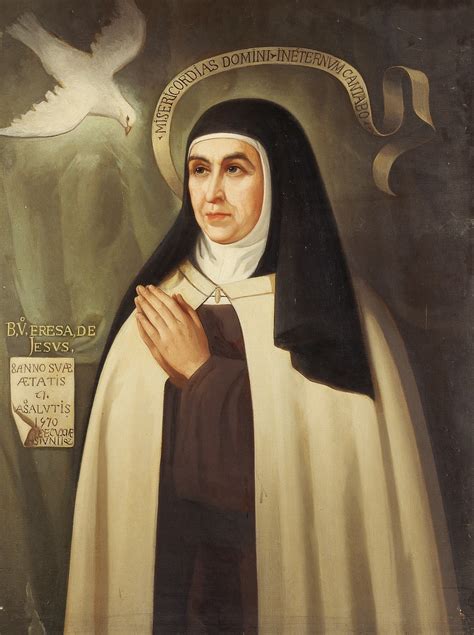
Portrait of Teresa of Ávila by Juan de la Miseria, her contemporary.

The autobiography of (Saint) Teresa of Ávila is a most remarkable book. Its beginning sections on Teresa’s early life feel at once relatable (she recalls her youthful interest in making herself pretty) and utterly alien: she and her brother admired the Christian martyrs so much that in childhood they “agreed to go off to the land of the Moors and beg them, out of love of God, to cut off our heads there”, and felt very disappointed that they could not find a way to do this. (Section 1.4, page 3 of the Kavanaugh-Rodriguez translation) The later sections are the more famous ones, depicting Teresa’s vivid visions of angels.

In the middle, though, the book takes an unexpected detour – nearly a hundred pages – providing instructions for prayer. I don’t believe in Teresa’s God, let alone pray to him, which made it very tempting to skip these chapters. I’m very glad I didn’t, though, because I found important things in them that I recognized as a Buddhist.

Continue reading →

Canadian psychedelic podcast interview

22 Monday Sep 2025

Posted by Amod Lele in Consciousness, Daoism, Deity, Early and Theravāda, Indigenous American Thought, Mahāyāna, Meditation, Metaphysics, Method and Theory in the Study of Religion, Psychology, Roman Catholicism, Self, Supernatural, Vedānta

≈ Comments Off on Canadian psychedelic podcast interview

Tags

autobiography, Buddhaghosa, Canada, drugs, Elon Musk, interview, John Hick, MAPS, Meister Eckhart, mystical experience, nondualism, Osheen Dayal, phenomenology, religion, Roland Griffiths, Śāntideva, Teresa of Ávila, Thailand, Upaniṣads, Zhuangzi

Following up my talk on psychedelics and mysticism, Osheen Dayal of the Canadian branch of MAPS just interviewed me on the same subject for their video podcast. In the interview we talk about a wide range of subjects from my personal Buddhist story through St. Teresa’s angel to Elon Musk. Have a look!

Seeing through conventional reality

17 Sunday Aug 2025

Posted by Amod Lele in Attachment and Craving, Christianity, Deity, Foundations of Ethics, Islam, Mahāyāna, Metaphysics, Truth

≈ 8 Comments

Tags

Augustine, C.S. Lewis, Candrakīrti, conventional/ultimate, existentialism, ibn Sīnā, Madhyamaka, Plato, Śāntideva

While Buddhist schools have many different takes on metaphysics – on what the world really is – they all acknowledge a distinction between two truths, or two levels of reality. That is: there is a conventional truth, the one familiar to us in everyday life where we can fruitfully speak of individual selves or persons and other everyday objects – and another, more ultimate (paramārtha) truth that is distinguished in some respect from the conventional, truer than the conventional. Their widely varying metaphysics mostly have to do with how we understand the ultimate truth, and I’ll talk about that more next week. I want to start this time, though, I want to note a key point that the metaphysical schools share: the importance of breaking down the conventional – or, put another way, of seeing through it.

Continue reading →

After mystical experiences

08 Sunday Jun 2025

Posted by Amod Lele in Daoism, German Tradition, Metaphysics, Method and Theory in the Study of Religion, Psychology, Roman Catholicism, Vedānta

≈ 2 Comments

Tags

Advaita Vedānta, Aristotle, drugs, Gauḍapāda, Ingmar Gorman, John Hick, MAPS, Meister Eckhart, mystical experience, nondualism, Rachael Petersen, religion, Roland Griffiths, Upaniṣads, Zhuangzi

I’m delighted to be giving a talk at Psychedelic Science 2025, the annual conference of the Multidisciplinary Association of Psychedelic Studies. The conference (June 17-20 in Denver) promises to be really fun and stimulating. If you can make it, I’d love to say hi: registration isn’t cheap, but you can use code SPEAKER15 to get 15% off your registration.

I’m especially excited because my talk is really experimental, the kind of broad comparative work that would have got frowned on when I was in grad school. I’m still aiming to exercise scholarly caution to avoid saying anything false, trying to stay reasonably close to what’s in the texts, but I am writing about multiple thinkers whose source languages (classical Chinese and old German) I don’t know well: something which I think one has to do in order to investigate human cultural commonalities, but which would have raised every eyebrow in my PhD program. It’s the kind of project that an aspiring professor only undertakes after getting tenure; in my case, I can do it because I’m no longer trying for a faculty job.

Continue reading →

In memoriam: Alasdair MacIntyre

25 Sunday May 2025

Posted by Amod Lele in Analytic Tradition, Foundations of Ethics, German Tradition, Metaphilosophy, Morality, Politics, Prejudices and "Intuitions", Roman Catholicism

≈ 4 Comments

Tags

Alasdair MacIntyre, Aristotle, autobiography, Friedrich Nietzsche, ISME, Karl Marx, Martha C. Nussbaum, obituary, relativism, Scotland, Thomas Aquinas, Thomas Kuhn

My photo of an elderly MacIntyre speaking in 2019 at “To What End?”

Alasdair MacIntyre is dead. He had a very good run, better than many could dream of: he was 95 years old, and produced an output significant enough to be in competition for the title of “greatest philosopher of his age”. Few indeed are the 20th- or 21st-century philosophers who have an entire learned society – in his case the International Society for MacIntyrean Enquiry (ISME) – devoted to pursuing the implications of their work. It seems that MacIntyre himself was a little uncomfortable with that society’s existence. The one time I ever saw MacIntyre in the flesh was at the society’s 2019 conference, held on the University of Notre Dame campus near his home, in honour of his 90th birthday – but, I was told, he only participated on condition that his name not appear anywhere in the conference title. (Thus, given his focus on teleology and the aims of human life, the conference was called “To What End?”)

Even now, MacIntyre still sits outside what is usually considered the philosophical mainstream. Though he was trained in the English-language mainstream of analytic philosophy and taught in analytic departments, he refused to confine himself to the analytic mode of philosophizing, always writing in a way broader and less precise than analytic departments were usually willing to count as good philosophy. That experience surely shaped one of MacIntyre’s more powerful philosophical insights: the recognition that philosophy itself always operates within the context of historical tradition – the conception of tradition at issue being close to Thomas Kuhn’s concept of paradigms. Kuhn and MacIntyre recognized that different paradigms differed not just on what claims they believed to be true and false, but on the standards by which one judged them true and false; MacIntyre knew that within philosophy, analytic philosophy’s standards were never the only ones available.

Thus MacIntyre is the sort of philosopher whom one often first encounters in unusual ways, outside being taught him in a classroom. Thus one colleague at “To What End?” helpfully started conversations with “What’s your MacIntyre story?” – imagining, rightly, that everyone had their own personal story of encountering his ideas, more interesting than being simply taught him in an Intro to Ethics class. (Now that I think of it, the one place I remember being asked a similar question was on a long tour around the Laphroaig whisky distillery in Scotland, which also began with the guide asking “What’s your Laphroaig story?” – a comparison that would likely have pleased MacIntyre, as he always took his philosophy to be deeply informed by his Scottishness.)

Continue reading →

Catholicism before Europe

18 Sunday May 2025

Posted by Amod Lele in African Thought, Eastern Orthodoxy, Greek and Roman Tradition, Place, Roman Catholicism

≈ Comments Off on Catholicism before Europe

Tags

Augustine, Gregory III, Israel/Palestine, Leo XIV, Pope Francis, race, Syria, United States

Much has been made, in the US at least, of the fact that the new pope – Robert Prevost, now Leo XIV –comes from the USA. The papacy is one of the few institutions in the world where Americans have been under-represented. In recent decades, the reason for that was the US’s disproportionate global influence – a pope from outside the US was seen as a counterbalance. Yet until the previous pope – an Argentinian – it would have been ludicrous to argue that the selection of popes was in any way balanced, since for over 1200 years every single pope had come exclusively from the continent of Europe.

It’s crucial to remember, though, that that wasn’t always the case! For the Catholic Church as an institution predates the rise of European influence in the world. Christianity, with its combination of Greek and Hebrew influences, is closely tied to the development of the “Western civilization” with those same influences. And a look at the Church’s history can help remind us, in a new way, that the West is neither white nor European – for neither, fundamentally, is the Church.

Continue reading →

Trump is a BJP-wala

19 Sunday Jan 2025

Posted by Amod Lele in Islam, Modern Hinduism, Modernized Buddhism, Politics, Protestantism, South Asia

≈ 7 Comments

Tags

20th century, 21st century, BJP, Donald Trump, fundamentalism, George W. Bush, identity, Martin Luther King Jr., religion, Tim Alberta, United States

When Donald Trump first rose to rapid popularity in American politics, many people were shocked and had no explanation. I was not among those people, for a couple of reasons. Among them: one way to make a new phenomenon comprehensible is analogy. And having watched Indian politics for a couple decades, I found it easy to say: Trump is a BJP-wala.

Continue reading →

Nondualism without monism

01 Sunday Dec 2024

Posted by Amod Lele in Deity, Mahāyāna, Metaphysics, Roman Catholicism, Vedānta

≈ 2 Comments

Tags

Advaita Vedānta, Christian Wolff, Madhyamaka, mathematics, Meister Eckhart, nondualism, Rāmānuja, Śaṅkara, Śūraṅgama Sūtra, Upaniṣads

Monism is the idea that everything is, or is ultimately reducible to, one. This is not quite the same as nondualism, a term increasingly common in mystical circles. Nondualism is the idea that everything is not two or more – not more than one. Nondualism and monism are very similar concepts, but they’re not exactly the same.

I’m speaking here of each term’s deepest metaphysical meaning, where it refers to the ultimate nature of the universe (each term can be used in other ways as well). The general core idea of nondualism is quite widespread: that is, that the most ultimate reality should not be identified with the many plural distinct things we typically observe and the distinctions between them. The ultimate is not dual or plural, and especially, at the ultimate level there is no distinction between subject and object. Yet all of that still doesn’t necessarily mean that the ultimate is one.

Continue reading →

“It is God’s will that I should have sinned”

24 Sunday Nov 2024

Posted by Amod Lele in Action, Anger, German Tradition, Morality, Roman Catholicism, Serenity, Shame and Guilt

≈ 7 Comments

Tags

Martha C. Nussbaum, Meister Eckhart, Reinhold Niebuhr

It’s not hard to see why the Catholic Church condemned Meister Eckhart for heresy. One of his teachings, in particular, is shocking even today: the good or blessed man, properly “poor in spirit”, is

so much of one will with God that he wills everything that God wills, and in the fashion in which God wills it. And therefore, because in some way or another it is God’s will that I should have sinned, I should not want not to have done so, for in this way God’s will is done “on earth,” that is, in misdeeds, “as it is in heaven,” that is, in good deeds. (Book of Benedictus section 2, pp. 216-17 in Meister Eckhart)

Or, as Eckhart’s accusers put it in the papal bull accusing him of heresy, “A good man ought to so conform his will to the divine will that he should will whatever God wills. Since God in some way wills for me to have sinned, I should not will that I had not committed sins; and this is true penitence.” (p. 77)

That’s a pretty extraordinary thing to be saying: it sounds like Eckhart is saying it’s good to be doing evil. That idea is as alarming to us as it would have been to the medieval Church.

Continue reading →
← Older posts

Welcome to Love of All Wisdom.

I invite you to leave comments on my blog, even - or especially - if I have no idea who you are. Philosophy is a conversation, and I invite you to join it with me; I welcome all comers (provided they follow a few basic rules). I typically make a new post every Sunday. If you'd like to be notified when a new post is posted, you can get email notifications whenever I add something new via the link further down in this sidebar. You can also follow this blog on Facebook. Or if you use RSS, you can get updates through the RSS feed.

Recent Comments

  • Morgan Hunter on Hiding your ideas in plain sight
  • Hiding your ideas in plain sight | Love of All Wisdom on Why freedom of speech matters
  • Polemarchus on Don’t be an Ugly Canadian
  • Paul D. Van Pelt on Don’t be an Ugly Canadian
  • Amod Lele on Don’t be an Ugly Canadian

Subscribe by Email

Post Tags

20th century academia Alasdair MacIntyre Aristotle ascent/descent Augustine autobiography Buddhaghosa Canada Confucius conservatism Disengaged Buddhism Engaged Buddhism Evan Thompson expressive individualism Four Noble Truths Friedrich Nietzsche G.W.F. Hegel gender Hebrew Bible identity Immanuel Kant intimacy/integrity justice Karl Marx Ken Wilber law Martha C. Nussbaum modernity music mystical experience nondualism Pali suttas pedagogy Plato race rebirth religion Siddhattha Gotama (Buddha) technology theodicy United States utilitarianism Śaṅkara Śāntideva

Categories

  • African Thought (15)
  • Applied Phil (377)
    • Death (44)
    • Family (53)
    • Food (22)
    • Friends (21)
    • Health (33)
    • Place (37)
    • Play (17)
    • Politics (237)
    • Sex (25)
    • Work (48)
  • Asian Thought (459)
    • Buddhism (331)
      • Early and Theravāda (140)
      • Mahāyāna (140)
      • Modernized Buddhism (101)
    • East Asia (101)
      • Confucianism (62)
      • Daoism (22)
      • Shinto (1)
    • South Asia (148)
      • Bhakti Poets (3)
      • Cārvāka-Lokāyata (5)
      • Epics (16)
      • Jainism (24)
      • Modern Hinduism (45)
      • Nyāya-Vaiśeṣika (6)
      • Sāṃkhya-Yoga (16)
      • Sikhism (1)
      • Vedānta (42)
      • Vedas and Mīmāṃsā (7)
  • Blog Admin (28)
  • Indigenous American Thought (8)
  • Method (278)
    • Metaphilosophy (180)
    • Method and Theory in the Study of Religion (155)
  • Practical Philosophy (429)
    • Action (16)
    • Aesthetics (52)
    • Emotion (193)
      • Anger (41)
      • Attachment and Craving (32)
      • Compassion (9)
      • Despair (7)
      • Disgust (5)
      • Faith (20)
      • Fear (15)
      • Grief (9)
      • Happiness (51)
      • Hope (19)
      • Pleasure (37)
      • Shame and Guilt (10)
    • External Goods (55)
    • Flourishing (102)
    • Foundations of Ethics (124)
    • Karma (44)
    • Morality (78)
    • Virtue (185)
      • Courage (7)
      • Generosity (14)
      • Gentleness (6)
      • Gratitude (13)
      • Honesty (15)
      • Humility (27)
      • Leadership (7)
      • Mindfulness (24)
      • Patient Endurance (30)
      • Self-Discipline (10)
      • Serenity (38)
      • Zest (8)
  • Practice (146)
    • Karmic Redirection (5)
    • Meditation (47)
    • Monasticism (47)
    • Physical Exercise (4)
    • Prayer (16)
    • Reading and Recitation (14)
    • Rites (23)
    • Therapy (11)
  • Theoretical Philosophy (401)
    • Consciousness (22)
    • Deity (76)
    • Epistemology (140)
      • Certainty and Doubt (19)
      • Dialectic (19)
      • Logic (15)
      • Prejudices and "Intuitions" (31)
    • Free Will (18)
    • Hermeneutics (66)
    • Human Nature (34)
    • Metaphysics (115)
    • Philosophy of Language (31)
    • Self (78)
    • Supernatural (54)
    • Truth (64)
    • Unconscious Mind (16)
  • Western Thought (522)
    • Analytic Tradition (106)
    • Christianity (162)
      • Early Factions (8)
      • Eastern Orthodoxy (3)
      • Protestantism (27)
      • Roman Catholicism (61)
    • French Tradition (50)
    • German Tradition (96)
    • Greek and Roman Tradition (126)
      • Epicureanism (25)
      • Neoplatonism (2)
      • Pre-Socratics (6)
      • Skepticism (2)
      • Sophists (8)
      • Stoicism (22)
    • Islam (44)
      • Mu'tazila (2)
      • Salafi (3)
      • Sufism (10)
    • Judaism (38)
    • Natural Science (101)
      • Biology (31)
      • Philosophy of Science (50)
      • Physics and Astronomy (11)
    • Social Science (194)
      • Economics (47)
      • Psychology (84)

Recent Posts

  • Hiding your ideas in plain sight
  • Don’t be an Ugly Canadian
  • How to actually decentre whiteness
  • Habermas and a road not taken
  • Canada’s anti-American anger is no small matter

Popular posts

  • One and a half noble truths?
  • Wishing George W. Bush well
  • Do Speculative Realists want us to be Chinese?
  • Why I am not a right-winger
  • On faith in tooth relics

Basic concepts

  • Ascent and Descent
  • Intimacy and integrity
  • Ascent-descent and intimacy-integrity together
  • Perennial questions?
  • Virtuous and vicious means
  • Dialectical and demonstrative argument
  • Chastened intellectualism and practice
  • Yavanayāna Buddhism: what it is
  • Why worry about contradictions?
  • The first philosophy blogger

Personal favourites

  • Can philosophy be a way of life? Pierre Hadot (1922-2010)
  • James Doull and the history of ethical motivation
  • Praying to something you don't believe in
  • What does postmodernism perform?
  • Why I'm getting married

Archives

Search this site

All posts, pages and metadata copyright 2009-2026 Amod Lele unless otherwise noted. Comments copyright 2009-2026 their comment authors. Creative Commons Attribution-NonCommercial-ShareAlike (BY-NC-SA) licence.

Proudly powered by WordPress Theme: Chateau by Ignacio Ricci.