• About me
  • About this blog
  • After Anger
  • Comment rules
  • Other writings

Love of All Wisdom

~ Philosophy through multiple traditions

Love of All Wisdom

Tag Archives: Richard Swinburne

The gap is not glorious

26 Sunday Jul 2026

Posted by Amod Lele in Daoism, Death, Deity, Early and Theravāda, Economics, Flourishing, Metaphysics, Mindfulness, Politics

≈ 12 Comments

Tags

Alex Caring-Lobel, Aśvaghoṣa, David Gelles, George Grant, Karl Marx, Laozi, Patton Oswalt, Richard Swinburne, Ross Coggins, theodicy

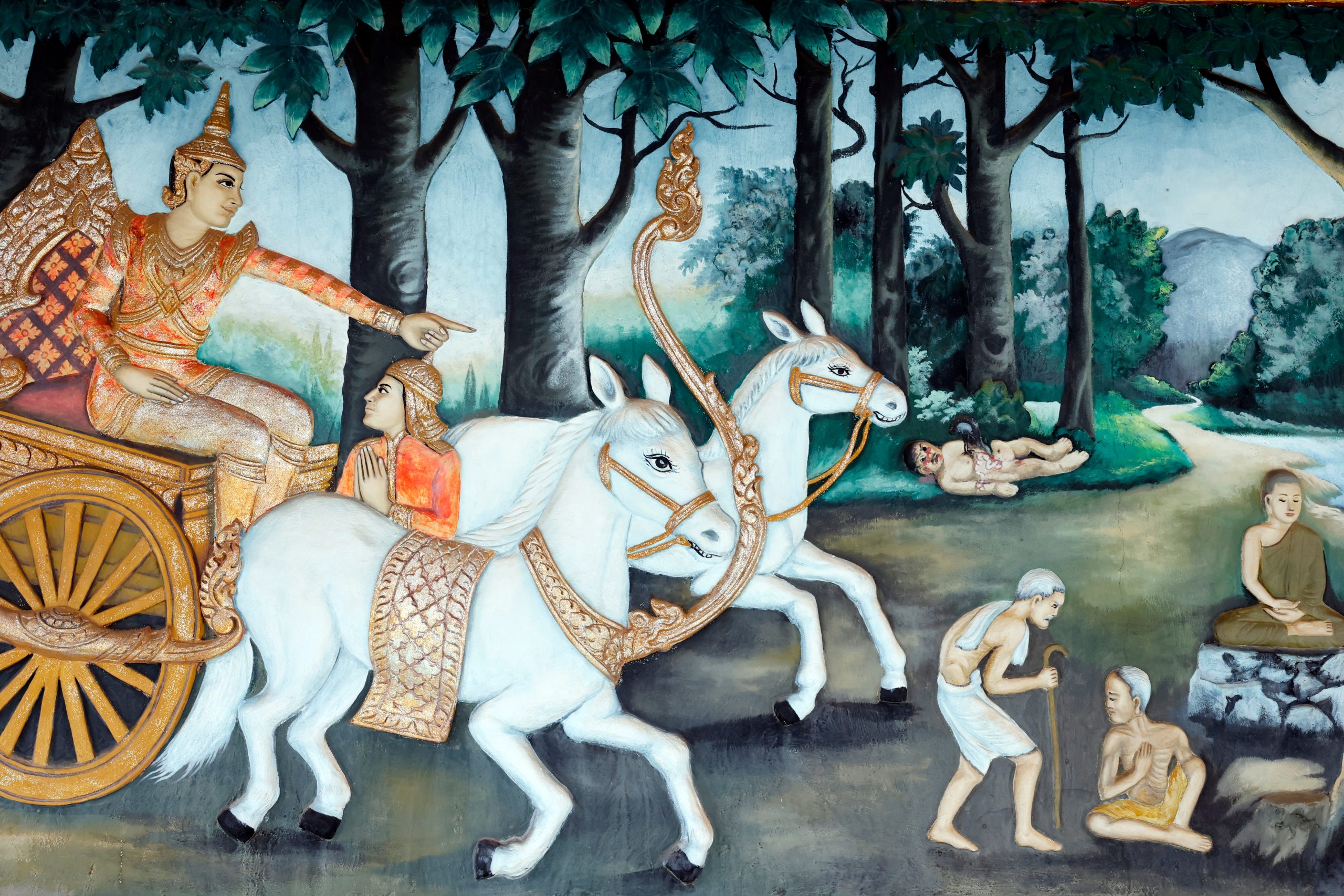
The Buddha’s encounter with unwelcome facts of life. Picture from Wat Preah Prom Rath, Siem Reap, Cambodia: Adobe Stock image copyright by Godong Photo.

The great Buddhist poet Aśvaghoṣa famously tells the story of the Buddha’s father, the king, who tried to keep his son as an heir rather than a monk by isolating him from all the bad things in the world. Of course the king’s plan doesn’t work: the Buddha-to-be sneaks out and sees an old man, a sick man and a dead man, reminding him that these fates will come to a king as surely as anyone else, and so he renounces the world and becomes a monk. The story shows us that there always remains a gap between what is and what should be: we will always face sad facts like illness and death. That gap is bad, it is always with us, and that is unfortunate; it is just the way things are, whether we like it or not. It provides a need and an impetus for us to improve our minds, to escape the suffering that comes from craving in the face of those sad facts.

A very different take on that gap comes from Jacobin senior editor Alex Caring-Lobel in the Springer Handbook of Mindfulness, which collects over thirty essays objecting to the modern mindfulness movemennt. These essays take particular objection to David Gelles’s claim that “stress emanates from a mismatch between our expectation of how things should be and the way things are”. (p85) Caring-Lobel, in particular, objects to Gelles’s view because it

dismisses that glorious gap between “how things should be and the way there [sic] are” as a kind of impediment to flourishing. This is, after all, the space of the social imagination. It is also the space in which democracy operates. (Caring-Lobel p209)

Continue reading →

Eventual human extinction and why it matters

18 Sunday Aug 2024

Posted by Amod Lele in Biology, Christianity, Death, Deity, Despair, Foundations of Ethics, Hope, Metaphysics, Physics and Astronomy, Politics, Protestantism

≈ 8 Comments

Tags

atheism, Martin Luther King Jr., natural environment, New Testament, Richard Swinburne, Simone Weil, theodicy

There will, eventually, be an end to the human race. We don’t think enough about the significance of this fact.

I am not even talking about avoidable apocalypses, as real as the threat of those is. I am assuming for the sake of argument that we will manage to avoid being stupid enough to kill ourselves off in the next few centuries, through global nuclear war or climate change or AI robots or nanotechnology or a newly emerging plague. Many if not all of those are real threats and we should do whatever we can to prevent them from destroying us. But for my purposes here I’m assuming we’re smart enough to fend them off. The point is that humanity will end even so. It may take a very, very long time. But it will happen.

Continue reading →

What I learned teaching Abrahamic monotheism

19 Sunday Jun 2011

Posted by Amod Lele in Christianity, Deity, Judaism, Rites, Supernatural

≈ 65 Comments

Tags

A.J. Jacobs, academia, atheism, autobiography, Christopher Hitchens, Hebrew Bible, Mao Zedong, pedagogy, Richard Dawkins, Richard Swinburne, Stonehill College, theodicy

I started writing this blog while I was teaching at Stonehill College, which hired me for a one-year visiting position and took me on shortly after that. A Catholic school, Stonehill requires all its students to take an introductory course in religion, and a third-year course in “moral inquiry”; faculty learn rapidly that these are the bread and butter of their teaching. In my time at Stonehill I taught one elective in Hindu tradition; the other eleven course sections were all the religion requirements.

Teaching students who did not want to be there was not always a joy. The wonderful advantage of teaching Stonehill’s required courses, though, was that there was almost no restriction on content. My love of big cross-cultural questions does not play well with the specialization taught in grad school and encouraged in academic publishing, where one must learn one thing and nothing else. But I could design these courses the way I wanted. The religion department had decided it wanted one common reference point that upper-year students could turn back to, and it had decided on the book of Exodus. But as long as you taught Exodus, the rest of the course was all up to you.

And so one semester I decided I wanted to learn more about Western monotheisms, and entitled my intro religion course “God in the West.” All that Buddhism and “Hinduism” I’d studied in grad school – never mind that. Because that was stuff I already knew pretty well. One of the things I hoped to impart to my students was a love of learning; and so I decided I would teach them a subject I wanted to learn about myself.

And learn I did. Continue reading →

Welcome to Love of All Wisdom.

I invite you to leave comments on my blog, even - or especially - if I have no idea who you are. Philosophy is a conversation, and I invite you to join it with me; I welcome all comers (provided they follow a few basic rules). I typically make a new post every Sunday. If you'd like to be notified when a new post is posted, you can get email notifications whenever I add something new via the link further down in this sidebar. You can also follow this blog on Facebook. Or if you use RSS, you can get updates through the RSS feed.

Recent Comments

  • Anonymous on The Radical Buddhism Project
  • Nick Gall on The gap is not glorious
  • Amod Lele on The present moment has no marshmallow
  • Amod Lele on The gap is not glorious
  • Nathan on The present moment has no marshmallow

Subscribe to receive Love of All Wisdom by email:

Post Tags

20th century academia Alasdair MacIntyre Aristotle ascent/descent Augustine autobiography Buddhaghosa Canada Confucius conservatism Disengaged Buddhism Engaged Buddhism Evan Thompson expressive individualism Four Noble Truths Friedrich Nietzsche G.W.F. Hegel gender Hebrew Bible identity Immanuel Kant intimacy/integrity justice Karl Marx Ken Wilber law Martha C. Nussbaum modernity music mystical experience nondualism Pali suttas pedagogy Plato race rebirth religion Siddhattha Gotama (Buddha) technology theodicy United States utilitarianism Śaṅkara Śāntideva

Categories

  • African Thought (15)
  • Applied Philosophy (389)
    • Death (48)
    • Family (54)
    • Food (23)
    • Friends (21)
    • Health (33)
    • Place (38)
    • Play (18)
    • Politics (244)
    • Sex (25)
    • Work (48)
  • Asian Thought (468)
    • Buddhism (338)
      • Early and Theravāda (141)
      • Mahāyāna (145)
      • Modernized Buddhism (105)
    • East Asia (103)
      • Confucianism (62)
      • Daoism (24)
      • Shinto (1)
    • South Asia (150)
      • Bhakti Poets (4)
      • Cārvāka-Lokāyata (5)
      • Epics (16)
      • Jainism (24)
      • Modern Hinduism (46)
      • Nyāya-Vaiśeṣika (6)
      • Sāṃkhya-Yoga (16)
      • Sikhism (1)
      • Vedānta (42)
      • Vedas and Mīmāṃsā (7)
  • Blog Admin (29)
  • Indigenous American Thought (9)
  • Method (279)
    • Metaphilosophy (180)
    • Method and Theory in the Study of Religion (156)
  • Practical Philosophy (438)
    • Action (18)
    • Aesthetics (53)
    • Emotion (198)
      • Anger (43)
      • Attachment and Craving (33)
      • Compassion (9)
      • Despair (7)
      • Disgust (5)
      • Faith (20)
      • Fear (15)
      • Grief (9)
      • Happiness (52)
      • Hope (20)
      • Pleasure (38)
      • Shame and Guilt (10)
    • External Goods (55)
    • Flourishing (106)
    • Foundations of Ethics (126)
    • Karma (45)
    • Morality (79)
    • Virtue (191)
      • Courage (7)
      • Generosity (14)
      • Gentleness (7)
      • Gratitude (13)
      • Honesty (15)
      • Humility (27)
      • Leadership (7)
      • Mindfulness (27)
      • Patient Endurance (32)
      • Self-Discipline (11)
      • Serenity (41)
      • Zest (8)
  • Practice (147)
    • Karmic Redirection (5)
    • Meditation (47)
    • Monasticism (47)
    • Physical Exercise (4)
    • Prayer (16)
    • Reading and Recitation (14)
    • Rites (24)
    • Therapy (11)
  • Theoretical Philosophy (409)
    • Consciousness (24)
    • Deity (78)
    • Epistemology (141)
      • Certainty and Doubt (19)
      • Dialectic (21)
      • Logic (15)
      • Prejudices and "Intuitions" (31)
    • Free Will (18)
    • Hermeneutics (66)
    • Human Nature (36)
    • Metaphysics (118)
    • Philosophy of Language (31)
    • Self (79)
    • Supernatural (56)
    • Truth (64)
    • Unconscious Mind (16)
  • Western Thought (531)
    • Analytic Tradition (107)
    • Christianity (162)
      • Early Factions (8)
      • Eastern Orthodoxy (3)
      • Protestantism (27)
      • Roman Catholicism (61)
    • French Tradition (50)
    • German Tradition (97)
    • Greek and Roman Tradition (126)
      • Epicureanism (25)
      • Neoplatonism (2)
      • Pre-Socratics (6)
      • Skepticism (2)
      • Sophists (8)
      • Stoicism (22)
    • Islam (44)
      • Mu'tazila (2)
      • Salafi (3)
      • Sufism (10)
    • Judaism (38)
    • Natural Science (105)
      • Biology (34)
      • Philosophy of Science (51)
      • Physics and Astronomy (11)
    • Social Science (200)
      • Economics (49)
      • Psychology (87)

Recent Posts

  • The Radical Buddhism Project
  • The present moment has no marshmallow
  • The gap is not glorious
  • Announcing my book: After Anger
  • On being from Canada (and not India)

Popular posts

  • One and a half noble truths?
  • Wishing George W. Bush well
  • Do Speculative Realists want us to be Chinese?
  • Why I am not a right-winger
  • On faith in tooth relics

Basic concepts

  • Ascent and Descent
  • Intimacy and integrity
  • Ascent-descent and intimacy-integrity together
  • Perennial questions?
  • Virtuous and vicious means
  • Dialectical and demonstrative argument
  • Chastened intellectualism and practice
  • Yavanayāna Buddhism: what it is
  • Why worry about contradictions?
  • The first philosophy blogger

Personal favourites

  • Can philosophy be a way of life? Pierre Hadot (1922-2010)
  • James Doull and the history of ethical motivation
  • Praying to something you don't believe in
  • What does postmodernism perform?
  • Why I'm getting married

Archives

Search this site

All posts, pages and metadata copyright 2009-2026 Amod Lele unless otherwise noted. Comments copyright 2009-2026 their comment authors. Creative Commons Attribution-NonCommercial-ShareAlike (BY-NC-SA) licence.

Proudly powered by WordPress Theme: Chateau by Ignacio Ricci.