• About me
  • About this blog
  • Comment rules
  • Other writings

Love of All Wisdom

~ Philosophy through multiple traditions

Love of All Wisdom

Tag Archives: theodicy

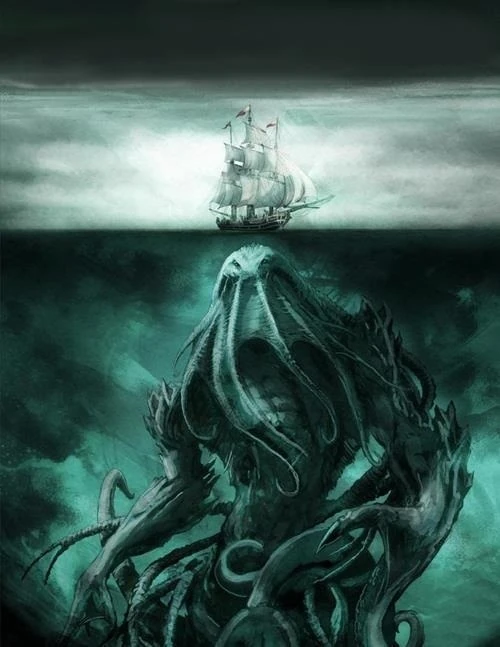
Why give Cthulhu a happy ending?

03 Sunday Jan 2016

Posted by Amod Lele in Aesthetics, Biology, Christianity, Deity, Metaphysics, Natural Science

≈ 10 Comments

Tags

AAR, Charles Darwin, David McConeghy, Friedrich Nietzsche, H.P. Lovecraft, J.R.R. Tolkien, kitsch, Mike Mignola, skholiast (blogger), Speculative Realism, theodicy

A few years ago, Skholiast wrote a lovely post on the philosophical significance of J.R.R. Tolkien and H.P. Lovecraft, two early 20th-century writers who shaped the genres we now call fantasy and horror, respectively. I was reminded of it this year at an enjoyable AAR panel entitled “Cthulhu’s Many Tentacles”.

Cthulhu Cthulhu, of course, is the best-known character (if that is the word) from Lovecraft’s stories, enough that the fictional pantheon he created has become known as the “Cthulhu Mythos”. Cthulhu is one of a set of “Elder Gods”: horrifying, vaguely amorphous, often tentacled monstrosities that have lain dormant for millennia and will soon devour humanity; their horror is such that the mere knowledge of them could drive one mad. The AAR panel gave recognition to many aspects of Lovecraft’s work: starting with a presentation on the man and his work itself, the presenters proceeded to examine the varied dimensions of the fandom that has grown up around Lovecraft (noting, in particular, that fan creativity has been greatly enabled by Lovecraft’s work rising into the public domain).

The most interesting point I took away from the panel came from a talk by David McConeghy (who also, coincidentally, was the respondent to my paper on teaching with technology). McConeghy noted that while a great deal of modern speculative fiction (he cited Mike Mignola’s comic-book series Hellboy) is clearly inspired by Lovecraft’s Cthulhu Mythos and makes references to it, these works also typically have happy endings. Continue reading →

The theology of Christmas carols

22 Sunday Dec 2013

Posted by Amod Lele in Aesthetics, Christianity, Deity, Emotion

≈ 2 Comments

Tags

Christmas, Edmund Sears, Henry Wadsworth Longfellow, kitsch, Milan Kundera, music, theodicy, United States, war

I will be taking a break from blogging over the next few weeks’ holiday. When new posts return in January, they will be on a biweekly (or fortnightly, if you wish) schedule: every alternate Sunday rather than every Sunday. I continue to enjoy writing Love of All Wisdom and intend to keep doing so, but as I have tried publishing more conventional papers, studying computer science and teaching a course on top of my day job, the weekly schedule has been too hard to sustain. I hope that alternating weeks will make it easier for me to continue engaging in the wonderful exchanges of ideas that have taken place here.

In Canada and the US today, the Christian aspect of Christmas is likely most noticeable in the music. There are of course a great number of English-language Christmas songs with little or no Christmas element (“Jingle Bells”, “Deck The Halls”, “Frosty The Snowman” and so on). It is increasingly common to hear only these songs played in public places. But one may quickly feel something missing here. Certainly some of these songs are grander than others; it would be a difficult task indeed to argue that “Deck The Halls” is no better a work than “I Saw Mommy Kissing Santa Claus”. But even so, there is a certain depth that is missing from them.

By contrast, many Christian carols engage with some weighty theological questions, especially that most significant of all questions for monotheistic believers: theodicy, the problem of bad. If there is a God – specifically, a being both omnipotent and omnibenevolent – how can the world be so full of terrible things? Continue reading →

Two gods

20 Sunday Oct 2013

Posted by Amod Lele in Deity, Early Factions, Foundations of Ethics, Metaphysics, Vedānta

≈ 1 Comment

Tags

Advaita Vedānta, Augustine, Marcion of Sinope, nondualism, Śaṅkara, theodicy

Last week I examined the theology of Marcion of Sinope, who believed – as did many other early Christians – that there existed two gods, one good and one evil. I argued that Marcion’s theology is an ingenious way for a Christian to make sense of the atrocities in the Hebrew Bible. But this week I want to argue that the appeal of such a theology goes well beyond the interpretation of scripture in the West. Rather, it is also a way to help us understand the world, if we are to take theism seriously. Continue reading →

The appeal of Marcionite interpretation

13 Sunday Oct 2013

Posted by Amod Lele in Deity, Early Factions, Hermeneutics, Judaism, Morality

≈ 5 Comments

Tags

Augustine, Egypt, Hebrew Bible, Marcion of Sinope, slavery, Stonehill College, theodicy

For Augustine, evil is nothing more than the absence of good, as we would say cold is no more than the absence of heat. Not every contemporary Christian follows this idea exactly, but the majority would surely agree that the goodness of God is supremely powerful, with evil (whether personified as Satan or not) significantly lesser.

It was not always this way. Many early Christian factions – most famously the Manicheans, but also the Marcionites and many Gnostics – believed that there were two warring gods, one good and one evil. Continue reading →

Converting to theism through the problem of good

24 Sunday Jun 2012

Posted by Amod Lele in Deity, Mahāyāna, Metaphysics, Roman Catholicism

≈ 79 Comments

Tags

atheism, Karl Marx, Leah Libresco, Pure Land, theodicy

A startling thing happened last week on Patheos, a website for conversation about “religion”. Atheist blogger Leah Libresco wrote a post entitled “This is my last post for the Patheos atheist portal”. Not for the reason you’d normally expect – that she had no time for blogging and was moving on to other ventures in life. No, Libresco wrote this because she was now going to start writing for the Catholic portal. Continue reading →

Logic and truth as normative

13 Sunday Nov 2011

Posted by Amod Lele in Analytic Tradition, Deity, Logic, Metaphilosophy, Metaphysics, Psychology, Social Science, Truth

≈ 5 Comments

Tags

Augustine, Max Weber, Stanley Rosen, theodicy

I’ve been thinking a lot about the seventh chapter in a splendid book called The Ancients and the Moderns, by a fascinating Boston University professor named Stanley Rosen. I read the book over two years ago, but the ideas of this chapter have since continued to percolate in my brain.

Rosen argues that we need to see a much closer association between two fields of study often thought separate: logic and psychology. At first glance, the two might seem to have little in particular to do with one another. Logic concerns itself with the proper formal relationships between statements in arguments; psychology, with the empirical investigation of mind and behaviour.

But more basically, what are logic and psychology? Both, really, are the study of thought. Continue reading →

What I learned teaching Abrahamic monotheism

19 Sunday Jun 2011

Posted by Amod Lele in Christianity, Deity, Judaism, Rites, Supernatural

≈ 65 Comments

Tags

A.J. Jacobs, academia, atheism, autobiography, Christopher Hitchens, Hebrew Bible, Mao Zedong, pedagogy, Richard Dawkins, Richard Swinburne, Stonehill College, theodicy

I started writing this blog while I was teaching at Stonehill College, which hired me for a one-year visiting position and took me on shortly after that. A Catholic school, Stonehill requires all its students to take an introductory course in religion, and a third-year course in “moral inquiry”; faculty learn rapidly that these are the bread and butter of their teaching. In my time at Stonehill I taught one elective in Hindu tradition; the other eleven course sections were all the religion requirements.

Teaching students who did not want to be there was not always a joy. The wonderful advantage of teaching Stonehill’s required courses, though, was that there was almost no restriction on content. My love of big cross-cultural questions does not play well with the specialization taught in grad school and encouraged in academic publishing, where one must learn one thing and nothing else. But I could design these courses the way I wanted. The religion department had decided it wanted one common reference point that upper-year students could turn back to, and it had decided on the book of Exodus. But as long as you taught Exodus, the rest of the course was all up to you.

And so one semester I decided I wanted to learn more about Western monotheisms, and entitled my intro religion course “God in the West.” All that Buddhism and “Hinduism” I’d studied in grad school – never mind that. Because that was stuff I already knew pretty well. One of the things I hoped to impart to my students was a love of learning; and so I decided I would teach them a subject I wanted to learn about myself.

And learn I did. Continue reading →

The problem of bad and the problem of good

01 Wednesday Sep 2010

Posted by Amod Lele in Analytic Tradition, Christianity, Deity, Early and Theravāda, Foundations of Ethics, Greek and Roman Tradition, Metaphysics, Roman Catholicism, Vedānta

≈ 26 Comments

Tags

Advaita Vedānta, Alasdair MacIntyre, Aristotle, Christine Korsgaard, law, obligation, Plato, Śaṅkara, theodicy, Thomas Aquinas

In my previous discussion of Christine Korsgaard’s prologue to The Sources of Normativity, I left out one significant feature of the story she tells of Western philosophy. This is the reason – related to the basic account of excellence of obligation – why Christianity proved philosophically more powerful than Greek thought.

On Korsgaard’s account of Greek metaphysics (à la Plato and Aristotle), goodness is a feature of reality, one more fundamental in a sense than the particular physical objects that appear before us. Perfect form is more real than imperfect matter. This is true whether, with Plato, those forms exist in a world apart from matter, or, with Aristotle, they exist within matter as its potential and telos.

But if that’s the case, Korsgaard notes, then the logical question is: why aren’t things perfect already? We normally think of theodicy – the problem of suffering and responses to it – as primarily a problem for Abrahamic traditions. If God is omnipotent and omnibenevolent, it’s hard to see how there can be suffering in the world (though it’s less hard to see how there can be evil). But broaden the question a bit – make it “the problem of bad” – and it appears elsewhere too. For Śaṅkara’s Advaita Vedānta, in which reality is pure knowledge, it’s a conundrum to think how there can be so much ignorance.

And Korsgaard seems to provocatively suggest that the Christians were better equipped to handle the problem than the Greeks – connecting to her account of how an ethics of excellence was superseded by an ethics of obligation. Continue reading →

Wilber and Aurobindo on intelligent design

30 Wednesday Jun 2010

Posted by Amod Lele in Biology, Christianity, Deity, Early and Theravāda, German Tradition, Metaphysics, Modern Hinduism, Natural Science, Vedānta

≈ 31 Comments

Tags

Aurobindo Ghose, Charles Darwin, Friedrich Schelling, G.W.F. Hegel, intelligent design, John Paul II, Ken Wilber, Michael Behe, Pali suttas, SACP, Śaṅkara, T.R. (Thill) Raghunath, theodicy

T.R. Raghunath, a professor in Nevada, gave an interesting talk at the SACP conference explaining Aurobindo Ghose‘s theory of the development of consciousness. There were a number of intriguing points in Raghunath’s talk, but the one that jumped out at me was a point about evolution. Aurobindo, according to Raghunath, accepts “the fact of evolution,” but not “Darwin’s explanation” of evolution. It is a developmental process that has the goal of growth, unfolding. Biological evolution is itself a developmental process of the spirit, in a way that diverges from a Darwinian materialist explanation.

A bell went off in my head when I heard this. In a later conversation with Raghunath, I asked him whether Aurobindo would support the contemporary idea of intelligent design and related critiques of Darwinian evolution, and he said basically yes: there is a guiding spiritual principle at work in the development of new species, it cannot be merely a matter of natural selection through random beneficial mutation. Throughout Raghunath’s talk I had been noticing Aurobindo’s influence on Ken Wilber, and here I saw a still more direct link.

On page 23 of what probably remains his most-read and best-known work, A Brief History of Everything, Wilber makes this now-infamous claim:

A half-wing is no good as a leg and no good as a wing — you can’t run and you can’t fly. It has no adaptive value whatsoever. In other words, with a half-wing you are dinner. The wing will work only if these hundred mutations happen all at once, in one animal — and also these same mutations must occur simultaneously in another animal of the opposite sex, and then they have to somehow find each other, have dinner, a few drinks, mate, and have offspring with real functional wings. Talk about mind-boggling. This is infinitely, absolutely, utterly mind-boggling. Random mutations cannot even begin to explain this. (emphases in original)

This is exactly the claim of irreducible complexity made by Michael Behe, perhaps the most visible proponent of intelligent design. Continue reading →

Trusting in man, trusting in God

09 Wednesday Jun 2010

Posted by Amod Lele in African Thought, Christianity, Deity, Epics, Faith, Free Will, Human Nature, Judaism, Morality, Prayer, Vedānta

≈ 40 Comments

Tags

20th century, Adolf Hitler, Augustine, Bhagavad Gītā, chastened intellectualism, Egypt, Fyodor Dostoevsky, Hebrew Bible, hell, Krishna, Mahābhārata, Mañjuśrī, Pol Pot, Rāmānuja, Sigmund Freud, theodicy, Vishnu, Xunzi

I once heard someone – I don’t remember where – criticize humanism (however defined) in the following manner: “The problem with humanism is it leads you to deify man, and the evidence seems to be that man is not worthy of being deified.” The point resonates with me as I think about chastened intellectualism, the idea – which I associate with Freud as well as Augustine and Xunzi – that human beings tend naturally toward wrong behaviour. Individually, despite good intentions, I find it a constant struggle to be a good and happy person; collectively, the history of the 20th century is a dark litany of what happens when – as is too often the case – people’s intentions are less than good. It is difficult to have faith in humanity when humanity has not earned it.

The argument to this point is, I think, in perfect sympathy with Augustine. Human beings for him are invariably and inevitably flawed, in a way that makes them unworthy of our trust. Instead, Augustine wants to argue, we must place our trust in a truly perfect being, God. Augustine’s argument here underlies a great deal of conservative Christianity: even if church institutions and/or biblical scripture appear wrong to us, they are a better guide than our own weak and easily misled intellects.

For the moment, let us leave aside the question of how we know Church or Bible embody God, or even whether God exists. I think there is a far deeper question at issue here: even assuming he exists, how can we trust God? Continue reading →

← Older posts
Newer posts →

Welcome to Love of All Wisdom.

I invite you to leave comments on my blog, even - or especially - if I have no idea who you are. Philosophy is a conversation, and I invite you to join it with me; I welcome all comers (provided they follow a few basic rules). I typically make a new post every Sunday. If you'd like to be notified when a new post is posted, you can get email notifications whenever I add something new via the link further down in this sidebar. You can also follow this blog on Facebook. Or if you use RSS, you can get updates through the RSS feed.

Recent Comments

  • Paul D. Van Pelt on Don’t be an Ugly Canadian
  • Amod Lele on Being marginalized doesn’t make you smarter
  • Amod Lele on Don’t be an Ugly Canadian
  • Paul D. Van Pelt on Don’t be an Ugly Canadian
  • Terry on Being marginalized doesn’t make you smarter

Subscribe to receive Love of All Wisdom by email:

Post Tags

20th century academia Alasdair MacIntyre Aristotle ascent/descent Augustine autobiography Buddhaghosa Canada Confucius conservatism Disengaged Buddhism Engaged Buddhism Evan Thompson expressive individualism Four Noble Truths Friedrich Nietzsche G.W.F. Hegel gender Hebrew Bible identity Immanuel Kant intimacy/integrity justice Karl Marx Ken Wilber law Martha C. Nussbaum modernity music mystical experience nondualism Pali suttas pedagogy Plato race rebirth religion Siddhattha Gotama (Buddha) technology theodicy United States utilitarianism Śaṅkara Śāntideva

Categories

  • African Thought (15)
  • Applied Phil (379)
    • Death (44)
    • Family (53)
    • Food (22)
    • Friends (21)
    • Health (33)
    • Place (37)
    • Play (17)
    • Politics (239)
    • Sex (25)
    • Work (48)
  • Asian Thought (459)
    • Buddhism (331)
      • Early and Theravāda (140)
      • Mahāyāna (140)
      • Modernized Buddhism (101)
    • East Asia (101)
      • Confucianism (62)
      • Daoism (22)
      • Shinto (1)
    • South Asia (148)
      • Bhakti Poets (3)
      • Cārvāka-Lokāyata (5)
      • Epics (16)
      • Jainism (24)
      • Modern Hinduism (45)
      • Nyāya-Vaiśeṣika (6)
      • Sāṃkhya-Yoga (16)
      • Sikhism (1)
      • Vedānta (42)
      • Vedas and Mīmāṃsā (7)
  • Blog Admin (28)
  • Indigenous American Thought (8)
  • Method (278)
    • Metaphilosophy (180)
    • Method and Theory in the Study of Religion (155)
  • Practical Philosophy (429)
    • Action (16)
    • Aesthetics (52)
    • Emotion (193)
      • Anger (41)
      • Attachment and Craving (32)
      • Compassion (9)
      • Despair (7)
      • Disgust (5)
      • Faith (20)
      • Fear (15)
      • Grief (9)
      • Happiness (51)
      • Hope (19)
      • Pleasure (37)
      • Shame and Guilt (10)
    • External Goods (55)
    • Flourishing (102)
    • Foundations of Ethics (124)
    • Karma (44)
    • Morality (78)
    • Virtue (185)
      • Courage (7)
      • Generosity (14)
      • Gentleness (6)
      • Gratitude (13)
      • Honesty (15)
      • Humility (27)
      • Leadership (7)
      • Mindfulness (24)
      • Patient Endurance (30)
      • Self-Discipline (10)
      • Serenity (38)
      • Zest (8)
  • Practice (146)
    • Karmic Redirection (5)
    • Meditation (47)
    • Monasticism (47)
    • Physical Exercise (4)
    • Prayer (16)
    • Reading and Recitation (14)
    • Rites (23)
    • Therapy (11)
  • Theoretical Philosophy (402)
    • Consciousness (22)
    • Deity (76)
    • Epistemology (141)
      • Certainty and Doubt (19)
      • Dialectic (21)
      • Logic (15)
      • Prejudices and "Intuitions" (31)
    • Free Will (18)
    • Hermeneutics (66)
    • Human Nature (34)
    • Metaphysics (115)
    • Philosophy of Language (31)
    • Self (78)
    • Supernatural (54)
    • Truth (64)
    • Unconscious Mind (16)
  • Western Thought (523)
    • Analytic Tradition (106)
    • Christianity (162)
      • Early Factions (8)
      • Eastern Orthodoxy (3)
      • Protestantism (27)
      • Roman Catholicism (61)
    • French Tradition (50)
    • German Tradition (97)
    • Greek and Roman Tradition (126)
      • Epicureanism (25)
      • Neoplatonism (2)
      • Pre-Socratics (6)
      • Skepticism (2)
      • Sophists (8)
      • Stoicism (22)
    • Islam (44)
      • Mu'tazila (2)
      • Salafi (3)
      • Sufism (10)
    • Judaism (38)
    • Natural Science (101)
      • Biology (31)
      • Philosophy of Science (50)
      • Physics and Astronomy (11)
    • Social Science (195)
      • Economics (48)
      • Psychology (84)

Recent Posts

  • Being marginalized doesn’t make you smarter
  • “The future will belong to the mestiza”
  • Hiding your ideas in plain sight
  • Don’t be an Ugly Canadian
  • How to actually decentre whiteness

Popular posts

  • One and a half noble truths?
  • Wishing George W. Bush well
  • Do Speculative Realists want us to be Chinese?
  • Why I am not a right-winger
  • On faith in tooth relics

Basic concepts

  • Ascent and Descent
  • Intimacy and integrity
  • Ascent-descent and intimacy-integrity together
  • Perennial questions?
  • Virtuous and vicious means
  • Dialectical and demonstrative argument
  • Chastened intellectualism and practice
  • Yavanayāna Buddhism: what it is
  • Why worry about contradictions?
  • The first philosophy blogger

Personal favourites

  • Can philosophy be a way of life? Pierre Hadot (1922-2010)
  • James Doull and the history of ethical motivation
  • Praying to something you don't believe in
  • What does postmodernism perform?
  • Why I'm getting married

Archives

Search this site

All posts, pages and metadata copyright 2009-2026 Amod Lele unless otherwise noted. Comments copyright 2009-2026 their comment authors. Creative Commons Attribution-NonCommercial-ShareAlike (BY-NC-SA) licence.

Proudly powered by WordPress Theme: Chateau by Ignacio Ricci.