
Tags
A few years ago, at the height of the Social Justice movement, I saw some people attempt a self-improvement project: go a year without reading any books by straight cis white men. I had significant misgivings about that project: I’m not crazy about any project that one can succeed at by reading less. (After all, the majority of Americans would succeed in that project effortlessly, simply by virtue of reading no books at all.)
But I want to leave that critique aside here because of a different, and also important, response: if you were going to undertake that project, you could still read the ancient Greeks!
The works of ancient Greek philosophy were still written almost entirely by men, that’s true. Their patriarchal society ensured that. (The most prominent female philosopher of the ancient West was probably Hypatia of Alexandria, who was Roman rather than Greek – and sadly, none of her works survive, which unfortunately means that what we can learn from her now is little or nothing.) And I’m not aware of any of the Greek philosophers being considered a third gender, or anything else in the non-binary or trans area, by others or by themselves. So they were cis men. Fine.
What they were not, was straight or white.
The ancient Greek world was not “white” in any reasonable use of the term. It wasn’t even European – spanning from what is now Italy across the Mediterranean to Anatolia, the non-European, Asian part of what is now Turkey. The very concept of “white people” would not exist for nearly another two thousand years. The seafaring ancient Greeks had mixed with Africans for centuries, but not with northern Europeans. Alexander eventually went all the way to India and established colonies in Ethiopia, making them a part of the Greek world for a time – but he never crossed the Alps. People with black skin and kinky hair were more a part of the Greek world’s mix than were blondes and redheads. The treatise Airs, Waters, Places, attributed to Hippocrates, refers to the “white skin” of Scythian nomads (described by Herodotus as “savage”) just as it refers to the “black skin” of Ethiopians – distinguishing both equally from the Greeks themselves.
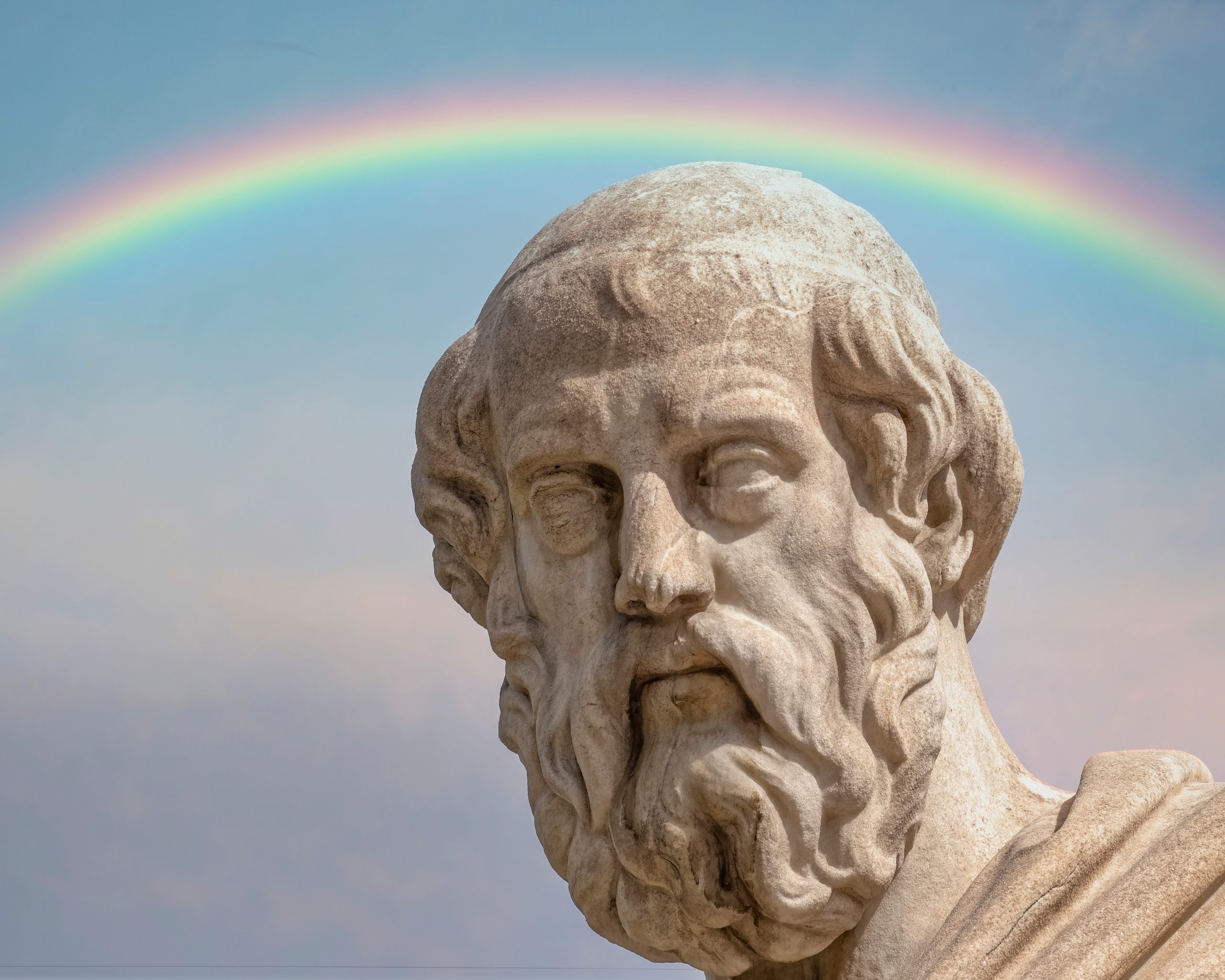
Likewise, you can’t read Plato’s Symposium and sincerely imagine Plato a straight dude. In this discourse on the nature of eros – romantic and sexual love – the examples are of love between two males. The culture of the Greek world valorized male-male love more than male-female love, and the Symposium embraces this. The particular variety of male-male love is between an older adult man and an adolescent boy; we would still usually disapprove of that relationship today, on the grounds of the ages rather than the genders, and we have our reasons for doing so. But without endorsing the Greeks’ approach to age in relationships, one can still note that one way or another the attraction was same-sex: it was not heterosexual, it was not straight.
The world of the classics, then, was far more diverse than we give it credit for, on multiple angles. That is in significant contrast to the medieval European world, where the centre of intellectual gravity had moved north and the biblical critique of “sodomy” had taken root. Thomas Aquinas was pretty unambiguously a straight white guy. But that’s not true of Plato or Thales.
This point troubles views current on both left and right. The anti-classical left-wingers who once chanted “Hey hey, ho ho, Western Civ has got to go” – led at one point by the late Jesse Jackson – caricature the Greeks as something much narrower, less diverse, less interesting than they actually were. But at least as much, when I posted on this topic a few years ago, one right-wing commenter was so threatened by the point about non-white Greeks that he somehow took it as a “pathetic rationalization” for “unlimited mass immigration into Europe”. And of course it’s amusing to watch right-wingers who seek a “RETVRN” to the classical world then turn around and yet want to ban it once they see how gay the classics actually are.
But that’s one of the great things about the Greek world – despite having laid the foundation for our world now, it is a very, very different world than our own, one that takes us out of our taken-for-granted world maybe even more than travelling to other places does. The Greeks did not know our modern categories of race, homosexuality, heterosexuality, let alone left and right. They were doing their own thing, in a way we can still learn a lot from.
Love of All Wisdom will take a week off on March 8 when I’m on vacation. I’ll be back March 15.
Pingback: Missed posts for Love of All Wisdom subscribers | Love of All Wisdom