
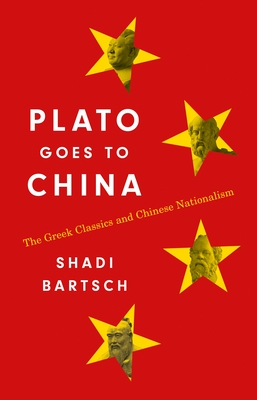
I recently read Shadi Bartsch‘s Plato Goes to China: The Greek Classics and Chinese Nationalism. The book’s topic is fascinating to me: the ways that modern Chinese intellectuals have taken up classical Greek philosophy. In some ways it made me feel oddly hopeful – that even under the totalitarian régime that has run China since 1989, it turns out that classical learning, even foreign classical learning, gets more respect than it does in the anti-intellectual United States. Unfortunately the book itself takes a highly unhelpful method of dealing with the topic: Bartsch spends a great deal of time telling you what’s wrong with the views of Chinese pro-government intellectuals. A Western audience really doesn’t need that: we’re already predisposed to be suspicious of that way of thinking. I wanted to learn about how the Chinese intellectuals themselves think – something I can’t get for myself, since my Chinese isn’t nearly good enough – and the book gives them very little time to speak in their own worlds.
But there was one thing the book sparked in me, which I don’t think was the author’s intent: an appreciation for the work of Leo Strauss.
Strauss, a German Jew who emigrated to the US in 1937, could reasonably be called a niche or cult thinker: there is a significant number of academics who remain his “Straussian” fans, while he is taken less seriously by most others. This is for a number of reasons, not least that his thought is typically taken to lean in a right-wing direction – perhaps most notoriously by supposed “Straussians” in the George W. Bush administration, like Paul Wolfowitz, who studied with Strauss. It is far from clear that those “Straussians” were being faithful to Strauss’s teaching, though, because – for reasons that should become clear in a moment – it can be very hard to discern what Strauss’s teaching actually is, even though he writes in admirably jargon-free prose. At a minimum, American Straussian interpretation, like 1990s hip-hop, is divided between East and West Coast; the West Coast Straussians seem eager to influence government policy in a way that Strauss himself never was.
What I learned from Bartsch’s book, though, is that Strauss’s thought has become very popular among intellectuals in contemporary China. That makes Strauss a striking figure in cross-cultural philosophy – for it is not just his reception but his influences that are outside the mainstream West. Strauss draws a significant portion of his own ideas from medieval Muslim thinkers, especially al-Fārābī. And in the early 2000s, it turns out, two Chinese professors, named Liu Xiaofeng and Gan Yang, brought the work of Strauss and his followers to China with a wide array of translations, and inspired a new generation of students.
What piqued my interest in particular was Bartsch’s claim that Liu Xiaofeng and Gan Yang had once been liberal reformists – until the 1989 crackdown on protest and dissent. Like many Chinese intellectuals who had once critiqued the Party régime, they halted that critique when it became personally dangerous.
But it’s in that context that a turn to Strauss becomes particularly interesting. Strauss’s essay “Persecution and the art of writing” was written in 1941, when fascism and Communism were ascendant around the globe, and notes that in those places where free speech had once been prevalent, “freedom is now suppressed and replaced by a compulsion to coordinate speech with such views as the government believes to be expedient, or holds in all seriousness.” (p22 in the book named after the essay) But he notes that in such cases people can still think independently in private conversations with friends, and even express those views in publicly available works – so long as they conceal those views in plain sight, by “writing between the lines”. Their writing may contain an exoteric view aligning with the officially accepted position, while hiding a very different esoteric view in plain sight, for those who are able to get the message. For example, they might write an essay ostensibly attacking liberal views they themselves held – but explain the views that they were “attacking” in sympathetic terms, while making the actual attack weak.
Gee, I can’t possibly imagine why that approach could be appealing to Chinese intellectuals after 1989!
I don’t know the work of Liu Xiaofeng and Gan Yang beyond what Bartsch mentions of it (though I’m certainly now intrigued to learn more). So I can’t say whether their work is actually well described by the inference that seems plausible to me: that they maintained something like their pre-1989 liberal views in the following decades, but learned to conceal them amid an outward profession of the publicly acceptable view, in just the way that Strauss describes.
But whether or not that description is true of Liu and Gan, it may start to have lessons for the rest of us. Freedom of speech is very important for a good society – but that says nothing about whether societies actually will protect it. Like it or not, we now appear to be in an era much like Strauss’s, where there is an eagerness to squelch dissenting views. In the past decade we saw that eagerness from left-wingers running major institutions; now we see it from the right-wing US government. But I wouldn’t be so worried if it were just that particular régime, which has shown such repeated incompetence that I find it hard to imagine that régime lasting. (I have no doubt that Donald Trump would like to lock people like me up for our criticisms of him; I also think that, unlike many of his authoritarian peers, he is far too stupid and impulsive to figure out a way to make that happen.) Rather, a right-wing intolerance of dissent has become standard around the world in governments from India to Israel to Turkey to Hungary – and the liberal alliance once led by the United States has been weakened so much, just in the past year, that it seems far less likely to be able to defend freedom against longer-standing autocracies like those of China and Russia.
We are, in short, in a world not unlike the one in which Strauss wrote his essay on persecution. I deeply hope that the liberty to express oneself freely will survive, and come to expand once more. But if it does not, Strauss might come to look like a promising guide for how one might continue to think and share ideas regardless.
What an interesting book! Too bad it doesn’t live up to its potential.
Aren’t the clearest cases of Straussianism, historically, those Enlightenment philosophers who argued that religious teachings were contrary to human reason, ostensibly to show human reason’s weakness, but in practice making religious teachings look indefensible. It’s still debated whether Bayle was an agnostic or a sincere Christian fideist, IIRC.
There’s a medieval Mu’utazilite theologian I was reading about who argued that slavery *would* be morally wrong if it was judged by human reason alone, since it causes suffering, and that only God’s law revealed in scripture permits it. Especially given Mu’utazilite commitment to the idea that God’s arbitrary commands *can’t* overturn universal rationally-accessible moral truths, I do wonder if he’s actually trying to Straussianly imply that scripture isn’t infallible.
That makes sense to me. Strauss developed his theory based on reading medieval Muslim and Jewish theologians, and they seem like a place where his theory is most likely to be applicable, since that was such a clear case of a situation where the acceptable range of views was narrow.
“In some ways it made me feel oddly hopeful – that even under the totalitarian régime that has run China since 1989, it turns out that classical learning, even foreign classical learning, gets more respect than it does in the anti-intellectual United States.”
It may be that the Chinese are predisposed by Confucianism to give too much respect to classical learning. As Barry Allen once put it:
I mean, for most of human history, people in most places have put their trust in the wisdom of the past. The modern English-speaking New World countries have tended to be the exact opposite, and in the past few decades they’ve gotten considerably worse. There’s a balance to be found, but the US hostility to humanistic learning (on left and right) has gotten so dispiriting lately that it’s good to be reminded that the rest of the world is not like that – even under nominal Communism.
To be clear, I’m not disagreeing with you about anti-intellectualism in the US! On the other hand, I instinctively have an unclassical methodology, preferring to start from the most recent syntheses of knowledge (e.g. recent systematic philosophy) rather than from the classics. But that knowledge synthesis should be informed by classical knowledge.
As you are well aware, a problem with Western systematic philosophy is that it hasn’t been well enough informed by non-Western recorded knowledge. I wouldn’t be surprised if the Chinese are doing much better than us in having a cross-cultural knowledge base, given how aggressively they translate recorded knowledge from Western languages into Chinese.
Yeah, that seems entirely possible. It feels a little depressing that a régime that stifles free inquiry would have a better cross-cultural knowledge base than we do, but here we are.
I’m aware of a number of Western philosophers who have recently had or now have a suprising degree of popularity in China including Alfred North Whitehead, John Dewey, Richard Rorty, and Eugene Gendlin—and I only know of these because of my own interests in these writers. The Chinese are also interested in the ancient Greek philosophers because they see a parallel between ancient Greece and their own Warring States Period philosophers who were more or less contemporaneous—if all of Western philosophy is footnotes to Plato (as Whitehead thought), then all of Chinese philosophy is footnotes to Laozi, Confucius, Mencius, Zhaungzi, and Xunzi.
John Dewey, of course, toured China for two years, 1919–1921. Much has been written about that. From C.F. Remer (July 3, 1920), “John Dewey in China”, Millard’s Review of the Far East 13(5), 266–268:
Dewey really got around! He was a big influence on Ambedkar in India too.
OK. I guess my remarks were not published here. Thought I had followed protocols and procedures . I guess not. I will refrain.
Not sure why they didn’t go through, Paul. I didn’t see them on my end; it wasn’t that I didn’t approve them.
OK. I submitted an addendum to remarks made to a post by Amod. That appeared to go through the pipeline. I appear to have been excluded by several bloggers. No worries. Google likes me! But, if I am offending others, who have power and authority to shut me out, I do not have power or authority to challenge that. Thanks for your support!
Thanks, Paul. When I’m moderating comments, the only reason I don’t approve them is if they’re spam ( ~= completely irrelevant) or if they’re abusive. Your posts have never been in either category; if they don’t come through, that’s most likely a technical difficulty (and one I’d like to know about in case I can find a fix).
Amen to Mr. Dewey. And thank you, to.
Views on Confucious vary. My reductionist side leans towards simplicity and wisdom. In may ways, we can measure simplicity. It is easier to build a house of wood, than one of stone— but, stone lasts longer. Simplicity, in this case falls towards wood.
Wood wins, toot, toot. It is maintainable. Confucious would agree. Stone is tougher to craft into a home. Weight and maleability are obstacles. But, once a home of stone is built, it is a castle. Yet, if there comes an earthquake of sufficient intensity, the stone will crumble to rubble, while a wooden structure may be salvageable. Confucious would agree here too. perhaps with reservations. So, think for yourselves. That is what I do.
I think the Chinese Wiseman would agree.
Recent attempts at responses to blogs are curious. Your post is the only one I can access. It appears my views are objectionable. My brother, in Canada, calls me an uncredentialed thinker. Perhaps that station is unacceptable, although it has not been before. You know how I write, Amod…even how I think…sometimes. ???
I can assure you that if you’re having any difficulty getting your comments to post, it’s a technical difficulty, not because of the content of your writing.
Thank you. Your view is valued.
If you are curious, see my remarks to Luke’s eloquent ones @ Schwitzsplinters. Luke seems pretty level—I look for that, which is why I remain loyal here.
PDV.
Am finding other blogs increasingly inaccessible, because of suspicions around my status as a human. I don’t know where this junk comes from. It is annoying and now pervasive. ‘bots are not so linguistically creative yet. I don’t go quietly. Never plan to.
Please read my remarks @ Schwitzsplinters.