• About me
  • About this blog
  • Comment rules
  • Other writings

Love of All Wisdom

~ Philosophy through multiple traditions

Love of All Wisdom

Category Archives: Practice

Legalize Plato

18 Sunday Jan 2026

Posted by Sandhya Lele in Greek and Roman Tradition, Hermeneutics, Politics, Reading and Recitation, Sex

≈ 2 Comments

Tags

academia, conservatism, gender, Martin Peterson, pedagogy, Plato, Republican Party, Roger Scruton, Saba Bazargan, Texas A&M University, Tommy Williams, United States, William F. Buckley

The Social Justice movement has been notorious for its intolerance to dissenting opinions, and has often reached high levels in university administrations. And of course such left-wing movements on race and gender have a long history of attacking “dead white males” – in contrast to those contemporary right-wingers who seek to “RETVRN” to a premodern West, stylizing it with a V to indicate their classical sympathies. So when a university orders a professor to remove Plato from his philosophy syllabus, surely that must be a woke thing. Right?

Nope!

Texas A&M University ordered the removal of Plato because he was too woke.

Continue reading →

The world of the women’s room

11 Sunday Jan 2026

Posted by Sandhya Lele in Epistemology, Food, Place, Prejudices and "Intuitions", Reading and Recitation, Social Science

≈ 3 Comments

Tags

Alfred Schutz, Canada, Disengaged Buddhism, gender, Hebrew Bible, Jerry Seinfeld, Thailand

When I first attended an academic conference en femme, it turned out to be relevant to the conference’s discussion of gender ethics. It also taught me something else – by accident.

When a break between panels began, a female colleague and I were having an enthusiastic discussion of topics coming out of the previous panel. We both needed to go to the washroom1, so we carried on our discussion on the way to the women’s room. Then we entered neighbouring toilet stalls and sat down to do our business – and continued our Buddhist-ethics conversation across the barrier between the stalls, while sitting down in them.

Continue reading →

In praise of alcohol

28 Sunday Dec 2025

Posted by Amod Lele in Aesthetics, Early and Theravāda, Food, Friends, Health, Judaism, Place, Pleasure, Rites, Zest

≈ 6 Comments

Tags

drugs, Eric Bogle, gender, Moses Maimonides, music, Purim, Scotland, Stan Rogers, Talmud

Alcohol is further out of fashion these days than at any time in living memory. Even American Prohibition just made people try harder to get alcohol. Today, though, alcohol drinking in the US has fallen to record lows, with only 54% of Gallup survey respondents saying they consume it. Nearly every cocktail-serving restaurant or even bar I visit these days has non-alcoholic mocktail options, often with sophisticated bartending flair – something barely imaginable twenty years ago.

The reasons for this are not too hard to imagine. On the one hand, the medical studies about alcohol’s harms keep piling up, often indicating that even moderate drinking – the kind touted as beneficial to health a couple decades ago – may now have many negative health consequences. On the other, alternative mind-altering substances are now easily available – most obviously cannabis, legal in many American jurisdictions and across Canada, which is a clearly healthier alternative. All in all, all things considered, the downward trend in drinking is probably not a bad thing. And there’s plenty of traditional precedent for being suspicious of alcohol: the fifth of the Five Precepts, guiding lay people, enjoins refraining from alcohol on the grounds that it causes heedlessness.

That said, there are reasons why alcohol has remained so enduringly popular in human history. And we do ourselves a disservice by disregarding them. Alcohol is not for everybody – many people find it takes control of their lives in a harmful way. But even for those people, there’s usually a reason it got so powerfully appealing in the first place. In many human lives, ones where one can control its consumption well, alcohol plays a very positive and valuable role. And as we approach the one festival in the North American ritual calendar where the drinking of alcohol typically plays the largest role, it’s worth thinking a bit about alcohol’s positives.

Continue reading →

When to judge your thoughts

23 Sunday Nov 2025

Posted by Amod Lele in Emotion, Mahāyāna, Meditation, Mindfulness, Modernized Buddhism, Psychology

≈ 2 Comments

Tags

Andy Puddicombe, Headspace, John Dunne, phenomenology

Modern mindfulness tends to urge us to stay in the present moment, learn to avoid getting distracted by wandering thoughts. A friend recently raised a thoughtful critique of this approach: aren’t there times when we want, even need, our thoughts to wander?

Continue reading →

Nondual mindfulness in Teresa of Ávila

16 Sunday Nov 2025

Posted by Amod Lele in Consciousness, Deity, Mahāyāna, Meditation, Mindfulness, Prayer, Psychology, Roman Catholicism

≈ 6 Comments

Tags

Andy Puddicombe, Brook Ziporyn, Headspace, John Dunne, mystical experience, nondualism, phenomenology, Śāntideva, Satan, Spain, Teresa of Ávila, Tiantai 天台, Zhiyi

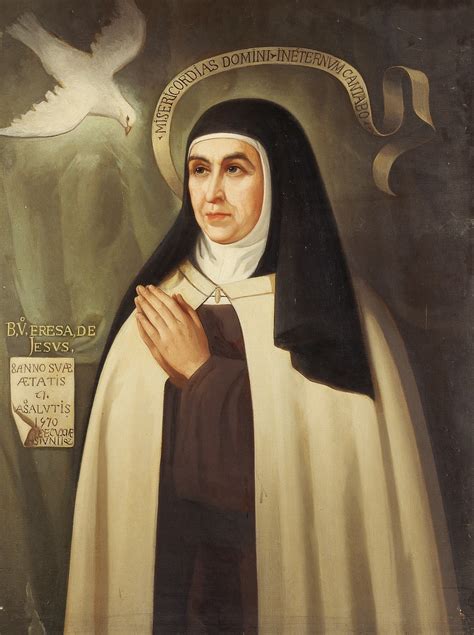
Portrait of Teresa of Ávila by Juan de la Miseria, her contemporary.

The autobiography of (Saint) Teresa of Ávila is a most remarkable book. Its beginning sections on Teresa’s early life feel at once relatable (she recalls her youthful interest in making herself pretty) and utterly alien: she and her brother admired the Christian martyrs so much that in childhood they “agreed to go off to the land of the Moors and beg them, out of love of God, to cut off our heads there”, and felt very disappointed that they could not find a way to do this. (Section 1.4, page 3 of the Kavanaugh-Rodriguez translation) The later sections are the more famous ones, depicting Teresa’s vivid visions of angels.

In the middle, though, the book takes an unexpected detour – nearly a hundred pages – providing instructions for prayer. I don’t believe in Teresa’s God, let alone pray to him, which made it very tempting to skip these chapters. I’m very glad I didn’t, though, because I found important things in them that I recognized as a Buddhist.

Continue reading →

Mindform Podcast interview

12 Wednesday Nov 2025

Posted by Amod Lele in Anger, Attachment and Craving, Confucianism, Early and Theravāda, Emotion, External Goods, Flourishing, Foundations of Ethics, Human Nature, Mahāyāna, Meditation, Metaphysics, Mindfulness, Morality, Natural Science, Pleasure, Politics, Psychology, Self

≈ Leave a comment

Tags

Alex O'Connor, Aristotle, authenticity, autobiography, Charles Goodman, conventional/ultimate, expressive individualism, Frank Lawton, Friedrich Nietzsche, interview, Jeremy Bentham, Kāma Sūtra, Madhyamaka, phenomenology, Śāntideva, Thailand, utilitarianism, virtue ethics

I was interviewed by Frank Lawton on a recent episode of the Mindform Podcast on self-development and wisdom, associated with Ryan A. Bush’s Designing the Mind. We begin with my formative story in Thailand and the anti-politics associated with it, proceeding to a critique of utilitarianism, a discussion of my gradual movement from Theravāda to Mahāyāna Buddhism, and finally to an exploration of expressive individualism. All told, I think it’s a very nicely rounded introduction to my philosophical thinking – even if my growing hair is in its awkward phase and I stammer a little too much!

Ambedkar and the Nation of Islam as skillful means

09 Sunday Nov 2025

Posted by Amod Lele in Hermeneutics, Islam, Method and Theory in the Study of Religion, Modernized Buddhism, Politics, Rites

≈ 5 Comments

Tags

B.R. Ambedkar, caste, Elijah Muhammad, Four Noble Truths, identity, Maharashtra, Malcolm X, Nation of Islam, race, United States, upāyakauśalya, W.D. Fard Muhammad

It’s hard for me to view B.R. Ambedkar as a real Buddhist, when he threw out the Four Noble Truths after getting to Buddhism by a mere process of elimination. But then, to a real Buddhist, it shouldn’t matter – at least it shouldn’t matter much – whether you are a “real Buddhist”! Buddhism has no more essence, no more svabhāva, than anything else does. What really matters is relieving suffering. What’s more important than his status as a Buddhist is that Ambedkar’s rejection of the Four Noble Truths deeply inhibits the relief of suffering – or rather, it has the potential to. Yet things might be a bit more complicated than that.

Continue reading →

Canadian psychedelic podcast interview

22 Monday Sep 2025

Posted by Amod Lele in Consciousness, Daoism, Deity, Early and Theravāda, Indigenous American Thought, Mahāyāna, Meditation, Metaphysics, Method and Theory in the Study of Religion, Psychology, Roman Catholicism, Self, Supernatural, Vedānta

≈ Comments Off on Canadian psychedelic podcast interview

Tags

autobiography, Buddhaghosa, Canada, drugs, Elon Musk, interview, John Hick, MAPS, Meister Eckhart, mystical experience, nondualism, Osheen Dayal, phenomenology, religion, Roland Griffiths, Śāntideva, Teresa of Ávila, Thailand, Upaniṣads, Zhuangzi

Following up my talk on psychedelics and mysticism, Osheen Dayal of the Canadian branch of MAPS just interviewed me on the same subject for their video podcast. In the interview we talk about a wide range of subjects from my personal Buddhist story through St. Teresa’s angel to Elon Musk. Have a look!

Philosophy as psychedelic practice

15 Sunday Jun 2025

Posted by Amod Lele in Certainty and Doubt, Epistemology, French Tradition, Mahāyāna, Meditation, Metaphilosophy, Metaphysics, Practice, Self, Serenity

≈ 5 Comments

Tags

Chan/Zen 禪, David J. Blacker, drugs, Madhyamaka, mystical experience, Oxherding Pictures, Pierre Hadot, René Descartes, Śāntideva

David J. Blacker’s recent Deeper Learning with Psychedelics is a valuable attempt to think through the implications of psychedelics for philosophy and education. One passage in particular caught my imagination: Blacker points out the similarities between a psychedelic experience and René Descartes’s passage of radical doubt.

Continue reading →

Is Asian philosophy footnotes to the Buddha?

01 Sunday Jun 2025

Posted by Amod Lele in Confucianism, Daoism, East Asia, Greek and Roman Tradition, Mahāyāna, Meditation, Metaphilosophy, South Asia, Vedānta

≈ Comments Off on Is Asian philosophy footnotes to the Buddha?

Tags

Alfred North Whitehead, Confucius, Livia Kohn, Plato, Śaṅkara, Siddhattha Gotama (Buddha), Upaniṣads, Zhu Xi, Zhuangzi

Recently I wanted to explore a fascinating passage of the Daoist founder Zhuangzi, where the text recommends “sitting in oblivion” or “sitting and forgetting” (zuòwàng 坐忘). That passage bears striking similarities to mystical practices and experiences from around the globe.

To help figure it out, I turned to Sitting in Oblivion by the Daoism scholar Livia Kohn, which shows how “sitting and forgetting” was developed as a practice and taken up at great length by later Daoist thinkers. One passage of Kohn’s particularly struck me:

The most important aspects of the rather extensive Buddhist imports into Daoism for sitting in oblivion include the organizational setting of meditation practice in monastic institutions, the formalized ethical requirement in the taking of precepts and refuge in the Three Treasures, the doctrines of karma and retribution, the five paths of rebirth, and the various layers of hell, as well as the vision of the body-mind in terms of multiple aspects, defilements, hindrances, and purification. (107)

“Rather extensive” indeed! I knew that East Asian Buddhists had drawn a great deal from Daoism – I have sometimes uncharitably described Chan/Zen as “Daoists cosplaying as Buddhists” – but I hadn’t realized how much the influence went in the other direction. Karma, rebirth, meditation, monastic institutions, taking precepts, taking refuge? At that point you sure sound a lot like Buddhists without the name!

Continue reading →
← Older posts

Welcome to Love of All Wisdom.

I invite you to leave comments on my blog, even - or especially - if I have no idea who you are. Philosophy is a conversation, and I invite you to join it with me; I welcome all comers (provided they follow a few basic rules). I typically make a new post every Sunday. If you'd like to be notified when a new post is posted, you can get email notifications whenever I add something new via the link further down in this sidebar. You can also follow this blog on Facebook. Or if you use RSS, you can get updates through the RSS feed.

Recent Comments

  • Amod Lele on Legalize Plato
  • Nathan on Legalize Plato
  • Legalize Plato | Love of All Wisdom on The world of the women’s room
  • Legalize Plato | Love of All Wisdom on Self-proclaimed philosophers should have known better
  • Sandhya Lele on The world of the women’s room

Subscribe by Email

Post Tags

20th century academia Alasdair MacIntyre Aristotle ascent/descent Augustine autobiography Buddhaghosa Canada Confucius conservatism Disengaged Buddhism Engaged Buddhism Evan Thompson expressive individualism Four Noble Truths Friedrich Nietzsche G.W.F. Hegel gender Hebrew Bible identity Immanuel Kant intimacy/integrity justice Karl Marx Ken Wilber law Martha C. Nussbaum modernity music mystical experience nondualism Pali suttas pedagogy Plato race rebirth religion Siddhattha Gotama (Buddha) technology theodicy United States utilitarianism Śaṅkara Śāntideva

Categories

  • African Thought (15)
  • Applied Phil (366)
    • Death (44)
    • Family (53)
    • Food (22)
    • Friends (21)
    • Health (32)
    • Place (35)
    • Play (17)
    • Politics (226)
    • Sex (24)
    • Work (45)
  • Asian Thought (456)
    • Buddhism (330)
      • Early and Theravāda (139)
      • Mahāyāna (140)
      • Modernized Buddhism (100)
    • East Asia (99)
      • Confucianism (61)
      • Daoism (22)
      • Shinto (1)
    • South Asia (147)
      • Bhakti Poets (3)
      • Cārvāka-Lokāyata (5)
      • Epics (16)
      • Jainism (24)
      • Modern Hinduism (44)
      • Nyāya-Vaiśeṣika (6)
      • Sāṃkhya-Yoga (16)
      • Sikhism (1)
      • Vedānta (42)
      • Vedas and Mīmāṃsā (7)
  • Blog Admin (28)
  • Indigenous American Thought (8)
  • Method (275)
    • Metaphilosophy (177)
    • Method and Theory in the Study of Religion (155)
  • Practical Philosophy (423)
    • Action (16)
    • Aesthetics (52)
    • Emotion (189)
      • Anger (39)
      • Attachment and Craving (32)
      • Compassion (9)
      • Despair (7)
      • Disgust (5)
      • Faith (20)
      • Fear (15)
      • Grief (9)
      • Happiness (49)
      • Hope (18)
      • Pleasure (36)
      • Shame and Guilt (10)
    • External Goods (53)
    • Flourishing (100)
    • Foundations of Ethics (124)
    • Karma (44)
    • Morality (78)
    • Virtue (182)
      • Courage (7)
      • Generosity (14)
      • Gentleness (6)
      • Gratitude (12)
      • Honesty (14)
      • Humility (26)
      • Leadership (7)
      • Mindfulness (23)
      • Patient Endurance (30)
      • Self-Discipline (10)
      • Serenity (38)
      • Zest (8)
  • Practice (145)
    • Karmic Redirection (5)
    • Meditation (47)
    • Monasticism (46)
    • Physical Exercise (4)
    • Prayer (16)
    • Reading and Recitation (14)
    • Rites (23)
    • Therapy (11)
  • Theoretical Philosophy (396)
    • Consciousness (22)
    • Deity (76)
    • Epistemology (139)
      • Certainty and Doubt (18)
      • Dialectic (19)
      • Logic (15)
      • Prejudices and "Intuitions" (31)
    • Free Will (18)
    • Hermeneutics (64)
    • Human Nature (34)
    • Metaphysics (115)
    • Philosophy of Language (30)
    • Self (78)
    • Supernatural (54)
    • Truth (62)
    • Unconscious Mind (16)
  • Western Thought (512)
    • Analytic Tradition (104)
    • Christianity (162)
      • Early Factions (8)
      • Eastern Orthodoxy (3)
      • Protestantism (27)
      • Roman Catholicism (61)
    • French Tradition (50)
    • German Tradition (94)
    • Greek and Roman Tradition (124)
      • Epicureanism (25)
      • Neoplatonism (2)
      • Pre-Socratics (6)
      • Skepticism (2)
      • Sophists (8)
      • Stoicism (22)
    • Islam (43)
      • Mu'tazila (2)
      • Salafi (3)
      • Sufism (10)
    • Judaism (38)
    • Natural Science (101)
      • Biology (31)
      • Philosophy of Science (50)
      • Physics and Astronomy (11)
    • Social Science (188)
      • Economics (43)
      • Psychology (83)

Recent Posts

  • Legalize Plato
  • The world of the women’s room
  • Do you need anger for respect and accountability?
  • In praise of alcohol
  • Who were the Magi?

Popular posts

  • One and a half noble truths?
  • Wishing George W. Bush well
  • Do Speculative Realists want us to be Chinese?
  • Why I am not a right-winger
  • On faith in tooth relics

Basic concepts

  • Ascent and Descent
  • Intimacy and integrity
  • Ascent-descent and intimacy-integrity together
  • Perennial questions?
  • Virtuous and vicious means
  • Dialectical and demonstrative argument
  • Chastened intellectualism and practice
  • Yavanayāna Buddhism: what it is
  • Why worry about contradictions?
  • The first philosophy blogger

Personal favourites

  • Can philosophy be a way of life? Pierre Hadot (1922-2010)
  • James Doull and the history of ethical motivation
  • Praying to something you don't believe in
  • What does postmodernism perform?
  • Why I'm getting married

Archives

Search this site

All posts, pages and metadata copyright 2009-2026 Amod Lele unless otherwise noted. Comments copyright 2009-2026 their comment authors. Creative Commons Attribution-NonCommercial-ShareAlike (BY-NC-SA) licence.

Proudly powered by WordPress Theme: Chateau by Ignacio Ricci.