• About me
  • About this blog
  • Comment rules
  • Other writings

Love of All Wisdom

~ Philosophy through multiple traditions

Love of All Wisdom

Tag Archives: Zhiyi

Nondual mindfulness in Teresa of Ávila

16 Sunday Nov 2025

Posted by Amod Lele in Consciousness, Deity, Mahāyāna, Meditation, Mindfulness, Prayer, Psychology, Roman Catholicism

≈ 6 Comments

Tags

Andy Puddicombe, Brook Ziporyn, Headspace, John Dunne, mystical experience, nondualism, phenomenology, Śāntideva, Satan, Spain, Teresa of Ávila, Tiantai 天台, Zhiyi
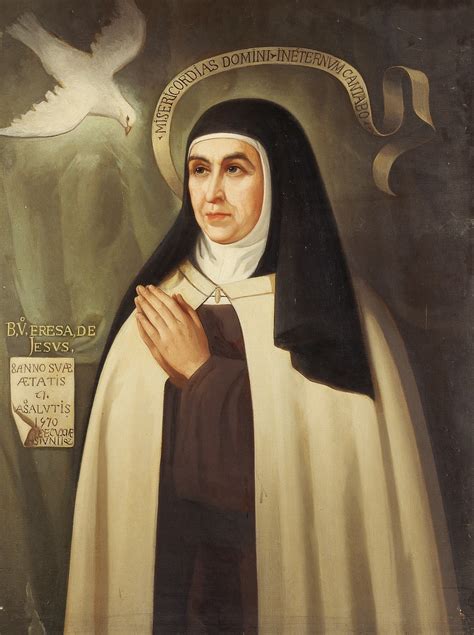
Portrait of Teresa of Ávila by Juan de la Miseria, her contemporary.

The autobiography of (Saint) Teresa of Ávila is a most remarkable book. Its beginning sections on Teresa’s early life feel at once relatable (she recalls her youthful interest in making herself pretty) and utterly alien: she and her brother admired the Christian martyrs so much that in childhood they “agreed to go off to the land of the Moors and beg them, out of love of God, to cut off our heads there”, and felt very disappointed that they could not find a way to do this. (Section 1.4, page 3 of the Kavanaugh-Rodriguez translation) The later sections are the more famous ones, depicting Teresa’s vivid visions of angels.

In the middle, though, the book takes an unexpected detour – nearly a hundred pages – providing instructions for prayer. I don’t believe in Teresa’s God, let alone pray to him, which made it very tempting to skip these chapters. I’m very glad I didn’t, though, because I found important things in them that I recognized as a Buddhist.

Continue reading →

In praise of the present moment

19 Sunday Nov 2023

Posted by Amod Lele in Anger, Daoism, East Asia, Flourishing, Mahāyāna, Meditation, Mindfulness, Modernized Buddhism, Serenity

≈ 3 Comments

Tags

Andy Puddicombe, autobiography, Brook Ziporyn, drugs, Four Noble Truths, Headspace, Johann Wolfgang von Goethe, John Dunne, Pali suttas, Ron Purser, Śāntideva, Tiantai 天台, Zhiyi

One of the things that helped me realize the need for self-improvement by not-self-improvement was regular practice with the excellent Headspace meditation app, created by a former Tibetan monk named Andy Puddicombe. Headspace is at the epicenter of “McMindfulness”: the app normally charges for access but I get it for free as a work wellness benefit, and this arrangement has made Puddicombe millions of dollars. In turn, the app is a big reason I defend McMindfulness – especially through John Dunne’s hugely helpful distinction between “classical” and “nondual” mindfulness.

That is to say: the core practice in Headspace is noticing your emotions, positive and negative, as they arise, and reacting to them with nonjudgemental acceptance. And you do so, yes, in the present moment. Critics like Ron Purser correctly note that that present-moment focus is not found in classical Indian texts like the Pali suttas or Śāntideva – but Dunne notes that it is found in other premodern Buddhist traditions, like the Tibetan writings of Wangchuk Dorje. And I dare say that that present-moment technique is an improvement: one that does a better job than the classical tradition’s techniques at their shared goal of reducing our suffering.

Continue reading →

The reasons for nondualism

21 Sunday Mar 2021

Posted by Amod Lele in Epistemology, Metaphilosophy, Metaphysics, Psychology, Reading and Recitation, Sufism, Vedānta

≈ 10 Comments

Tags

Advaita Vedānta, Alasdair MacIntyre, Aristotle, conventional/ultimate, drugs, G.W.F. Hegel, Gārgī Vācaknavī, Muhyiddin ibn 'Arabī, mystical experience, Nathan (commenter), nondualism, pramāṇa, Roland Griffiths, Śaṅkara, Thales, Upaniṣads, Zhiyi

I said previously of nondualism, “I’m not sure I can think of any other major philosophical idea that flowered so much in so many different places, more or less independently. I think that gives us prima facie reason to think the nondualists were on to something important.” Nathan reasonably took me to task for this claim in a comment: “Amod seems to overlook that ideas can be successful without being true.”

I don’t think it’s fair to say I overlooked that point: I said the pervasiveness gave us reason prima facie – at first glance – to say think the nondualists were on to something. That doesn’t mean nondualism is true, and I didn’t say that it was. Second glances might reveal something different. And where I think Nathan is right is in asking us to take those second glances. Is nondualism widespread for a reason other than its being true?

Continue reading →

Welcome to Love of All Wisdom.

I invite you to leave comments on my blog, even - or especially - if I have no idea who you are. Philosophy is a conversation, and I invite you to join it with me; I welcome all comers (provided they follow a few basic rules). I typically make a new post every Sunday. If you'd like to be notified when a new post is posted, you can get email notifications whenever I add something new via the link further down in this sidebar. You can also follow this blog on Facebook. Or if you use RSS, you can get updates through the RSS feed.

Recent Comments

  • Hiding your ideas in plain sight | Love of All Wisdom on Why freedom of speech matters
  • Polemarchus on Don’t be an Ugly Canadian
  • Paul D. Van Pelt on Don’t be an Ugly Canadian
  • Amod Lele on Don’t be an Ugly Canadian
  • Amod Lele on Don’t be an Ugly Canadian

Subscribe by Email

Post Tags

20th century academia Alasdair MacIntyre Aristotle ascent/descent Augustine autobiography Buddhaghosa Canada Confucius conservatism Disengaged Buddhism Engaged Buddhism Evan Thompson expressive individualism Four Noble Truths Friedrich Nietzsche G.W.F. Hegel gender Hebrew Bible identity Immanuel Kant intimacy/integrity justice Karl Marx Ken Wilber law Martha C. Nussbaum modernity music mystical experience nondualism Pali suttas pedagogy Plato race rebirth religion Siddhattha Gotama (Buddha) technology theodicy United States utilitarianism Śaṅkara Śāntideva

Categories

  • African Thought (15)
  • Applied Phil (377)
    • Death (44)
    • Family (53)
    • Food (22)
    • Friends (21)
    • Health (33)
    • Place (37)
    • Play (17)
    • Politics (237)
    • Sex (25)
    • Work (48)
  • Asian Thought (459)
    • Buddhism (331)
      • Early and Theravāda (140)
      • Mahāyāna (140)
      • Modernized Buddhism (101)
    • East Asia (101)
      • Confucianism (62)
      • Daoism (22)
      • Shinto (1)
    • South Asia (148)
      • Bhakti Poets (3)
      • Cārvāka-Lokāyata (5)
      • Epics (16)
      • Jainism (24)
      • Modern Hinduism (45)
      • Nyāya-Vaiśeṣika (6)
      • Sāṃkhya-Yoga (16)
      • Sikhism (1)
      • Vedānta (42)
      • Vedas and Mīmāṃsā (7)
  • Blog Admin (28)
  • Indigenous American Thought (8)
  • Method (278)
    • Metaphilosophy (180)
    • Method and Theory in the Study of Religion (155)
  • Practical Philosophy (429)
    • Action (16)
    • Aesthetics (52)
    • Emotion (193)
      • Anger (41)
      • Attachment and Craving (32)
      • Compassion (9)
      • Despair (7)
      • Disgust (5)
      • Faith (20)
      • Fear (15)
      • Grief (9)
      • Happiness (51)
      • Hope (19)
      • Pleasure (37)
      • Shame and Guilt (10)
    • External Goods (55)
    • Flourishing (102)
    • Foundations of Ethics (124)
    • Karma (44)
    • Morality (78)
    • Virtue (185)
      • Courage (7)
      • Generosity (14)
      • Gentleness (6)
      • Gratitude (13)
      • Honesty (15)
      • Humility (27)
      • Leadership (7)
      • Mindfulness (24)
      • Patient Endurance (30)
      • Self-Discipline (10)
      • Serenity (38)
      • Zest (8)
  • Practice (146)
    • Karmic Redirection (5)
    • Meditation (47)
    • Monasticism (47)
    • Physical Exercise (4)
    • Prayer (16)
    • Reading and Recitation (14)
    • Rites (23)
    • Therapy (11)
  • Theoretical Philosophy (401)
    • Consciousness (22)
    • Deity (76)
    • Epistemology (140)
      • Certainty and Doubt (19)
      • Dialectic (19)
      • Logic (15)
      • Prejudices and "Intuitions" (31)
    • Free Will (18)
    • Hermeneutics (66)
    • Human Nature (34)
    • Metaphysics (115)
    • Philosophy of Language (31)
    • Self (78)
    • Supernatural (54)
    • Truth (64)
    • Unconscious Mind (16)
  • Western Thought (522)
    • Analytic Tradition (106)
    • Christianity (162)
      • Early Factions (8)
      • Eastern Orthodoxy (3)
      • Protestantism (27)
      • Roman Catholicism (61)
    • French Tradition (50)
    • German Tradition (96)
    • Greek and Roman Tradition (126)
      • Epicureanism (25)
      • Neoplatonism (2)
      • Pre-Socratics (6)
      • Skepticism (2)
      • Sophists (8)
      • Stoicism (22)
    • Islam (44)
      • Mu'tazila (2)
      • Salafi (3)
      • Sufism (10)
    • Judaism (38)
    • Natural Science (101)
      • Biology (31)
      • Philosophy of Science (50)
      • Physics and Astronomy (11)
    • Social Science (194)
      • Economics (47)
      • Psychology (84)

Recent Posts

  • Hiding your ideas in plain sight
  • Don’t be an Ugly Canadian
  • How to actually decentre whiteness
  • Habermas and a road not taken
  • Canada’s anti-American anger is no small matter

Popular posts

  • One and a half noble truths?
  • Wishing George W. Bush well
  • Do Speculative Realists want us to be Chinese?
  • Why I am not a right-winger
  • On faith in tooth relics

Basic concepts

  • Ascent and Descent
  • Intimacy and integrity
  • Ascent-descent and intimacy-integrity together
  • Perennial questions?
  • Virtuous and vicious means
  • Dialectical and demonstrative argument
  • Chastened intellectualism and practice
  • Yavanayāna Buddhism: what it is
  • Why worry about contradictions?
  • The first philosophy blogger

Personal favourites

  • Can philosophy be a way of life? Pierre Hadot (1922-2010)
  • James Doull and the history of ethical motivation
  • Praying to something you don't believe in
  • What does postmodernism perform?
  • Why I'm getting married

Archives

Search this site

All posts, pages and metadata copyright 2009-2026 Amod Lele unless otherwise noted. Comments copyright 2009-2026 their comment authors. Creative Commons Attribution-NonCommercial-ShareAlike (BY-NC-SA) licence.

Proudly powered by WordPress Theme: Chateau by Ignacio Ricci.