
My father’s memorial service was last weekend. The event was wonderful, bringing together friends and family I hadn’t seen in decades. It was heartwarming to see colleagues, neighbours, Canadian family, Indian family, American family share their fond recollections of him. That evening, colleagues, my uncle, my childhood best friend and I got into a discussion of Greek antiquity so spirited that it felt like my father Jayant was still in the room.
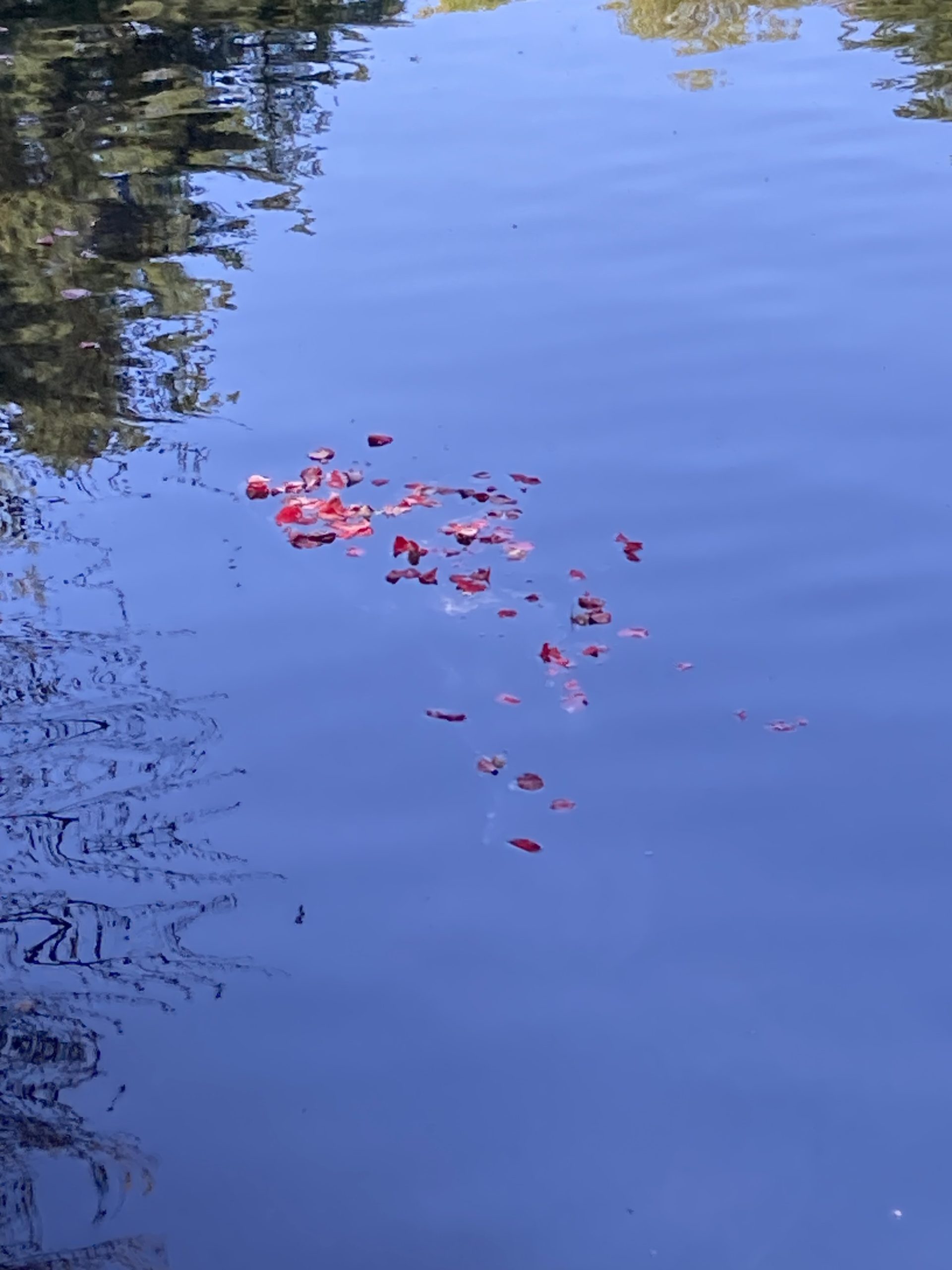
I was asked to deliver readings for the event. I was happy to do it; the challenge was finding something right for him, in his spirit. We scattered his ashes over Milk Lake, the small lake he loved where we had a cottage and I spent many weekends of my childhood. There, I chose a reading from Dnyaneshwar: a medieval poet-saint from Jayant’s home state of Maharashtra, whose devotional (bhakti) poetry was foundational for Jayant’s native Marathi language in the way that Dante was for Italian or Shakespeare for English. (“Dnyaneshwar” is the phonetic spelling of his name in modern Marathi; it means “lord of knowledge” and in Sanskrit would be transliterated “Jñāneśvara”. For English-speakers it can roughly be pronounced “nyah-NAY-shwar”.) Jayant grew up with Dnyaneshwar and came to write about him more as an adult. I found a beautiful passage from Dnyaneshwar’s main work, a commentary on the Bhagavad Gītā, which felt like it had the right feeling for scattering ashes on the water:
Birth, life, and dissolution follow one another in eternal progression, like the ceaseless flow of the river Ganges…. What is born dies, and what dies is born again. Like the wheels of a water clock, this cycle continues. Just as sunrise and sunset follow each other, in this world birth and death are certain. At the time of the great dissolution, even the three worlds perish, so birth and death are inevitable. (on Gītā II.26-27)
The trick in my mind was that, despite the beauty of the language and the sentiment, its content is not something Jayant would actually have believed. He admired Dnyaneshwar’s ideas as an adult and wrote about them because he thought that the final chapter of Dnyaneshwar’s commentary was something modern in the best sense, a reflection on society in a way that would lead to changing it for the better. But he didn’t believe that the dead would be reborn, or that there would be a great dissolution of the cosmos where it would be reborn. He had a great respect for old tradition, but in a naturalized way. When asked his religion, he would say “I believe in the divinity of human beings.” He performed a daily pūjā ritual lighting a candle for the family gods (especially Ganesh). I asked him to describe in his own words what he was doing when he did that, and he said, “I believe in the divinity of human beings.”
So when I did another reading at the memorial service proper, I wanted to balance that reading with something that would have been in the spirit of Jayant’s own deepest ideals. That was much trickier for a committed Marxist; Marxists don’t write a lot about death and its significance. It would not have fit to read the famous words inscribed on Marx’s own gravestone – “The philosophers have only interpreted the world, in various ways; the point, however, is to change it” – for Jayant remained a thinker rather than an activist, someone personally far more passionate about interpreting the world than about changing it, even if the hope was that the interpretation would someday serve the change.
What I read in the end was a selection from Ernst Bloch, a German Marxist philosopher whom Jayant had admired. From the introduction to Bloch’s The Principle of Hope, the passage approached death in the context of inspiration and aspiration for a better world. This is what I read:
As attempts to become like proper human beings, the various moral guiding images appear, and the so often antithetical guiding panels of the right life. The fictional figures of human venturing beyond the limits then appear: Don Giovanni, Odysseus, Faust, the last precisely on the way to the perfect moment, in utopia which thoroughly experiences the world; Don Quixote warns and demands, in dream-monomania, dream-depth. As call and pull of very immediate, very far-striking lines of expression, music emerges, the art of strongest intensity distilled into song and sound, of the utopian Humanum in the world. And then: the images of hope against death are gathered, against this hardest counterblow to utopia; death is therefore its unforgettable awakener. It is especially a circulation of that Nothing which is devoured into being by the utopian pull; there is no becoming and no victory into which the annihilation of what is bad is not actively devoured. All the glad tidings which constitute the imagination of religion culminate mythically, against death and fate, both the completely illusory tidings and those with a humane core, ultimately related to deliverance from evil, to freedom towards the “kingdom”.
As you will no doubt have noticed, the trouble with this passage is that it is very difficult. I don’t claim to fully understand it myself! So I’m not sure anyone else in the room did either. But I knew that was an issue; the reason I still used it was that that fact too was in Jayant’s spirit. In order to get a fuller sense of the whole, Jayant sought intellectual challenges, looking for inspiration to difficult German philosophers like Hegel and Habermas – and Bloch. I once compared the process of understanding those thinkers (in an image he appreciated) to cutting up a hologram: whereas cut-up pieces of a photograph show you fully vivid parts of the original, pieces of a hologram instead give you a blurrier picture of the whole. Many people at the service remembered how Jayant had thought at a very high level but never talked down to anyone, seeking to engage them and help them understand what was difficult.
And so I sought to honour him with this passage that I think he would have fully agreed with – one that sets death, and “religion”, in the context of hope and aspiration for a better world in the future. For Marxism is about nothing if not hope. In the passage Bloch tells us that because death is an ending, it reminds us that what exists now is not something fixed or permanent; death, like the quest for utopia, devours the present and throws us into the future. So Jayant sought the “humane core” in “religious” thinkers like Dnyaneshwar, their quest to move society forward. Bloch, for his part, cites Western heroes – Faust, Odysseus – as examples of dreamers who looked beyond what is merely given, “ventured beyond the limits”. They were “images of hope against death” because they were not content with what was, but instead sought what could be. I remember my father as just such a hero.
Amod, this is lovely. A fitting commentary on our moving celebration.
Thank you.
Dorothy
Interesting—it doesn’t sound like your father was very influenced by Buddhism? I know you’ve told your story before about how you discovered Buddhism on your own in Thailand.
Lately I’ve been having a bit of a personal rapprochement with the concept of hope after having deprecated it for a couple of decades under the influence of Buddhism. For example, there’s a chapter in Thich Nhat Hanh’s Peace Is Every Step titled “Hope as an obstacle”:
Other Buddhist teachers have made similar statements.
A couple of years ago I read Hakuin’s commentary on the Heart Sutra, which includes the line, in someone’s translation: “Even if the cosmos is destroyed, my hope is endless.” That’s quite a mindset: a hope that is endless even when facing the total destruction of the universe. That kind of hope seems perfectly compatible with the usual Buddhist warnings against hope. Actually we don’t know whether everything will be destroyed very soon or later. So our hope has to be complex and robust enough to be ready for anything.
You’re right to bring up Buddhism; it was indeed a smaller influence on him, though the influence was there. It was really my mother who had found Buddhism, through SN Goenka’s vipassanā retreats. He went along and found value in them, but didn’t integrate them into his thought the same way – though he might have if he’d kept his faculties for longer. He did have the first verse of the Dhammapāda – in Pali and English – posted on his office wall, and near the end of his life he was working on a paper on the way Dnyaneshwar had taken Ganesh’s broken tusk as a symbol of Buddhism and emptiness.
And thanks very much for the remarks on hope. One of my teachers long ago talked about of Buddhism as a “critique of hope”. I have tended to think of it along that line, writing a post with that title a very long time ago – though looking back on it much later, I’m reminded how ambiguous I was about the point even then. So it’s helpful to get these more nuanced reminders about ways hope of some sort can have a place within a Buddhist worldview.
Pingback: On being from Canada (and not India) | Love of All Wisdom