
Tags
Caitlyn Jenner, expressive individualism, gender, Ibram X. Kendi, identity, John Stuart Mill, race, Rachel Dolezal, Rebecca Tuvel
The bullying campaign to cancel Rebecca Tuvel’s defence of transracialism was shoddy and shameful. There was no merit in it at all. Whether or not you think Tuvel’s argument for transracialism succeeds, that part seems to me pretty obvious. But it does raise the next question, to which the answers are less obvious: does Tuvel’s argument work? Does the logic of accepting transgender identity imply accepting transracial identity?
You could not have got me to answer that question (in public) back in 2017, while Tuvel was still being actively persecuted. For a while, that bullying campaign and others like it successfully achieved their goal of terror: they succeeded in getting me, and others like me, to silence our dissenting views out of fear of the consequences that were so regularly experienced by others.
But the climate has changed a lot since then, in ways that make it still harder to speak on some issues (like Israel and Palestine), but easier to speak on this one. So I am going to take a risk now, stick my head up, bite the bullet, and answer the question: yes!
Personally speaking: for the first forty years of my life I was never offered the option to be female… and neither was I offered the option to be white. Logically, it would make far more sense to offer me the latter than the former, given that race has considerably less biological reality than sex, and that insofar as either concept does mean anything biologically, I am biologically half white but not half female. But instead, what I am offered is the former: I am offered the option to be female when I want to be.
I am not complaining about that one bit; I am delighted by the opportunity! But the opportunity to be treated as female does foreground the fact that I’m not offered the opportunity to be treated as white – even though, in terms of ancestry, I already am every bit as white as Kamala Harris is black. I would like to be treated just as white people are treated – and in many parts of my life I have been. But the exceptions do stand out: people do look at my skin and insist that I am different from white people, and it is those occasions that have constituted the microaggressions – and the macroaggressions.
So I’m deeply sympathetic to Tuvel’s defence of transracialism: for me it’s more than “just asking questions” (as valid as that activity is); it’s personally meaningful. And I also think it stands up well as a logical argument.
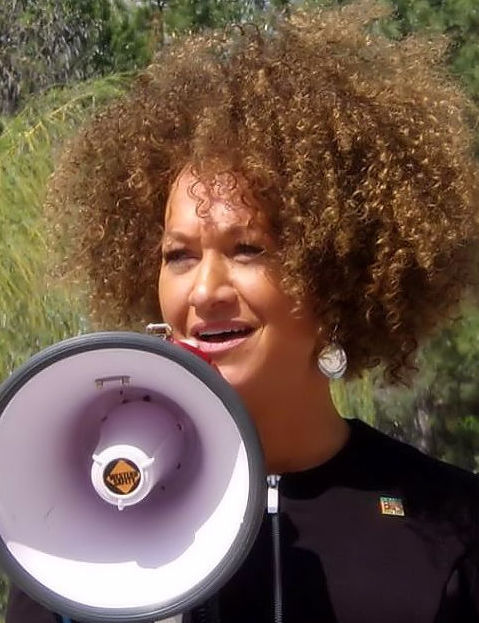
The shortest way to put Tuvel’s main claim, in terms of the pop-cultural icons she discusses, would be: if Caitlyn Jenner, then Rachel Dolezal. (Jenner being probably the most famous transwoman, Dolezal an example of a woman with “white” ancestry who called herself “black”.)
Now in discussing the implications of that claim, as with so many “if A, then B” claims, it helps to deploy the philosopher’s logical distinction between arguments modus ponens and modus tollens: a modus ponens argument is “if A then B, and A, therefore B”, whereas modus tollens is “if A then B, but not B, therefore not A”. Tuvel’s foes, I think, are terrified of her claim because they worry about it being applied as a tollens: “if Caitlyn Jenner is allowed then Rachel Dolezal is allowed, but Rachel Dolezal must not be allowed, therefore Caitlyn Jenner must not be allowed either.” But it is crucially important that Tuvel rightly applies the claim in the opposite direction, as a ponens: “if Caitlyn Jenner is allowed then Rachel Dolezal is allowed, and Caitlyn Jenner is allowed, therefore Rachel Dolezal is allowed.“
While I disagree with the modus tollens alternative – that transracial identity is suspect and therefore transgender identity should be too – even that alternative is not absurd. It is common in racial thought these days to say people of marginalized races should celebrate their biologically given racial identity. I disagree completely with that perspective. But if one were to take that perspective on race – often associated with Ibram X. Kendi – then it would make logical sense to take it on gender too. And if you want confirmation of that point, take it from none other than Kendi himself, where he says, in this video:
Talking about race, even talking about gender. I think it was last week my daughter came home and said she wanted to be a boy. Which was horrifying, for my wife to hear, for myself to hear, and of course, y’know, we’re like “okay, what affirmative messages about girlhood y’know can we be teaching her to protect her from whatever she’s hearing in our home, or even outside of our home, that would make her want to be a boy.”
To reiterate, it is Kendi, not Tuvel, who took up the transracialism equivalency in an anti-transgender direction. He thinks people should identify with the races assigned to them at birth – and therefore likewise with the genders. If you think anyone deserves cancellation for advocating that position (which I absolutely do not), you should be cancelling Kendi and not Tuvel.
But Kendi’s point is telling and importnat because it reveals a deeper contradiction in the Social Justice movement’s underlying philosophy, which is expressive individualist when it comes to gender yet essentialist when it comes to race: don’t let your biological sex determine who you are, but do let the colour of your skin determine it! I am allowed to wear all the girly shit I want, but God help me if I try to wear dreadlocks or hang a dream catcher. I am culturally appropriating everything feminine, and somehow that gets encouraged while racial cultures are newly expected to self-segregate in a way that they were not before.
For all my overall disdain for Kendi and his embarrassingly weak arguments, I’ll grant that his anti-trans position at least gives him more consistency than is common in the movement. Tuvel and I take a consistent expressive individualist position, which Tuvel appropriately grounds in John Stuart Mill’s On Liberty: the general principle is that biology should not define our identity. A position like Kendi’s, on which it’s “horrifying” to hear someone reject their gender or their race, is at odds with that, and accordingly we reject it – but it is at least consistent on its own essentialist and collectivist grounds.
There are some reasonable objections one could have to transracialism, but in the end I don’t think they stand. I’ll take that point up next time.
I think I understand transgender identity, as when a band wrote and recorded Lola. The band was The Kinks, and “Lola” preceded surgical/hormonal sex change by several years, if not decades: “…girls will be boys and boys will be girls, it’s a mixed up, muddled up, shook up world”…, etc. Maybe The Kinks were prescient, but I doubt that. On the other hand, the term, transracial, seems a bridge too far, if, and only if, it connotes what it sounds like. I’m probably completely in the dark on this. Am probably content to remain in that darkness. Oh, well. My choice. Grandchildren have their parents for counsel and guidance—their job, not mine.
Yes, I do think “Lola” was about someone who would now be considered transgender – less because the Kinks were specially prescient and more because there have always been people who have crossed established gender boundaries. So too, people have always crossed racial boundaries ever since those have been set – and I think both of these kinds of crossings should be encouraged.
Pingback: Answering objections to transracialism | Love of All Wisdom