
Tags
Alasdair MacIntyre, autobiography, conservatism, Hans-Georg Gadamer, Jayant Lele, Jürgen Habermas, Karl Marx, Ken Wilber, obituary, Singapore
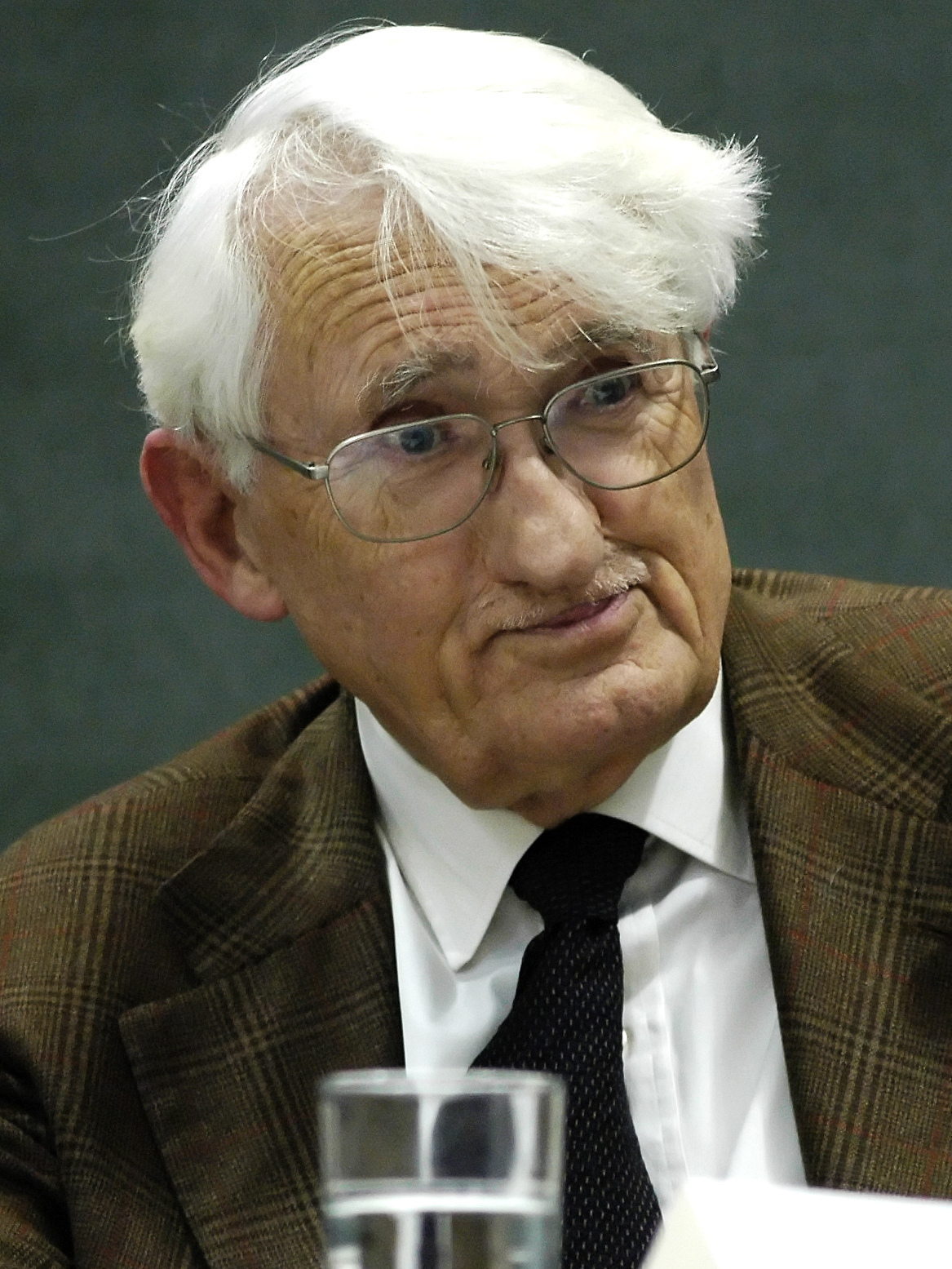
It’s not often that a philosopher makes the top entry of Wikipedia’s “In the news” page – I don’t recall that ever happening before – but that happened last week with the death of Jürgen Habermas. I think that status is well earned. Habermas was one of the few philosophers to earn respect from both the analytic and “continental” sides of the philosophical tradition, engaging in reciprocated debate with both John Rawls and Jacques Derrida. We might even say that his death marks the end of the great era of German philosophy, an era that begins with Immanuel Kant – for while through his early life there were other major German figures leaving an impact on philosophy, he was really the last remaining German philosopher to have made such a significant mark. I think the only later philosopher of arguably comparable stature who is carrying on the German philosophical tradition is Slavoj Žižek – who is not himself German but Slovenian.
There are plenty of obituaries appropriately reviewing Habermas’s overall contributions. But for me personally, Habermas’s death brings me back to an earlier time of my life, and makes me think of roads not taken.
A long time ago, I expected Habermas to leave a big mark on my own thinking; he certainly had on my late father’s. Probably Habermas’s most significant contribution was to probe deeply into the connection between philosophy and the social sciences, in a way deeply influenced by Marx but also going beyond him. And my own first two degrees were in the social sciences, though it was philosophy that caught my attention and excitement; as I went through my master’s degree in development sociology, I came to see that cross-cultural philosophy was where my heart was really at. And Habermas helped me make that pivot.
I wrote a master’s thesis examining how Asian philosophical traditions were being taken up politically by modern governments: comparing Hindu nationalism in India with the Singapore government’s attempt to deploy Confucianism politically. My father pointed me to Habermas’s theory of legitimation crisis, which helped me pull it all together. Briefly, Habermas thinks that since modern states have lost the premodern traditional justifications of their legitimacy, they need to make themselves appear legitimate by providing materially for their populations – which produces a crisis as it gets more expensive to do so. I argued in turn that the Indian and Singaporean governments were trying to deploy Hinduism and Confucianism as an attempt to make themselves appear legitimate after that crisis, in a way that attempted to return to older tradition.
I began my PhD exploring cross-cultural philosophy right after that, and I think I expected Habermas would play a big role. His thought left a major mark not only on my father but on Ken Wilber, who was one of the few thinkers bold enough to attempt to build a philosophical system cross-culturally. Habermas seemed like the kind of thinker that I would come back to regularly.
Yet that didn’t happen. In the past quarter-century I haven’t personally found the occasion to think with or about Habermas very much. And I think the biggest reason was a course I took at the beginning of my PhD with Francis Fiorenza – also recently deceased – on hermeneutics. For that was when I read Habermas’s debate with another relatively recent giant of German philosophy: Hans-Georg Gadamer.
I expected to come out on Habermas’s side of the debate. Where Habermas emphasized critique and Marxist-leaning suspicion, Gadamer sought to rehabilitate the concepts of tradition, authority, even prejudice. Such conservative-sounding concepts felt anathema to my left-wing self; Habermas seemed like the clear good guy. Yet as I actually read the debate and wrote a short paper about it, I found myself instead siding with Gadamer.
Central to the Habermas-Gadamer debate was the concept of tradition: what is handed down culturally from generation to generation. Following the suspicions that we left-wingers have about the conservatism of traditions handed down to us, Habermas wants to be able to reject tradition as “systematically distorted”, moving to a “meta-hermeneutic” state that goes beyond it. But I realized that Gadamer is right to say that isn’t possible: even our critiques themselves are constituted by tradition, made possible by what we have learned from it.
Gadamer’s insights here are very close to those of Alasdair MacIntyre – who, in turn, helped turn me away from the Habermas-influenced Wilber. MacIntyre recognizes that Wilber’s attempt to build a universal philosophical system is too glib and naïve, it papers over the differences between traditions. Crucially, MacIntyre and Gadamer would agree, tradition always informs our inquiry even when we do something new that attempts to break with tradition: “innovation in enquiry almost always involves drawing upon the materials afforded by traditions and self-definition in terms of those traditions. So it was with Descartes, in spite of his protestations to the contrary, as Gilson showed; so it was with Marx, as he himself would willingly have agreed.” I have plenty of differences with MacIntyre, but I think that on this point he and Gadamer are right and Wilber and Habermas wrong: even our attempts to reject tradition are themselves constituted by tradition in a significant way, we cannot reach a tradition-independent stance.
So, the philosophical road I took wound up taking me far from Habermas. He did not leave the mark on me that I once expected he would. But given the number of powerful thinkers who took him seriously, it’s clear there is a lot to reckon with in Habermas’s thought. His road is one I might yet return to someday.
Thanks for this reflection. I’ve read other thinkers who comment on or cite Habermas, and I’ve read reviews of some of his books, and encyclopedic summaries, etc., but I never read him. Your discussion of Habermas versus Gadamer & MacIntyre, none of whom I’ve felt inclined to study directly, suggests to me that the reason for my disinterest in all of them is my perception (right or wrong) that they overemphasize discourse, summarized in the term “discourse ethics” associated with Habermas; even the “traditions” emphasized by Gadamer & MacIntyre are traditions of discourse. Discourse is important but, I think, needs to be considered within a bigger framework and shouldn’t itself be taken as the biggest framework. It’s when we start analyzing outside of a purely discursive framework that we see that traditions aren’t necessarily as important as Gadamer & MacIntyre thought (unless we want them to be). This has generally been better understood in some other academic disciplines (e.g. anthropology and geography, though even there some thinkers understand it better than others) than in academic philosophy, I guess.
“Discourse” proper as a term is mainly in Habermas and Foucault, and isn’t one I haven’t found particularly helpful. But that becomes very different when the analysis is extended to “tradition” – which is also primarily about that which is done in language but it isn’t only that, it can also include embodied practices (at least in MacIntyre’s handling, though I agree he can equivocate on that). I don’t think traditions are as strictly bounded as MacIntyre often tends to imply, but I do think the concept is important for addressing pretty much every discipline, as a meta-disciplinary vocabulary. It’s Kuhn and Lakatos (aided by the Duhem-Quine thesis) who do the theoretical legwork underlying that – Kuhn sometimes uses “tradition” interchangeably with “paradigm”, and Lakatos’s “research programme” is more or less the same idea.
Thanks, that’s helpful. It reminds me of a paper I came across a few years ago (and had forgotten about until now) that was published ten years ago; I don’t know how much the study of traditions has advanced since then: James Alexander, “A systematic theory of tradition”, Journal of the Philosophy of History, 10(1), 2016, 1–28:
The continuity element of Alexander’s theory is not necessarily discursive, just a repetition of a pattern. But, interestingly, when discussing the emergence of writing in his section on continuity, Alexander quotes a passage from Gadamer’s Truth and Method that says “tradition is essentially verbal”, which corroborates my impression about Gadamer.
Yeah, I generally agree with this: “tradition” can mean different things and be used for different purposes within different theoretical systems (aka different traditions!) And I think you’re probably right to call out Gadamer’s specific approach (along with Habermas’s) as being too verbally oriented; Gadamer, like the postmodernists, followed the language-obsessed Heidegger.
I hadn’t really thought in these terms before, but this may be a place where MacIntyre’s approach is more robust than Gadamer’s: while he equivocates more than I’d like him to, MacIntyre does indicate that traditions includes embodied practices of the sort we usually associate with “tradition”. I don’t think Kuhn and Lakatos are explicit about it but I think their theories at least accommodate the same insight: there are procedures within paradigms for the way you do biology or physics, and while that’s primarily about the way you interpret the results linguistically, I think it can also include the way you conduct your experiments and observations.
Regarding your last sentence, that’s very explicit in Ian Hacking’s writings on history and philosophy of science, although I don’t think of him as a theorist of tradition.