
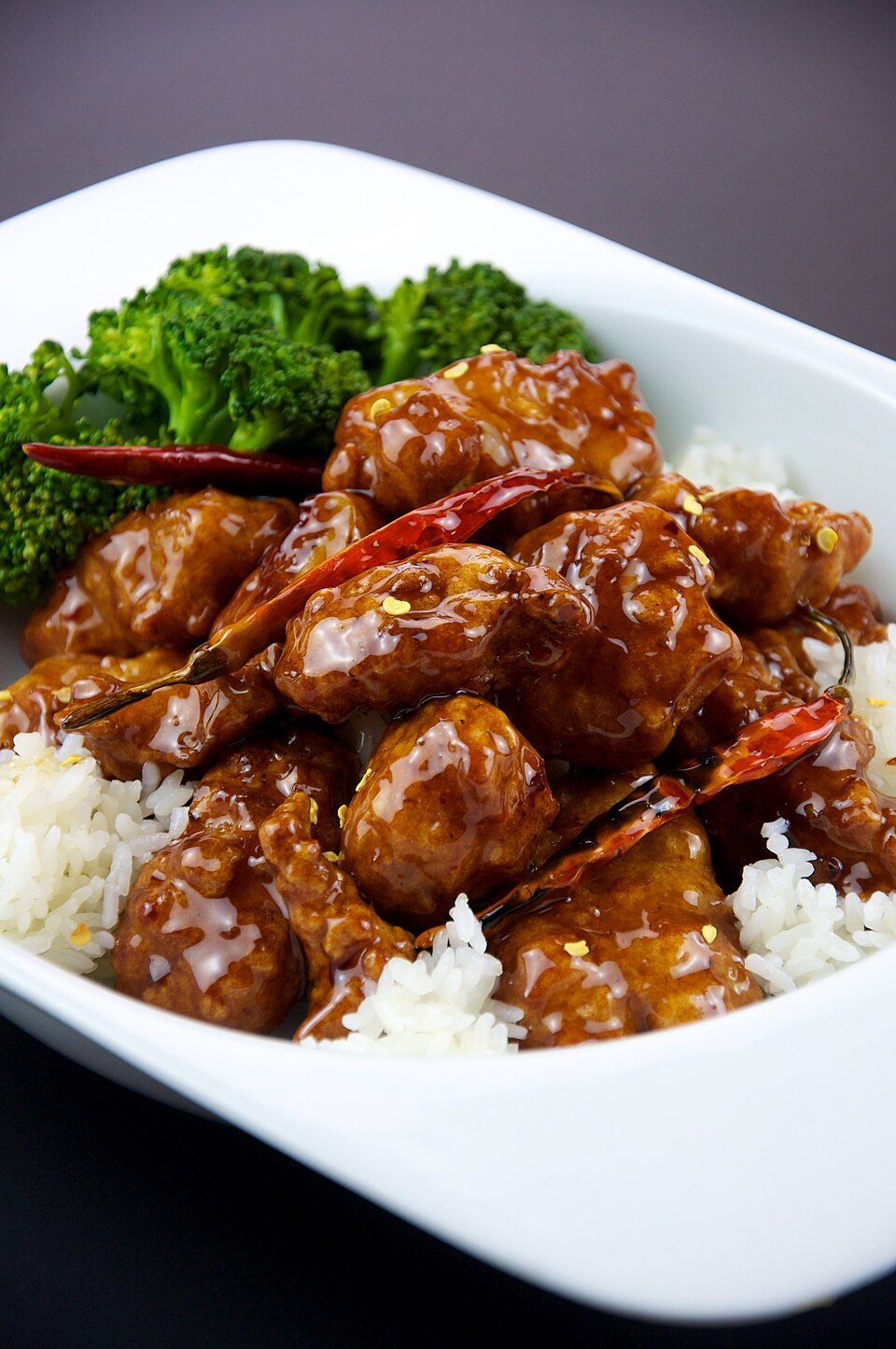
For longer than I’ve been alive, restaurants in North America that call themselves “Chinese” have typically served dishes that would not be recognized in China: chop suey, sweet and sour pork. This North American Chinese food is not one of my favourite cuisines, but I am fond of one of its unhealthier highlights: General Tso’s chicken, chicken deep-fried to a crisp then covered in a sweet and spicy sauce.
In the past two decades there have been a number of essays and articles explaining the history of General Tso’s chicken: how it began with a Hunan-American chef who wanted to make a new dish reminiscent of Hunan court cuisine, which had neither the crisp batter nor the sauce’s sweetness, but then quickly got taken up by other American chefs into something that delighted the American public and became taken up as a typically Hunan dish even though it was nothing of the sort. Perhaps most strikingly, according to one such article, “General Tso’s chicken is now being adopted as a ‘traditional’ dish by some influential chefs and food writers in Hunan”: some people back in Hunan now claim the dish as theirs.
And what this all reminds me of is a significant metaphor used in the study of Indian religions.
In 1970, before I was born, anthropologist Agehananda Bharati tellingly used a food metaphor to articulate his critique of modern Indian tradition. He observed a “process of re-enculturation” where Western concepts entered Indian culture, and referred to this process as the pizza-effect:
The original pizza was a simple, hot-baked bread without any trimmings, the staple of the Calabrian and Sicilian contadini from whom well over 90% of all Italo-Americans descend. After World War I, a highly elaborated dish, the U.S. pizza of many sizes, flavors, and hues, made its way back to Italy with visiting kinsfolk from America. The term and the object have acquired a new meaning and a new status, as well as many new tastes in the land of its origin, not only in the south, but throughout the length and width of Italy. (273n19)
For Bharati, the “Hindu Renaissance” of 19th-century India, which shaped contemporary understandings of Hinduism (including the coinage of the word “Hinduism” itself), followed the pattern of the pizza-effect: perhaps most significantly in the prominence it gave to the Bhagavad Gītā.
Indians and sympathetic occidentals alike have come to regard the Bhagavadgītā as the Hindu Bible. No challenge against this notion has ever emerged from the spokesmen of the Renaissance, yet this claim is not part of an informed view about Hindu lore…. But the informed Hindu must contest the Bhagavadgita’s Renaissance status: it is not canonical like the Vedas or the Upanisads; it is smrti, belonging to a category of texts the acceptance of which is not incumbent on the Hindu. The leaders of the Renaissance have blurred this distinction. (274)
Just as Italians gave American idea of pizza a “new meaning and new status” in a way that displaced their traditional concepts of pizza, so modern Hindus gave the Gītā a high status that it would not have had on an “informed view”.
Bharati’s view was commonplace in the late 20th-century academy, up to the first years of the 21st when I entered grad school. An “informed view” told us that, contrary to what modern Hindus might believe, the Gītā wasn’t their real sacred text; they’d been misled by reform movements that misrepresented the tradition.
That view was a commonplace for a reason: Bharati was right that modern Hinduism was something very different from the traditions that preceded it. But the question Bharati never seemed to ask was: so must that be a bad thing?
After all, while the United Kingdom’s political system maintains a continuity with its past in the way the French or American systems do not, it’s clearly not the same system it was in 1500 – and few if any would deny that this newness is a good thing. Almost nobody wants to return the government of England to what it was in 1500. We’ve learned some things in the ensuing centuries, we made some changes, and that’s good. Couldn’t the same also be true of modern Hinduism? I’m going to take the daring step of insisting that a flatbread with tomato sauce and cheese on it tastes better than a plain one. Modern pizza, whether eaten in Italy or the USA or somewhere else, is an improvement on baked bread with no trimmings. No wonder Italians embraced it as their own.
The real and reasonable objection behind Bharati’s view is that it is a misrepresentation to view modern Hinduism as basically the same thing as was present in medieval times, let alone in the beef-loving Vedas. That much is true and fair, and I can hardly object to it. After all, I’ve spent plenty of time arguing what an innovation Engaged Buddhism is. I think the point is important because the premodern Disengaged Buddhists have so much wisdom to teach us, wisdom that gets lost when we treat it as just reflecting the modern Engaged view. I agree with Bharati on that much. I just don’t think it means the modern movement is wrong, it just needs to be aware of itself.
And that brings me back to General Tso’s chicken. Food is a place where we are often most strongly drawn to that strange concept of authenticity. Authenticity can be a strange thing to value, since so often what it means is the absence of choice. Yet value it we do. In a consumer-capitalist era where we are so often pandered to – most recently by sycophantic AI – we often hunger for the “real thing”, the thing that wasn’t made for us.
But what then is the real thing? What is authentically what? When I visited Sri Lanka, I was startled to find that in Sri Lanka, mutton rolls and devil chicken – my favourite dishes in Sri Lankan restaurants abroad – are considered Chinese food. You’d never find them in China, but to Sri Lankans they are Chinese, just as General Tso’s chicken or chop suey are to most Americans. Whereas over here we consider these “Chinese” foods as delicious authentic Sri Lankan dishes – which makes sense, since the only place you’ll find them outside of Sri Lanka are in Sri Lankan restaurants!
And so likewise that is probably the best way to think of General Tso’s chicken – as American cuisine. I would personally much rather eat at a place serving soup dumplings and dan dan noodles – food that people eat in China – than one serving General Tso’s chicken. But if General Tso’s chicken is on the menu, I’m not going to judge the place a pale imitation of real Chinese food (as I might do with a Thai restaurant that leaves out the chile peppers!) Rather, I recognize that it’s serving a Chinese-American dish, where Chinese-American food is a part of American cuisine as Chinese-Sri Lankan food is a part of Sri Lankan cuisine (or Chinese-Peruvian food is a part of Peruvian cuisine), and judge it on its own terms. (Similarly, I expect an Indian restaurant is much more likely to serve authentic Indian food if it refers to some of its “Chinese” dishes as “Schezwan” – because that is the authentically Indian misspelling of “Szechuan”, the one you’ll see across India.)
So also, when I was recently reading the great Zen popularizer D.T. Suzuki, I was brought back to General Tso! Because in Suzuki I saw a lot of the kind of conceptions about Buddhism I have spent a quarter century arguing against – like affirming interdependence. I have thought of these as misconceptions, because they don’t reflect the Buddha’s teaching or what Buddhism was like in its original context; in that sense, they are not authentic Buddhism. Yet in recent years I’ve also come to see ways that East Asian styles of Buddhism, especially meditation, can be better at attaining Buddhist goals than Indian ones. Like American or Sri Lankan Chinese food, East Asian Buddhism has its own history, with its own valuable results. So it’s better to take Suzuki – and his profound contemporaries the Kyoto School – on their own terms.
There was little present-moment mindfulness in traditional Indian Buddhism, but it was there in premodern Tibet. Is that authentic? And how much does that even matter? I think it’s important not to misrepresent history – we shouldn’t say that General Tso’s chicken actually originated in China, or that the historical Buddha thought we should embrace interdependence. But it turns out the historical Buddha (as we know him) was wrong about a lot of things (like gender). It’s good to come up with things that are new.