
Tags
Desiderata, H.P. Lovecraft, Johannes Kepler, Meister Eckhart, music, natural environment, Simone Weil
The early 17th century, the time of Galileo, was a golden age for astronomy. One of its leading figures was the German Johannes Kepler, who made successful mathematical models of the planets’ orbit around the sun. Kepler also reacted strongly against something we now take for granted: the idea that the universe is infinite, with many solar systems rather than everything orbitting the sun. Kepler thought that the evidence didn’t support an infinite universe, and he was very grateful for that. For when Kepler thought of an infinite universe he said:
This very cogitation carries with it I don’t know what secret, hidden horror; indeed one finds oneself wandering in this immensity, to which are denied limits and center and therefore also all determinate places. (from De stella nova)
And here’s the thing: Kepler was right to be horrified.
Like his contemporaries and his medieval predecessors, Kepler took for granted that the world was the orderly product of an omnibenevolent, omnipotent God. That is a powerfully comforting and appealing vision of the world. It allows you to think, with the Desiderata, that “whether or not it is clear to you, no doubt the universe is unfolding as it should.” It can feel touching to read thinkers like Meister Eckhart, a couple hundred years before, deducing the world’s nature from the book of Genesis. (In interpreting “God created heaven and earth”, Eckhart says “heaven” stands for rational form and “earth” for the matter on which it is imposed.) They hadn’t seen the kind of evidence that Kepler’s contemporaries were just beginning to see: evidence that needs no God to explain the world anywhere.
In Kepler’s case, he was well aware that the Earth was full of manifest imperfection and chaos – from asymmetrical protuberances through to diseases and famines. But he found his comfort in the skies: “the heavens, the first of God’s works, were laid out much more beautifully than the remaining small and common things.” (quoted in Field 1988: 97) They followed an order so rational they corresponded to music: when he had accurately calculated the orbits of the planets, he noticed that their orbital speeds approximated a harmonic proportion. Even the disharmony of the Earth itself followed logically from its orbit, corresponding to a semitone: “The Earth sings Mi, Fa, Mi: you may infer even from the syllables that in this our home misery and famine hold sway.”
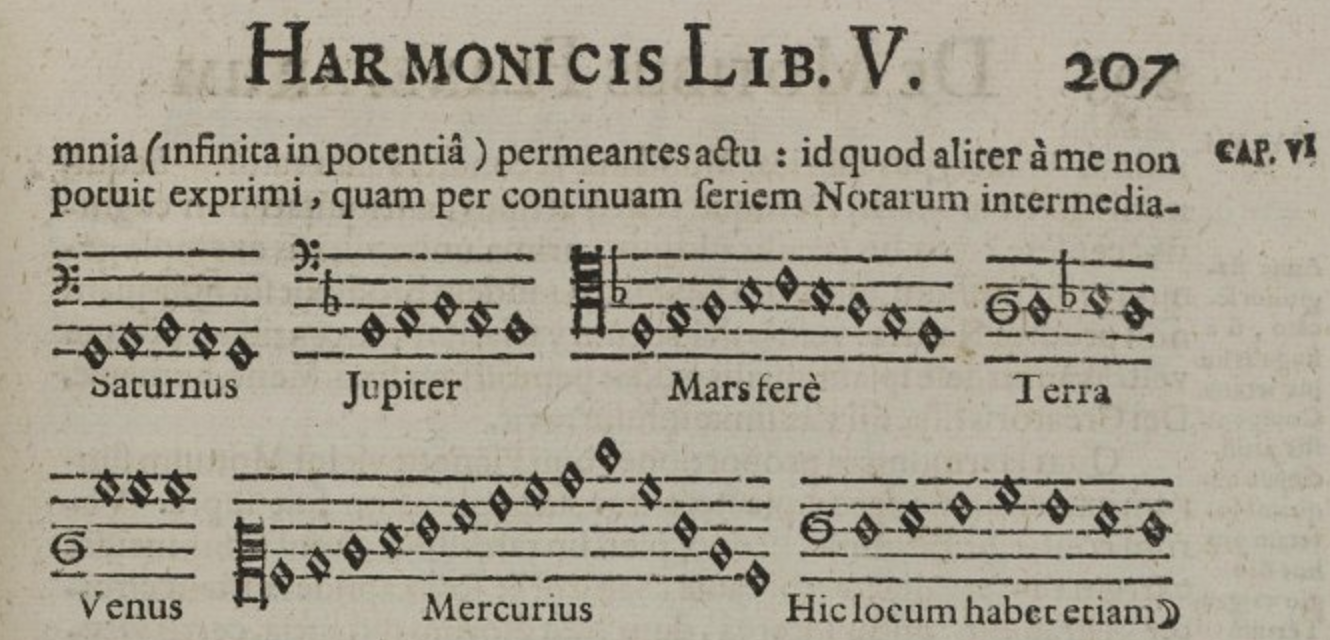
We know now that none of this proved to be true. The planets’ correspondences with harmonic proportions were merely approximate – and the universe indeed turned out to be infinite, following no such order. Centuries later, even what seemed the most obvious example of God’s intervention in the world – the way that organisms were so well suited to their environments – would turn out to be better explained as evolutionary adaptations to random chance.
And so there is a direct path, it seems to me, from Kepler to H.P. Lovecraft’s works. Kepler, I think, saw that the infinite universe would be one without God’s plan behind it, which is why it rightly filled him with a “secret, hidden horror” – the same horror that Lovecraft expresses in his stories, where the knowledge of the universe’s true nature drives people mad. One can reasonably argue that Lovecraft’s vision doesn’t have the same punch for people who never expected the universe to make sense – but it is pretty horrific for people like Kepler and Eckhart who did. It would be really nice to believe that everything in the world is part of a benevolent god’s plan – and it’s a wrenching shock to find out that it isn’t.
Indeed I think Kepler’s clinging to a divine plan remains with us in the utopian instinct – the one that, in the words of the French philosopher Simone Weil, seeks an “absolute good” in a utopian future. That, it seems to me, is to neglect the darkest lesson of cosmology: that no matter what we do, human life will come to an end, not in a heaven or other utopia, but in simple nonexistence.
There is still great beauty to be found in the stars, of course. Recent images from the James Webb Space Telescope are truly dazzling. But they are not orderly in the way Kepler imagined; the heavens follow no more plan or logic than do the things of Earth. The stars are sublime, if anything is: they fill us with awe as they show us our smallness. In my view, the sublime is one powerful kind of beauty. (Lovecraft’s error, indeed, may have been to associate the sublime with ugliness.) But Kepler and his predecessors had imagined something higher: an orderly kind of beauty, following symmetry and proportion, and planned by a benevolent God. The very concept of the sublime emerges as people try to understand their feelings of awe toward worldly phenomena that aren’t in rational order. The Pillars of Creation are pretty amazing. But they give us no evidence of a creator.
It seems to me that there has been a fundamental difference in people who can and cannot accept that life has an end. There seem to be varying degrees of acceptance of that fact and varying stories I have heard that keep folks short of fully accepting that fact. I think that it is not until full acceptance that one is most fully able to see life and our story-telling ability for what it is.
That brings up the “stories” we accept blindly or unquestioningly or consciously tell ourselves. We cannot escape the need and built-in necessity to imagine life and our experience as a story.
The definition of a story can be – a connected sequence of real or imagined events that moves toward a conclusion. (We can debate the point of a story or simple image sequence some other time.)
There are those in the neuroscience world who say that our “right brain” creates a story from our somatic experience and our “left brain” wants to be presented with a story that makes sense from our “right brain”. Our “left brain” constantly filters the stories our “right brain” is constantly constructing. Some have said our remembered dreams are a small window into that story generating function.
Admittedly the right-ness and left-ness of that former statement is anatomically incorrect, but represent functions that are built into us all. It also overly simplifies the situation in our brain. A story means one thing if we use the definition above. Probably more correctly is that the “right brain” creates an image sequence that the “left brain” needs to have “make sense”. The interaction between these functions is likely very iterative and complicated and may be different whether we are “conscious” or “unconscious” in all their forms.
Regardless a “story” is what we first come up with as we organize and make sense of our experience. Immediately we compare that story with what we perceive as reality or other previous experience. A story that does not comport with what we construct as reality is catalogued as a nice “story” not found in objective reality.
A major modifier that come in this interaction is what we “believe”. This appears have a highly variable influence on what we conceive as reality and how that perception of reality accepts the story we instinctively produce. Our beliefs can also allow more acceptance of the story as real.
Such complexities of how we are built to perceive ourself and environment and then create a sense of the realities of ourselves and what is outside our corporeal self means that no one person can completely be free of the function of making stories of our experience, the whole history of scientists like Kepler, much less any of us.
I think that’s right: we need stories to make sense of our existence. The tricky part is that we often think of ourselves as part of a “never-ending story” – or as one with a happy ending. The traditional Christian messianism, “his kingdom will have no end”, is sort of a combination of the two – as is the utopianism of Marxism and related views, where there will be a future just society that fixes our problems. It turns out that that’s not how the story works – the story of humanity will end someday, and it will end with human extinction. We have every reason to delay that end as much as we can – there’s a big difference between going extinct a billion years from now because of astronomical events, and going extinct in a few decades from an AI causing nuclear holocaust! (For example.) But one way or another we do have to be at peace with the human story one day ending in a lifeless void.
Well. Certainly, reality is at once beautiful and gruesome. Folks who have weakness of mind such as belief and superstition find their lives tossed into fear and ignorance. They tend to eschew notions of enlightenment as evidence of debauchery and self-indulgence.
They dream no impossible dreams, for those are only fantasies and vain imaginings. Lost in their weaknesses, they have no pathway to strength.
Artists, playwrights, writers and other creative people tend towards mental imbalances
of one degree or another. Ordinary persons may likewise go a bit crazy, though we must think that different to those others: perhaps they lose their sensibility due to boredom, rather than excessive stimulation: one person’s rest is another’s restlessness. Genius
is more burdensome than ordinary folks think.
If you are correct about my alleged “weakness of mind,” then determinism must also be true (as cause and effect are relentless, while so-called “compatiblism” is merely determinism in a nicer suit). Yet, I’ve never met anybody who lives as if determinism were true. Indeed, everything about my life suggests that volition is a real thing. Despite many outside influences and my priors, I decide what to have for lunch, who to vote for, and what I believe to be true. Moreover, you write this essay as if we readers might be convinced of its truth somehow.
What sort of superstition is that?
Our position is unique since we look both into the world of atomic and sub-atomic particles and out into the vastness of the universe both of which are the source of everything we know. This position with all its mysteries and ambiguities and its beauty should be a joy since we are watching the face of creation and it should never be a cause of fear. We are who we are because of that and as far as we know unique. What a gift to be able to think, to feel, to wonder, to communicate, to breathe , to love. We have emerged slowly from the caves of ignorance and superstition and into the light of knowledge and understanding. That is surely a cause of celebration. Progress has been slow but it is progress.
I agree that there are many things to celebrate. It’s a cruel, crazy, beautiful world.
How odd. Why might a dynamically chaotic infinite universe threaten the idea of a Creator? Perhaps our image of God is too small, too contained…. and too like us.
I think it’s not just the idea of a creator at issue in the universe, but the specific kind of creator – one who has a rational nature that makes the cosmos intelligible, as articulated by the likes of ibn Sīnā. A rational creator who creates an ordered cosmos (kosmos in Greek itself meaning order, the opposite of chaos).
I wonder when using the word ‘chaos’, we actually mean ‘out of our control’ or even ‘beyond our understanding ‘. A ‘rational’ Creator might still create a universe of (what seems to us finite beings) random elements, just for the fun of it. Or even the Joy. Anyway, what would an ‘orderly’ cosmos look like?
If you look at the way premodern Christians and Muslims (including Kepler’s early modern contemporaries) imagined the universe to be, you’ll get a strong sense of the orderly cosmos. Like when Francesco Sizzi – an observational astronomer who discovered variations of sunspots – argued that Jupiter could not have moons on these grounds:
“There are seven windows in the head, two nostrils, two eyes, two ears and a mouth; so in the heavens there are two favourable stars, two unpropitious, two luminaries, and Mercury alone undecided and indifferent. From which and many other similar phenomena of nature, such as the seven metals, etc., which it were tedious to enumerate, we gather that the number of planets is necessarily seven.”
I enjoyed your post. I have lately been studying the works of G.W. Leibniz. As a life-long atheist, I automatically substitute “nature” whenever I read “God”. (After Spinoza, of course.) By invoking Leibniz’s principle of a pre-determined harmony governing the entire, infinite universe, I find it much easier to reconcile “Earth’s manifest imperfection and chaos” with Leibniz’s much-mocked best of all possible worlds claim. One of his arguments when he made that claim was that as imperfect creatures ourselves, how would we ever live happily in a perfect world (where God resides). And he’s right: the limitations, flaws, shortcomings that our species carry in our DNA are an exact fit on this planet. A pre-determined harmony really does exist if we ‘trust’ that nature never betrays itself and its perfect world is encased in the stratosphere.
Personally, I think Leibniz is being mocked rightly. Our species’ flaws are a fit to reproduce in the savanna environment that we have long since left. They are not a good fit for ourselves – for our well-being here in the environments we have built, or for that matter even on our well-being on the savanna itself, where it still led us to deadly violence agains one another. Depression and anxiety (as opposed to simple mourning and fear) serve little if any useful purpose for us; we would be much better off without them, and yet we have still not managed to get rid of them.
I did not accuse anyone of weakness of mind. The world and universe is in a random organization which we, as intelligent denizens, remain wont to explain. Certainly, we can predict things, basing predictions on our observations and logical extension of what we know. But, our logical predictions are only as good as the ones which are imminent, failing interventions, our own or something beyond our limited powers. Our interpretations of astronomy and astrophysics are comforting, until some massive object comes hurtling towards us, out of the darkness of space. Gravitational perturbations may offer some natural shielding from oblivion. So far, so good. Fictional adaptations offer on-screen entertainment and an assurance that all will be well with the small blue planet. Those are our wishful thinking, pictorialized—only as good as film makers can make them. Reality still says: if something can go wrong it may. When is the question.
“One can reasonably argue that Lovecraft’s vision doesn’t have the same punch for people who never expected the universe to make sense – but it is pretty horrific for people like Kepler and Eckhart who did.”
In the past, when you wrote about a Lovecraftian horrific universe, my objection was that horror is just one possible emotional perspective, not “the way things are”. But this new framing of horror as the response of people like Kepler and Eckhart to an insufficiently orderly universe makes sense, as it acknowledges the perspectival nature of the horror.
After writing this comment yesterday, I awoke in the middle of the night with the interesting thought that Kepler’s Lovecraftian horror might be somewhat akin to Nishitani’s “field of nihility” (kyomu no ba) in Religion and Nothingness. Kepler’s cosmology aligns quite well with Nishitani’s criticism of Christian theology as leading straight to nihilism. Nothing in Kepler’s cosmology allowed him to imagine anything like Nishitani’s alternative “field of emptiness” (kū no ba).
Yes, your past comments were in the background of my thinking as I wrote this. Where I think the unordered universe really lands us is some form of existentialism – which Nishitani’s view certainly is, even though for some reason I never see anyone refer to the Kyoto School as existentialists.
I’m happy to report (I remembered after searching my files) that Yasuo Deguchi, currently a professor of philosophy at Kyoto University, called Nishitani “a Mahāyāna existentialist” in “Nishitani on emptiness and nothingness”, in JeeLoo Liu & Douglas L. Berger (eds.), Nothingness in Asian Philosophy (Routledge, 2014, p. 303):
Good to hear!
Pingback: Johannes Kepler’s Horror – Hybrid Copy