
Tags
Desiderata, H.P. Lovecraft, Johannes Kepler, Meister Eckhart, music, natural environment, Simone Weil
The early 17th century, the time of Galileo, was a golden age for astronomy. One of its leading figures was the German Johannes Kepler, who made successful mathematical models of the planets’ orbit around the sun. Kepler also reacted strongly against something we now take for granted: the idea that the universe is infinite, with many solar systems rather than everything orbitting the sun. Kepler thought that the evidence didn’t support an infinite universe, and he was very grateful for that. For when Kepler thought of an infinite universe he said:
This very cogitation carries with it I don’t know what secret, hidden horror; indeed one finds oneself wandering in this immensity, to which are denied limits and center and therefore also all determinate places. (from De stella nova)
And here’s the thing: Kepler was right to be horrified.
Like his contemporaries and his medieval predecessors, Kepler took for granted that the world was the orderly product of an omnibenevolent, omnipotent God. That is a powerfully comforting and appealing vision of the world. It allows you to think, with the Desiderata, that “whether or not it is clear to you, no doubt the universe is unfolding as it should.” It can feel touching to read thinkers like Meister Eckhart, a couple hundred years before, deducing the world’s nature from the book of Genesis. (In interpreting “God created heaven and earth”, Eckhart says “heaven” stands for rational form and “earth” for the matter on which it is imposed.) They hadn’t seen the kind of evidence that Kepler’s contemporaries were just beginning to see: evidence that needs no God to explain the world anywhere.
In Kepler’s case, he was well aware that the Earth was full of manifest imperfection and chaos – from asymmetrical protuberances through to diseases and famines. But he found his comfort in the skies: “the heavens, the first of God’s works, were laid out much more beautifully than the remaining small and common things.” (quoted in Field 1988: 97) They followed an order so rational they corresponded to music: when he had accurately calculated the orbits of the planets, he noticed that their orbital speeds approximated a harmonic proportion. Even the disharmony of the Earth itself followed logically from its orbit, corresponding to a semitone: “The Earth sings Mi, Fa, Mi: you may infer even from the syllables that in this our home misery and famine hold sway.”
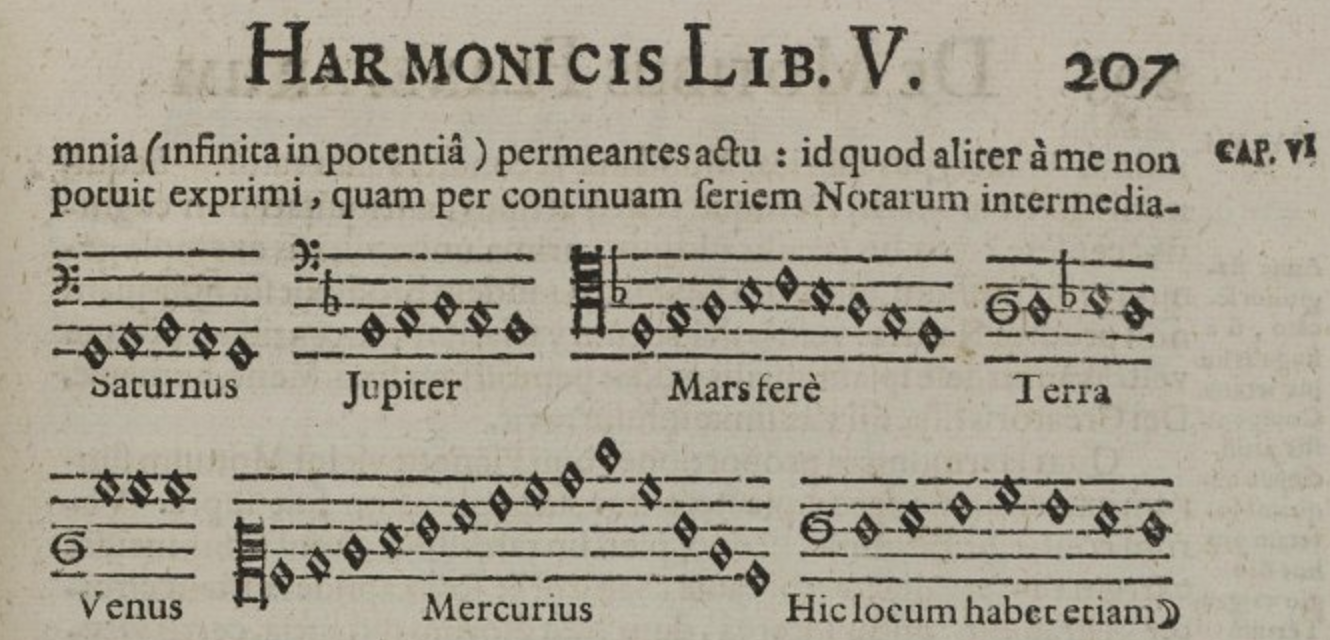
We know now that none of this proved to be true. The planets’ correspondences with harmonic proportions were merely approximate – and the universe indeed turned out to be infinite, following no such order. Centuries later, even what seemed the most obvious example of God’s intervention in the world – the way that organisms were so well suited to their environments – would turn out to be better explained as evolutionary adaptations to random chance.
And so there is a direct path, it seems to me, from Kepler to H.P. Lovecraft’s works. Kepler, I think, saw that the infinite universe would be one without God’s plan behind it, which is why it rightly filled him with a “secret, hidden horror” – the same horror that Lovecraft expresses in his stories, where the knowledge of the universe’s true nature drives people mad. One can reasonably argue that Lovecraft’s vision doesn’t have the same punch for people who never expected the universe to make sense – but it is pretty horrific for people like Kepler and Eckhart who did. It would be really nice to believe that everything in the world is part of a benevolent god’s plan – and it’s a wrenching shock to find out that it isn’t.
Indeed I think Kepler’s clinging to a divine plan remains with us in the utopian instinct – the one that, in the words of the French philosopher Simone Weil, seeks an “absolute good” in a utopian future. That, it seems to me, is to neglect the darkest lesson of cosmology: that no matter what we do, human life will come to an end, not in a heaven or other utopia, but in simple nonexistence.
There is still great beauty to be found in the stars, of course. Recent images from the James Webb Space Telescope are truly dazzling. But they are not orderly in the way Kepler imagined; the heavens follow no more plan or logic than do the things of Earth. The stars are sublime, if anything is: they fill us with awe as they show us our smallness. In my view, the sublime is one powerful kind of beauty. (Lovecraft’s error, indeed, may have been to associate the sublime with ugliness.) But Kepler and his predecessors had imagined something higher: an orderly kind of beauty, following symmetry and proportion, and planned by a benevolent God. The very concept of the sublime emerges as people try to understand their feelings of awe toward worldly phenomena that aren’t in rational order. The Pillars of Creation are pretty amazing. But they give us no evidence of a creator.
It seems to me that there has been a fundamental difference in people who can and cannot accept that life has an end. There seem to be varying degrees of acceptance of that fact and varying stories I have heard that keep folks short of fully accepting that fact. I think that it is not until full acceptance that one is most fully able to see life and our story-telling ability for what it is.
That brings up the “stories” we accept blindly or unquestioningly or consciously tell ourselves. We cannot escape the need and built-in necessity to imagine life and our experience as a story.
The definition of a story can be – a connected sequence of real or imagined events that moves toward a conclusion. (We can debate the point of a story or simple image sequence some other time.)
There are those in the neuroscience world who say that our “right brain” creates a story from our somatic experience and our “left brain” wants to be presented with a story that makes sense from our “right brain”. Our “left brain” constantly filters the stories our “right brain” is constantly constructing. Some have said our remembered dreams are a small window into that story generating function.
Admittedly the right-ness and left-ness of that former statement is anatomically incorrect, but represent functions that are built into us all. It also overly simplifies the situation in our brain. A story means one thing if we use the definition above. Probably more correctly is that the “right brain” creates an image sequence that the “left brain” needs to have “make sense”. The interaction between these functions is likely very iterative and complicated and may be different whether we are “conscious” or “unconscious” in all their forms.
Regardless a “story” is what we first come up with as we organize and make sense of our experience. Immediately we compare that story with what we perceive as reality or other previous experience. A story that does not comport with what we construct as reality is catalogued as a nice “story” not found in objective reality.
A major modifier that come in this interaction is what we “believe”. This appears have a highly variable influence on what we conceive as reality and how that perception of reality accepts the story we instinctively produce. Our beliefs can also allow more acceptance of the story as real.
Such complexities of how we are built to perceive ourself and environment and then create a sense of the realities of ourselves and what is outside our corporeal self means that no one person can completely be free of the function of making stories of our experience, the whole history of scientists like Kepler, much less any of us.