
Tags
Aristotle, autobiography, Confucius, expressive individualism, French Revolution, Harriet Taylor Mill, Jeremy Bentham, Jessica Main, John Rawls, John Stuart Mill, Karl Marx, London, Nathan J. Robinson, Rongdao Lai, Susan Neiman, utilitarianism
Karl Marx and John Stuart Mill have both done a great deal to shape modern political philosophy. Their differences stand out fairly easily: Mill the analytical English-language utilitarian enthusiast of capitalist progress, Marx the “continental” dialectical advocate of communist revolution. Yet what stands out to me is what they have in common.
Maybe their commonalities stand out to me because they’re the first two philosophers I ever seriously engaged with myself, back in high school. As I sought a deeper justification for my own activist political views, Mill’s Utilitarianism was the first primary philosophical text I ever read. And my father’s Marxism spurred me to do a paper on Marxism in a high-school economics class, for a teacher who was somewhat bewildered by it. Possibly as a result, both thinkers have shaped my own political philosophy considerably – though I have my disagreements with both. But in both my agreements and disagreements, I find their similarities more important than their differences.
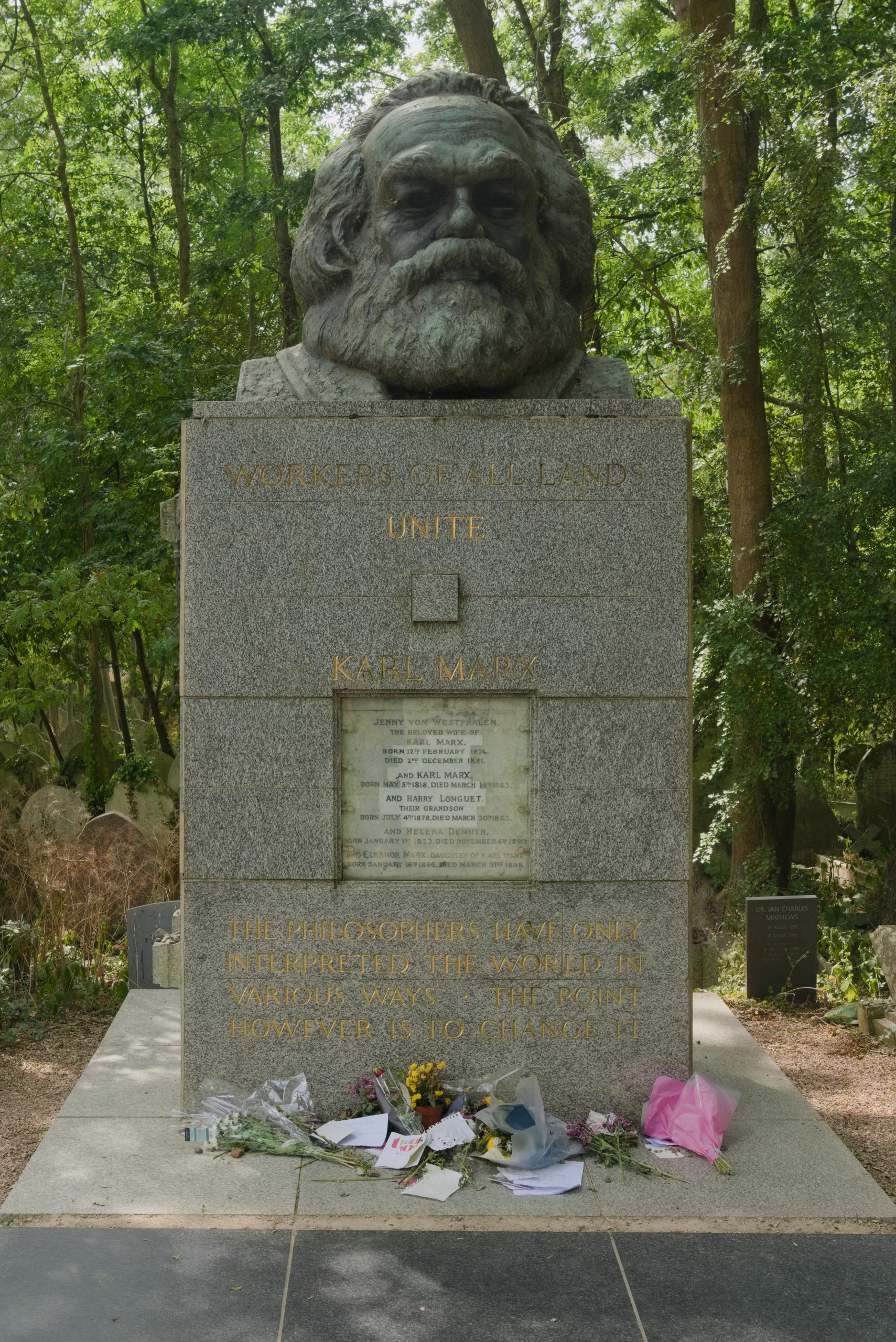
The most obvious similarity may sound trivial in itself, but I think it is at the root of other similarities that were much larger. Namely, Marx and Mill were men of the exact same place and time. (Also notably, neither one was a professor, even though there was a burgeoning university system in their place and time.) While Marx was a German, he was exiled from the country for political reasons, and spent the last decades of his life – 1850-1881 – in London, where you can visit his gravestone. Though a world traveller, Mill was based in London until his death, in 1873 – so for two decades the two lived in the same city. Mill’s work was already famous and Marx knew it well. The converse was not true – Marx’s work was, alas, entirely obscure until Lenin adopted it for the 1917 Russian Revolution – but the two would have shared spaces like the British Library and Museum, and probably have bumped into each other at least once or twice.
That point is more than just a cute quirk of trivia, because we are shaped by our places and times: if you tell me someone lived in the San Francisco Bay Area in 1968 or in Germany in the early 1930s, I can tell you something about what was on their minds. (When I started this blog in 2009, I would never have expected I’d be writing so much about race and gender, but I didn’t know all the things that would happen in the intervening years.) Marx and Mill were both men of Victorian London. And there are at least two crucial ways in which their ideas are emblematic of that time – responding to the ideas already in the air, but developing them further in ways that are still with us.
First of all, both men advocate a view of the world which is natural to us but would have seemed strange to most people in earlier times, and probably even to most of the world at their own time. This is the activist worldview that sees political change as something essential to a good human life. Jessica Main and Rongdao Lai, in their article spelling out the category of engaged Buddhism, claim that
socially engaged reasoning recognizes action as moral only when it changes the nature of the social relations and situations that cause the other to experience pain, privation, and exclusion. From early in the twentieth century, this has meant systematic solutions and broad reform to properly address social problems.
Marx and Mill were, in their ways, pioneers of this sort of “socially engaged reasoning”, writing a few decades before the early twentieth century. A couple generations before the two of them, Jeremy Bentham – a significant influence on both – founded the philosophy of utilitarianism, which calculated morality in terms of its overall social effect, “the greatest good for the greatest number”. Tellingly, Bentham’s major work was entitled An Introduction to the Principles of Morals and Legislation – ethics and politics, for Bentham, are entirely continuous, all seeking a large-scale social goal, one which requires social reform to be achieved. Mill’s own volume Utilitarianism enthusiastically took up the task of defending Bentham’s view.
Marx, on the other hand, was a vitriolic critic of the economic views of Bentham, “that insipid, pedantic, leathertongued oracle of the ordinary bourgeois intelligence of the 19th century”. Yet he nevertheless embraced Bentham’s view that what humans most need is political change for the greater good, and that our most essential task as humans now is to help bring about that change. An extreme form of that view is popular today among thinkers like Nathan J. Robinson, who claimed that it’s irresponsible even to engage in philosophy when one could be spending that time on activism.
Such a view is a sharp departure from premodern conceptions of the human good. That’s not to say that premodern conceptions were always disengaged or anti-political; thinkers like Aristotle and Confucius saw political engagement as significant to a good human life. Confucius and Aristotle called on their followers to govern or participate in the process of government, where possible, and govern well. But that governing project was not understood as a project of change, let alone of systemic change; one might make adjustments to the existing order, or return to a better system that existed elsewhere but it was not understood as building a new and better system. To advocate a project of systematically reforming society wherever possible, let alone revolutionizing it, in the name of an as-yet-unrealized ideal: that is not something Confucius or Aristotle would have done, or ibn Rushd or Wang Yangming or Kauṭilya or any other politically involved premodern thinker. Mill and Marx were together doing something relatively new in human history.
The fact that they were doing this new thing, in turn, has a lot to do with the London Victorian times they shared. With the French and to some extent American Revolutions in living memory, revolution was a live option in that day. Perhaps still more importantly, the Victorian era was one of dynamism, when for better or for ill, the English were transforming the world in unprecedented ways. Marx speaks of how the modern bourgeoisie “has accomplished wonders far surpassing Egyptian pyramids, Roman aqueducts, and Gothic cathedrals; it has conducted expeditions that put in the shade all former Exoduses of nations and crusades.” Mill saw these changes firsthand even more than Marx, spending time as a bureaucrat administering the British Empire in India. For the first time in history, humans were coming to live in a world shaped far more by other humans’ intervention than by the natural forces that had preceded us.
As the historian of philosophy Susan Neiman reminds us, while the European byword for evil a century after Marx and Mill was “Auschwitz”, a century before them it was “Lisbon” – as in the Lisbon earthquake. In the 18th century the worst thing in the world was a force of nature we just had to live with, in the 20th it was a fully intentional human action – a deep signal of how the world humans lived in had become a world humans designed, for good or for ill. And neither Marx nor Mill knew the tragedy of Auschwitz (or of the comparable horrors that would come to be committed in Marx’s own name!), so in their time it was very easy to believe in progress. Thus Marx and Mill both had positive things to say, however qualified, about the way colonialism was transforming otherwise conservative societies around the world.
Such a progressive activist view is a major feature that these two contemporaries shared, and played a major role in developing. But they also played a major role in developing expressive individualism: that often invisible ideal that nevertheless animates many of our most passionately felt movements today, according to which it is quintessentially valuable to act according to one’s own nature. In his greatest work, On Liberty – together with his wife Harriet Taylor Mill – Mill proclaimed that a person’s “own mode of laying out his existence is the best, not because it is the best in itself, but because it is his own mode.” Likewise, when he actually spelled out how he envisioned communism looking, Marx envisioned a society that “makes it possible for me to do one thing today and another tomorrow, to hunt in the morning, fish in the afternoon, rear cattle in the evening, criticise after dinner, just as I have a mind”, in contrast to a division of labour where “each man has a particular, exclusive sphere of activity, which is forced upon him and from which he cannot escape.”
This mode of thinking, too, would have been very alien to Aristotle or to Mencius – even though for many of us after Marx and Mill, it has become part of the air we breathe. There are glimmers of it in a few premodern thinkers like Duns Scotus and Petrarch, but it really reaches full flowering with Marx and Mill – and perhaps more so with Nietzsche a few decades after them.
In that combination of activism and expressive individualism taken together, I think, Mill and Marx together become the most intellectually formative thinkers for what we have now come to call the left (a term originally referring back to supporters of that French Revolution that was a powerful influence on both). Marx’s overall influence on the left that should be obvious (though it does sometimes still need to be pointed out). Mill, for his part, is very much a liberal – both in the older sense of the word, in which he departs from Marx, and in the modern popular sense that just means “left-wing”, in which he does not. John Rawls, perhaps the most influential left-wing philosopher of the 20th century and the one who popularized the term “social justice”, shares a lot with both Marx and Mill. While many of their respective followers – my late father likely included – might have bristled at the comparison, for me between these two great thinkers, it’s the similarities more than the differences that loom large.
This is an impressively synoptic post. I would add that there were a number of other thinkers in Bentham’s generation and soon after that emphasized the unity of social progress and scientific/epistemic progress, like Nicolas de Condorcet in France and Elihu Palmer in the newly forming United States, each of whom was caught up in the political revolutions in their respective countries. I think of that generation as formative thinkers of progress, although it’s hard to say that they are more important than later generations; I suspect that each generation had something to contribute to the unity of social progress and scientific/epistemic progress (and/or backsliding). In the generation or two after Mill and Marx, John Dewey looms large in my mind as a thinker of that unity, though he’s closer to Mill than to Marx; for example, Dewey wrote an essay titled “Why I Am Not a Communist”.
I’m not a Hegel expert, but from my ignorant position it seems that Hegel emphasized scientific/epistemic progress but not social progress (in conformity with the political conditions in the German Empire?), so it took a subsequent Hegelian, Marx, to add a socially progressive aspect. (Correct me if I’m wrong or if that portrayal of Hegel is too simplistic.)
Yeah, I didn’t mean to say that Bentham, Mill and Marx are the only thinkers responsible for the ideas of progress and the duty of activism. That’s a very long story, one which might become a larger research project of mine someday. (I think a significant part of it goes back to the Roundheads against the Cavaliers in England!)
I wouldn’t say that Hegel didn’t emphasize social progress. I think it goes together with epistemic progress for him, and he’s actually a formative thinker in the development of that idea. It’s just that from Hegel’s point of view most of the important progress, on both counts, has already happened; by the time of Hegel’s adulthood in the aftermath of the French Revolution, the world is basically where it needs to be. That’s where both Mill and Marx would strongly disagree with him.
I think this shows why modernist Buddhists and scholars often consider that only social and political activism counts as “engaged Buddhism.” That is a modernist idea: that bettering material life and society more broadly occurs mainly in that way, and not in the old ways that would include educating people to live moral and virtuous lives in accord with natural law, doing one’s duty, charitable acts, prayer, and so on. It is also evident that this change in ideas of how life would get better relate to a more secular, materialist, and humanist view of the world in which natural law, God, karma, and so on are no longer viewed as relevant — part of the evolution from premodern cosmos to modern universe.
The emphasis on social and political activism is modern (if the account in the post above is true enough, and I think it is), but I would also take into account the scope of a person’s thinking. Some people are specialists and some are generalists; some people have a special interest in social and political activism, so that topic becomes very central to them perhaps to the detriment of what you call “the old ways”. Buddhists who think that only social and political activism count as “engaged Buddhism” are probably such specialists. But other people think with a more comprehensive, holistic, integrative scope that reflects on the value of both social activism and the development of everyday virtues and moral conduct, religious philosophy, aesthetics, etc.
John Dewey, whom I mentioned in my first comment, is an example of the more comprehensive type of thinker, as opposed to the specialist in social activism. In that way he’s like Aristotle and Confucius, whom Amod mentioned above, but with the addition of the modern emphasis on systemic social and epistemic change. Notably, Dewey’s religious philosophy is naturalistic but treats “God” (in a Western context) and “the religious” as being of continuing relevance.
That’s a useful response. Dewey is interesting… a very broad modernist apparently! I am not sure why modernism in Buddhism became so tightly focused on activism, excluding various other relevant activities from “engaged Buddhism.”
I think you would have to analyze how certain people use the term “engaged Buddhism” and what has influenced their conception of it. As you probably know, Thich Nhat Hanh’s tradition has consistently espoused a broad definition of the term that’s not tightly focused on activism. For example, there’s an article from earlier this year, “Continuing Thay: Engaged Buddhism in the Plum Village Tradition”, that says (very typically for them):
absolutely, and I follow TNH in this. But prominent scholars of engaged Buddhism do not. See:
https://blogs.dickinson.edu/buddhistethics/2023/02/02/democratizing-engaged-buddhism/