
Tags
Alex Caring-Lobel, Aśvaghoṣa, David Gelles, George Grant, Karl Marx, Patton Oswalt, Richard Swinburne, Ross Coggins, theodicy, Zhuangzi
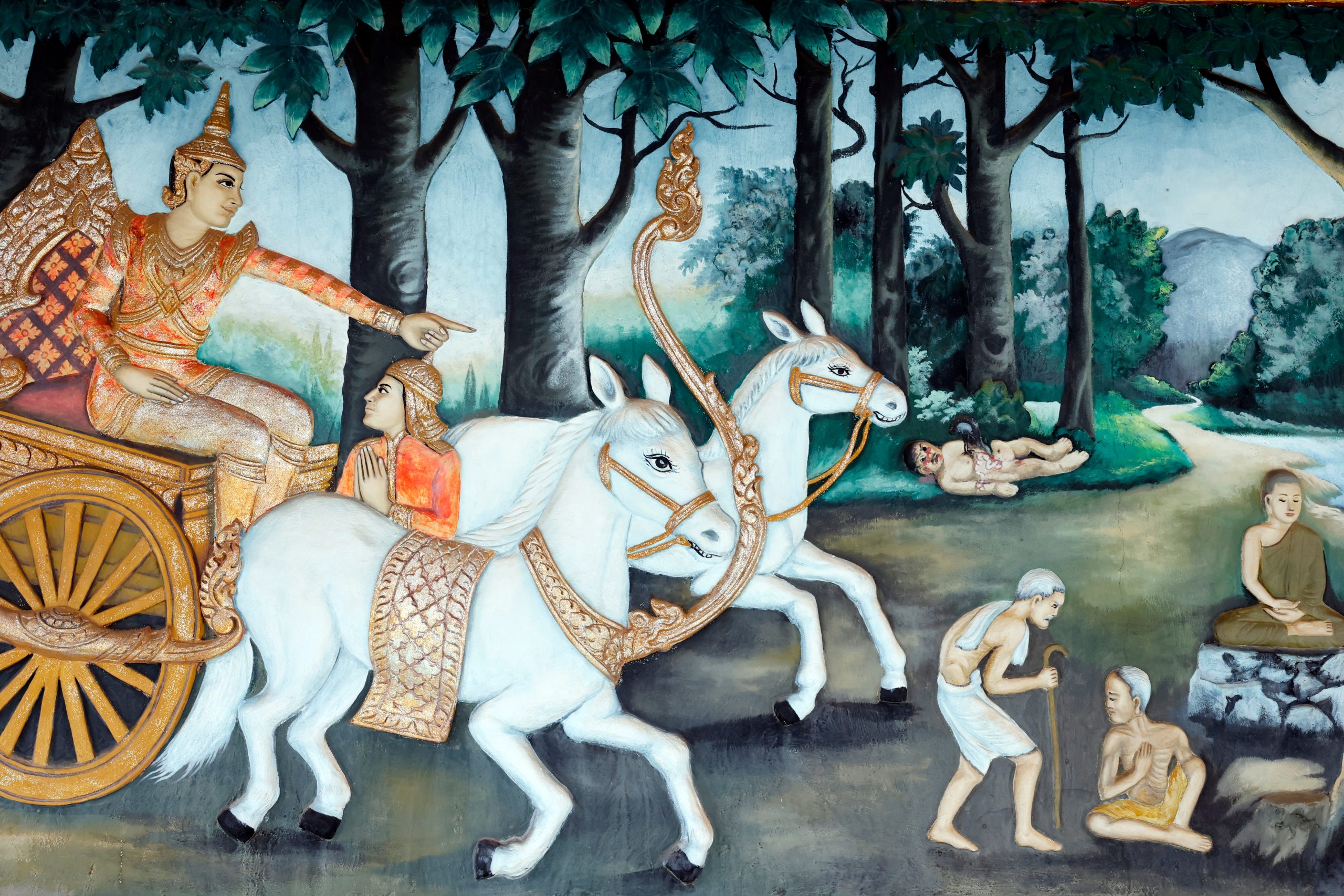
The great Buddhist poet Aśvaghoṣa famously tells the story of the Buddha’s father, the king, who tried to keep his son as an heir rather than a monk by isolating him from all the bad things in the world. Of course the king’s plan doesn’t work: the Buddha-to-be sneaks out and sees an old man, a sick man and a dead man, reminding him that these fates will come to a king as surely as anyone else, and so he renounces the world and becomes a monk. The story shows us that there always remains a gap between what is and what should be: we will always face sad facts like illness and death. That gap is bad, it is always with us, and that is unfortunate; it is just the way things are, whether we like it or not. It provides a need and an impetus for us to improve our minds, to escape the suffering that comes from craving in the face of those sad facts.
A very different take on that gap comes from Jacobin senior editor Alex Caring-Lobel in the Springer Handbook of Mindfulness, which collects over thirty essays objecting to the modern mindfulness movemennt. These essays take particular objection to David Gelles’s claim that “stress emanates from a mismatch between our expectation of how things should be and the way things are”. (p85) Caring-Lobel, in particular, objects to Gelles’s view because it
dismisses that glorious gap between “how things should be and the way there [sic] are” as a kind of impediment to flourishing. This is, after all, the space of the social imagination. It is also the space in which democracy operates. (Caring-Lobel p209)
Let’s spend some time with Caring-Lobel’s remarkable adjective, claiming that the gap between how things should be and the way they are is glorious, in order to understand just how remarkable it is. Inside the gap between how things should be and how they are, we find famines, plagues, racism, slavery, genocides: all things that are and yet should not be. Of course that gap is an impediment to flourishing. How could it not be?
Yet somehow Caring-Lobel manages to proclaim this locus of slavery and murder “glorious”, as a “space of the social imagination.” On such an account it is glorious that the Nazis took over Germany because that gave the Allies a chance to stop them; it aids human flourishing that famines exist, because we can imagine sending money to save people from them. I am reminded of nothing so much as pre-WWI celebrations of the glory of war: how wonderful it is that we have a chance to prove our manliness in combat! In Caring-Lobel’s topsy-turvy world, it is glorious that the world is filled with horrors, because it gives people like him a chance to come in and fix them.
I am not sure whether Caring-Lobel just never thought of his position’s shocking implications, or did think of them but didn’t feel he needed to bother defending them. But I do find positions like this surprisingly common. WEIRD people are so wedded to activism, find it so important, that in their eyes even genocides and famines become “glorious” because now they get an opportunity to stop them. The roots of such views are surely theological: there’s a close affinity here to the Christian theologian Richard Swinburne’s Maoist God, who creates a world in which innocent babies are tortured to death in order to provide an opportunity for privileged people like us to go in and save them. (Patton Oswalt provides a wonderful comedic skewering of one such theology, when it appears in the song “Christmas Shoes”).
But Caring-Lobel’s view takes one further step even beyond Swinburne. When Swinburne refers to the universe as half-finished, that at least suggests an end state where it will be finished: where we will have done the work that God betters us by doing, so that then we can finally enjoy a world without the torments of plagues and massacres, a world where we have closed the gap between what is and what should be. In that regard Swinburne is much like Karl Marx: for him, at least eventually we will get to a new social order that solves all our problems.
The Canadian philosopher George Grant notices this point about Marx, contrasting him favourably to those who seek social change for its own sake:
In the conceptions of history now prevalent among those ‘creative’ men who plan the mastery of the planet, changing the world becomes ever more an end in itself. It is undertaken less simply to overcome the natural accidents that frustrate our humanity and more and more for the sheer sake of the ‘creation’ of novelty. (27)
Grant is perhaps thinking of the capitalists who would become prominent in Silicon Valley, those who proclaim “disruptive innovation” as a positive good. Such men (and they remain mostly men) share a great deal in common with Caring-Lobel. For them as for him, the good end state is not the point; it is the process of changing things that is an end in itself. We shouldn’t even want to reach a utopia where no children starve, or where our work is no longer alienated, because it would leave no room for our intervention. It would close the “glorious gap”, the “space of the social imagination”. I can provide no better summary of such a position than the closing lines of Ross Coggins’s biting satirical poem “The Development Set”:
Enough of these verses – on with the mission!
Our task is as broad as the human condition!
Just pray to God the biblical promise is true:
The poor ye shall always have with you.
Now I think we can reasonably accept a pessimistic view, where there isn’t a way to close the gap between what is and what should be. There is a great deal in human history that would suggest such a pessimism – and indeed it’s a good match for Aśvaghoṣa, whose story is all about the inevitability of bad things. What’s not reasonable is to then think that this is glorious, that this is the way things should be.
There is a Daoist counterpoint here too. Zhuangzi famously says that the Dao is in the piss and shit; I understand that claim in terms of a general Daoist project of acceptance, recognizing the need to “dwell within the flow” of things as they happen. Since the gap between what is and what should be is there, and is going to be there whether we like it or not, we need to make our peace with it. But the acceptance here is tied to the fact that we can’t change these things – that, as in Aśvaghoṣa, they are inevitable parts of life and therefore we must make our peace with them. Caring-Lobel gets it quite backwards: taking delight in the “glory” of the world’s horrors because they allow us white saviours to jump in and fix them. Yes, we do live better when we have a positive outlook toward life including its bad things – but that shouldn’t mislead us into thinking they are glorious.
This post’s content was originally written for my upcoming book; I left it out of the published version to make the argument flow a bit more smoothly. But if you like what you’ve just read here, I think you’ll like what’s in the book, and I would encourage you to preorder it if you’re so inclined.
EDIT (31 Aug 2026): This post originally attributed the “Dao is in the piss and shit” quote to the Daodejing (Laozi); thanks to a helpful reminder from Boram Lee below, I corrected that to Zhuangzi.
I think you’re parsing Caring-Lobel’s claim wrong here: “Inside the gap between how things should be and how they are, we find famines, plagues, racism, slavery, genocides: all things that are and yet should not be.” — these bad things are not in the *gap* between how things are and how things should be, but are among the things that *are*. Caring-Lobel doesn’t say that how things are is glorious (they probably think it’s not good that there are genocides and racism!), but that the gap between how things are (which includes racism and genocides) and how things should be is “the space of social imagination” and “the space in which democracy operates”. It seems to me they are right about that: it’s the distance between the world as we find it and the world as it might be that lets us imagine novel social arrangements and deliberate democraticly about how we want to make the world to be. That freedom to act and to make a world that better suits us is, I think, rightly judged to be glorious.
Thank you, Susan, and welcome. Technically, you could say that genocides and racism are just part of the way things are without reference to the gap – if you were refusing to condemn them, if you were just operating as a social scientist suspending judgement or as a computer program running the numbers. But when you’re doing that, you’re not talking about what should be at all, and therefore there is no gap to be referred to at all. But the minute you do start acknowledging what should be, then you are also looking at the things that should be and are not (or should not be and are). That’s the gap, which cannot be eliminated, only reduced – and it is where all existing bad things, qua existing bad things, are.
I do suspect that there’s something of a difference in paradigms operating here, a difference in the way concepts are employed that is itself reflective of larger value systems. I think there is a prophetic kind of worldview (present in Marx but also in Swinburne) where the absolute good is placed in the future, as Simone Weil says, and the present is viewed as a stage on which to struggle to create that future. That is a metaphysics of progress that I strongly reject: based on what we now know about the world, the ultimate end is the destruction of humanity itself. The gap between what is and what ought to be is a tragic one, one that can never be closed; we can narrow it here and there, and it is good to do so, but mostly it represents a pain and frustration inevitable in life that we have to learn to live with if we are to live well (as I think Gelles rightly notes).
Hi Amod,
“…the Dao is in the piss and shit…”
This is from Zhuangzi Ch. 22 rather than the Daode jing.
Oh, so it is! Thank you for the correction. And here I was thinking that was my favourite quote from Laozi – I guess I’m just more of a Zhuangzi fan!
There’s a popular meta-historical idea that adversity is necessary for social and technological progress. I don’t think this well-supported by the actual historical record though. For example, Ancient Greece being rival city states is sometimes tied to rise of the Greek philosophical tradition, but Thucydides says the opposite: Athens prospered because it had poor soil and thus was spared much of the conflict that engulfed its neighbors. The relatively peaceful Spring and Autumn period in China saw a lot of intellectual foment, while little such development happened in the Warring States era that followed it. And the Islamic Golden Age is strongly tied to a long period of peace and prosperity.
That being said, I think you’re being somewhat uncharitable to Caring-Lobel. I would connect that statement more to the Hegelian notion that we can always make progress towards an ideal, rather than saying the evil and suffering are a positive good because it gives us the opportunity to struggle against them. And even if it is the latter, I think you’re misunderstanding the idea of glory. When the ancients (and moderns for that matter) said “dulce et decorum est pro patria mori” they weren’t saying that you should lose as many men in battle as possible. The fight against the Nazis *was* glorious. The existence of the Nazis was not.
Of course one can become addicted, as it were, to the pursuit of glory and value it excessively. If struggles for social change are glorious, as Caring-Lobel suggests, then perhaps the thousand ships of Homer and the interminable internecine squabbles of the left are two sides of the same coin.
Thanks, Marcus. I’m not sure this is quite right to describe Hegel, because as far as I can tell, he thought the ideal had more or less already been reached. (Marx is a very different story, of course.)
I suppose you can reasonably look at glory in the way you describe, yes – but I think it’s important to realize that the glory is effectively a consolation prize. There is a glory in fighting against the Nazis, and that is a good thing – but it would be a far, far better thing had the Nazis never existed to fight against at all.
I guess I think of Hegel sort of like Clausewitz where the fact that he said that “war is the continuation of policy with other means” is what he’s known for, even though he didn’t actually agree with it. So even though Hegel said the dialectic was finished, he created the idea of striving through dialogue and debate and repeated iteration. (Death of the author. Once you say it, other people can do what they want with it.)
Sure – Marx certainly ran with that, in its own way. It’s just good to be clear what’s actually in an author’s work and what was added later. (The authors of the Hebrew Bible would likely have been horrified to learn it would come to be called the “Old Testament”.)
I find critical-theory polemics against capitalist/corporate mindfulness, like Caring-Lobel’s chapter, to be tiresomely well-trodden territory, but I have to agree with Susan’s and Marcus’s comments above that there seems to be an uncharitable misreading of Caring-Lobel here. I wouldn’t imagine that he believes exactly what’s imputed to him here about what makes the gap glorious.
Hi Amod,
I’m curious how you, as a Buddhist, think about the relationship between mindfulness and action in the world. To what extent do they represent rival approaches? To what extent are they compatible, even complementary? Do you think our answers should vary depending on the issue at stake?
Since Caring-Lobel is writing in Jacobin, let’s take as an example somebody working at an Amazon warehouse. Would you advise them to practice mindfulness or try to unionize? Or obtain education on the side?
I think the answer here is “both”. This is actually a topic I’ll bring up in the later chapters of the book, connecting Buddhism to the Serenity Prayer. When there’s nothing we can do to change a bad situation, what we need is mindfulness and the serenity it supports. When we can change it or it seems reasonably likely that we can, then it’s good to try to do so – though even there we’re not well served by frustration and the anger that results from it.
What a coincidence, I was first inspired to comment on one of your blog posts on August 4, 2025: https://loveofallwisdom.com/blog/2025/08/the-dark-side-of-expressive-individualism/#comment-47043 . And here it is just a few days over a year later and I feel inspired to comment again! Not so coincidentally, both my comments are in response to your emphasizing the dark side of some aspect of a world that I view as ambivalent—both good and bad, glorious and dreadful.
In this instance, I want to explore your characterization of the “gap between what is and what should be” as bad or unfortunate, and your objection to characterizing it as glorious. I want to suggest the middle path that the gap is both dreadful AND glorious.
The first noble truth is that life entails Dukkha, dissatisfaction, which is the result of wanting things to be different from how they are. So another way of characterizing the gap is that it is the gap between what is and what we want it to be. So if life entails Dukkha, then life entails the gap: No gap no life.
So if life entails the gap, then life is only possible in the gap. And this means that the gap is not only filled with the dreadful aspects of life, but also with life’s glorious aspects! So the gap is both glorious and dreadful. To characterize the gap as bad or unfortunate is to focus only on the dreadful and not on the glorious.
Given that life entails the gap and the gap entails dukkha, dissatisfaction, then in what way can we possibly understand progress? Two of my favorite ways of framing progress are from Dewey and Ziporyn.
Dewey: https://i.imgur.com/pjFJlMj.png
Progress isn’t about closing THE ULTIMATE GAP, but of closing proximate gaps in order to open new ones. It is the perpetual opening and closing of piecemeal gaps that is glorious and dreadful.
Ziporyn (Tiantai Buddhism): https://i.imgur.com/8ucAwxh.png
The other shore (Nirvana) isn’t escaping the gap, the dukkha, the suffering, it is the “raft factory”, the perpetual creation of infinite piecemeal rafts on which to sail THE GAP.