• About me
  • About this blog
  • Comment rules
  • Other writings

Love of All Wisdom

~ Philosophy through multiple traditions

Love of All Wisdom

Category Archives: Protestantism

In defence of Buddhism without rebirth

17 Sunday Sep 2017

Posted by Amod Lele in Death, Karma, Modernized Buddhism, Natural Science, Protestantism, Supernatural

≈ 8 Comments

Tags

Gananath Obeyesekere, Ian Stevenson, Imre Lakatos, intelligent design, Jan Westerhoff, rebirth, suicide

A few years ago I wondered how a naturalized Buddhism could avoid advocating suicide. If our goal is the cessation of suffering, and death is not the beginning of a new birth but a simple ending, shouldn’t death itself be our goal? I didn’t go very far with this argument, in part because I didn’t identify as a Buddhist at the time – there was a certain way in which not being a Buddhist made it not my problem. But now I am a Buddhist. And an excellent recent chapter by Jan Westerhoff, in Jake Davis’s fine new edited volume on Buddhist ethics, brings the point back into uncomfortable focus. Continue reading →

In memoriam: Claude Vipond

23 Sunday Oct 2016

Posted by Amod Lele in Death, Family, Protestantism

≈ 1 Comment

Tags

20th century, atheism, autobiography, Canada, Christmas, Claude Vipond, generations, modernism, modernity, obituary, Stephen Leacock

My maternal grandfather, Claude Vipond, died peacefully last Tuesday. His life was long – he reached 95 years. Claude was a doctor and a World War II veteran, but I knew him entirely as a grandfather – an often larger-than-life figure at family gatherings, delivering corny jokes with an enthusiasm that made them hilarious. At large Christmas gatherings he would read to the grandchildren, not some sentimental Victorian Christmas story but Stephen Leacock‘s marvelously tongue-in-cheek Caroline’s Christmas.

The irreverence of Leacock’s self-subverting story left a strong impression on me as a boy – much like the movie The Princess Bride, which came out when I was the age of its child narratee. In a different way from my father, “Caroline’s Christmas” helped teach me the pleasures of being an outsider, with an ironic detachment expressed in humour – in ways perhaps more profound than I realized at the time. In many ways I think that story really sums up my grandfather’s spirit. Continue reading →

On natural law and positive law

03 Sunday Jul 2016

Posted by Amod Lele in Deity, Foundations of Ethics, Hermeneutics, Islam, Morality, Politics, Protestantism, Reading and Recitation, Roman Catholicism

≈ 1 Comment

Tags

fundamentalism, Jeremy Bentham, law, Martin Luther, modernity, rights, Thomas Aquinas, William of Ockham

In the previous discussion of why intellectualism and voluntarism are important, I left out what I think may be the most important aspect of all, one which leaves its mark on our thought today in the modern West. Namely: whether God is an intellect or a will bears directly on the way we think of morality – at least when we understand morality in terms of law, as the Abrahamic traditions all have to some degree.

If God is a will, then that will makes morality: morality is whatever God’s will commands. Continue reading →

My first encounters with Alasdair MacIntyre

08 Sunday Nov 2015

Posted by Amod Lele in Analytic Tradition, Buddhism, Foundations of Ethics, Metaphilosophy, Method and Theory in the Study of Religion, Protestantism, Roman Catholicism

≈ 9 Comments

Tags

Alasdair MacIntyre, autobiography, Canada, conservatism, G.W.F. Hegel, Ken Wilber, Susan Dwyer

In philosophy as in any other field, one sees further by standing on the shoulders of giants. I have tried to engage in detail with contemporary thinkers whose work seems like it might be helpful in advancing the inquiries that most interest me. The first such was Ken Wilber. I’ve said before that I think he asks the right questions but gets the wrong answers, and I think a key reason for that is that he has an unsustainable method, a perennialist method that refuses to acknowledge genuine diversity. I have learned a lot from my engagement with him, but I cannot take up his approach.

Alasdair MacIntyre More recently I have turned in detail to the works of Alasdair MacIntyre, whose thought I’ve already juxtaposed against Wilber’s a number of times (often in MacIntyre’s favour). I had expected that I would engage MacIntyre much as I had engaged Wilber: seeing him as a source of important and productive ideas, but ultimately wrong. Now I am not so sure. Continue reading →

Hegel after Hegel (I)

28 Sunday Jul 2013

Posted by Amod Lele in German Tradition, Politics, Protestantism

≈ 1 Comment

Tags

20th century, atheism, Communism, G.W.F. Hegel, identity, James Doull, Karl Marx, Ken Wilber, Ludwig Feuerbach, war

I’ve been spending some time lately with James Doull‘s last essay, “Hegel’s Phenomenology and post-modern thought”, and also with his closely related address on “Heidegger and the state”. (Both are in Philosophy and Freedom, the only published book of Doull’s writings.) Doull’s project in the Hegel essay is in a sense meta-Hegelian: to situate Hegel‘s thought in a philosophical history, as Hegel himself would do with the thinkers before him.

So the first parts of the essay tell the story of premodern and modern Western thought as it leads up to Hegel – a fine exegesis. But it’s the latter part of the essay that gets really interesting. For of course the history of philosophy went on after Hegel – and how should a Hegelian deal with that? Continue reading →

Light in the darkness

18 Sunday Dec 2011

Posted by Amod Lele in Aesthetics, Method and Theory in the Study of Religion, Modern Hinduism, Protestantism, Rites, Roman Catholicism

≈ 5 Comments

Tags

Benjamin C. Kinney, Christmas, Confucius, Diwali, Frits Staal, Jesus, New Testament

As Christmas approaches, I return to the theme I took up two years ago of the meaning of Christmas to a non-Christian – spurred on in part by my recent reflections on single–mindedness. Ben, commenting on that previous post, noted:

Christmas appears to have a dual message in our culture. ‘Rampant consumerism’ is one half, and ‘The True Meaning Of Christmas ™’ is the second. While there are exceptions that focus more on family and loved ones and generosity, references to TTMOC largely also include references to the birth of Jesus.

I think Ben is on to something important: an unreflective understanding of Christmas can turn into a simple consumerism. So, many who do reflect on Christmas either refuse to celebrate it at all or try to make it entirely about Jesus. I think both reactions, but especially the latter, are examples of single-mindedness as a problem: an attempt to pick out one single meaning that’s most important and ignore the details. But for those of us who genuinely enjoy Christmas, the details can be the most important part. Continue reading →

Philosophical single-mindedness (2)

27 Sunday Nov 2011

Posted by Amod Lele in Aesthetics, German Tradition, Greek and Roman Tradition, Place, Politics, Protestantism, Psychology, Salafi, Vedānta

≈ 3 Comments

Tags

Advaita Vedānta, Aristotle, Augustine, Communism, conservatism, David Harvey, G.W.F. Hegel, James Doull, Jane Jacobs, Karl Marx, Karl Popper, modernism, Myers-Briggs, Plato, Pol Pot, Śaṅkara

Last week I spoke of a philosophical single-mindedness shared by modernists, evangelical Protestants, Salafi Muslims and St. Augustine, and this week I’d like to reflect on it further. What these various single-minded thinkers hold in common is opposed above all, I think, by literal conservatism. Conservatives in the literal sense seek to preserve much of the world as it is – “if it ain’t broke, don’t fix it.” They are opposed to radical breaks and revolutions, whether those aim to take us forward (as the modernists) or backward (as the Salafis). I noted in my earlier post that Jane Jacobs’s urban criticism, a direct attack on modernist architecture and modernist urban planning, is a quintessential example of literal conservatism; Jacobs would react with the same hostility to the Salafi assault on Mecca. In that respect, for all its urbanity, Jacobs’s work is of a piece with the agrarian rural conservatism of Front Porch Republic and Wendell Berry.

The appeal of such literal conservatism is certainly not limited to aesthetics, but one may perhaps see it most clearly in the aesthetic realm. (Some modernists, like the Marxist geographer David Harvey, see an aesthetic conservatism as opposed to a more ethical modernism.) For it’s hard to imagine elevating a single most important principle, as modernists typically do, as the principle behind beauty: could one ever say “Everything constructed according to principle X will be beautiful,” without making principle X entirely vacuous and devoid of content? Aesthetics seem to require a focus on the details and not merely the big picture.

Now of the various single-minded thinkers I’ve mentioned so far – modernists, evangelicals, Salafis and Augustine – one might note that they all have their historical roots in Western traditions. Continue reading →

Philosophical single-mindedness (1)

20 Sunday Nov 2011

Posted by Amod Lele in Aesthetics, Modernized Buddhism, Place, Prayer, Protestantism, Rites, Roman Catholicism, Salafi

≈ 15 Comments

Tags

architecture, Augustine, autobiography, Jesus, Martin Luther, modernism, music, Stonehill College

One of the most common slams made against modernist (Yavanayāna) Buddhism is that it is “Protestant.” I’ve previously written about how there’s more to Buddhist modernism than this, and about the curious quasi-theological assumption that having Protestant influence is seen as a bad thing. At the same time, I’ve been realizing that there are close links between Protestantism and modernism. Not too surprising, perhaps, since the two emerge out of the same historical context, the Europe of the past 500 years – but I think their similarities may go deeper than that. Continue reading →

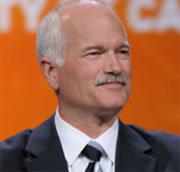
Love is better than anger: Jack Layton (1950-2011)

28 Sunday Aug 2011

Posted by Amod Lele in Anger, Buddhism, Fear, Flourishing, Gentleness, Happiness, Hope, Patient Endurance, Politics, Protestantism

≈ 48 Comments

Tags

autobiography, Canada, Disengaged Buddhism, Engaged Buddhism, Gary Snyder, Jack Layton, obituary, S.N. Goenka, Śāntideva, Thich Nhat Hanh

Jack LaytonIt will not do my readers much of a service to announce that Jack Layton has died. To non-Canadian readers, the name will probably mean little or nothing; Canadian readers in the past week will have heard of little else.

Jack Layton was the leader of the left-wing New Democratic Party, the only political party whose candidates I have ever voted for. He died of cancer on 22 August, at the relatively young age of 61 – at the peak of his career. Until Layton took over the NDP, the party had never received more than 44 of the roughly 300 seats in the Canadian Parliament. Earlier this year, under his leadership, the party earned over 100, most of those in Québec – where the party had never held more than a single seat before. It received more than twice as many seats as the third-place Liberals, a party which had governed Canada so often that it viewed itself as the “natural governing party.” And a great deal of this rapid rise derived from Layton’s personal popularity. His funeral has now been receiving coverage in Canada comparable to that of Princess Diana’s – at a time when it is held as a commonplace that people hate politicians and are fed up with them. His life and death moved a great many. My American wife, who a year ago didn’t know who Jack Layton was, was moved to tears watching the coverage of his memorials.

Now why am I going on about Jack Layton on a philosophy blog? Continue reading →

Multiple perennial questions

07 Sunday Aug 2011

Posted by Amod Lele in Confucianism, East Asia, Eastern Orthodoxy, Epistemology, Flourishing, Free Will, Human Nature, Mahāyāna, Metaphilosophy, Metaphysics, Politics, Protestantism, Roman Catholicism, South Asia

≈ 115 Comments

Tags

ascent/descent, Friedrich Nietzsche, Fyodor Dostoevsky, Immanuel Kant, intimacy/integrity, Mencius, Mou Zongsan, perennialism, Śāntideva, T.R. (Thill) Raghunath, Xunzi

I’m returning today to the idea of perennial questions: questions that recur throughout the history of philosophy, where both sides of a debate keep getting articulated in many different places. The key feature of these perennial questions, to my mind, is that they are large: they cannot be narrowed down to a single precisely defined question within a single philosophical subfield, of the sort that analytic philosophers aim to ask, but extend their ramifications across multiple fields of theoretical and practical inquiry.

So far I’ve explored two major perennial questions: ascent versus descent and intimacy versus integrity. I have taken these as two different axes along which philosophies can be classified – in their ethics and soteriology as well as their metaphysics and epistemology.

But why should we treat these as exhausting the perennial questions? Continue reading →

← Older posts
Newer posts →

Welcome to Love of All Wisdom.

I invite you to leave comments on my blog, even - or especially - if I have no idea who you are. Philosophy is a conversation, and I invite you to join it with me; I welcome all comers (provided they follow a few basic rules). I typically make a new post every Sunday. If you'd like to be notified when a new post is posted, you can get email notifications whenever I add something new via the link further down in this sidebar. You can also follow this blog on Facebook. Or if you use RSS, you can get updates through the RSS feed.

Recent Comments

  • Nathan on Against nostalgic ecology
  • Tjarlz Quoll on Against nostalgic ecology
  • Nathan on You still have to naturalize karma
  • Amod Lele on You still have to naturalize karma
  • Nathan on You still have to naturalize karma

Subscribe to receive Love of All Wisdom by email:

Post Tags

20th century academia Alasdair MacIntyre Aristotle ascent/descent Augustine autobiography Buddhaghosa Canada Confucius conservatism Disengaged Buddhism Engaged Buddhism Evan Thompson expressive individualism Four Noble Truths Friedrich Nietzsche G.W.F. Hegel gender Hebrew Bible identity Immanuel Kant intimacy/integrity justice Karl Marx Ken Wilber law Martha C. Nussbaum modernity music mystical experience nondualism Pali suttas pedagogy Plato race rebirth religion Siddhattha Gotama (Buddha) technology theodicy United States utilitarianism Śaṅkara Śāntideva

Categories

  • African Thought (15)
  • Applied Philosophy (385)
    • Death (47)
    • Family (54)
    • Food (22)
    • Friends (21)
    • Health (33)
    • Place (37)
    • Play (18)
    • Politics (241)
    • Sex (25)
    • Work (48)
  • Asian Thought (463)
    • Buddhism (334)
      • Early and Theravāda (140)
      • Mahāyāna (143)
      • Modernized Buddhism (103)
    • East Asia (102)
      • Confucianism (62)
      • Daoism (23)
      • Shinto (1)
    • South Asia (149)
      • Bhakti Poets (4)
      • Cārvāka-Lokāyata (5)
      • Epics (16)
      • Jainism (24)
      • Modern Hinduism (45)
      • Nyāya-Vaiśeṣika (6)
      • Sāṃkhya-Yoga (16)
      • Sikhism (1)
      • Vedānta (42)
      • Vedas and Mīmāṃsā (7)
  • Blog Admin (29)
  • Indigenous American Thought (8)
  • Method (279)
    • Metaphilosophy (180)
    • Method and Theory in the Study of Religion (156)
  • Practical Philosophy (435)
    • Action (17)
    • Aesthetics (53)
    • Emotion (196)
      • Anger (42)
      • Attachment and Craving (32)
      • Compassion (9)
      • Despair (7)
      • Disgust (5)
      • Faith (20)
      • Fear (15)
      • Grief (9)
      • Happiness (52)
      • Hope (20)
      • Pleasure (37)
      • Shame and Guilt (10)
    • External Goods (55)
    • Flourishing (104)
    • Foundations of Ethics (126)
    • Karma (45)
    • Morality (79)
    • Virtue (188)
      • Courage (7)
      • Generosity (14)
      • Gentleness (7)
      • Gratitude (13)
      • Honesty (15)
      • Humility (27)
      • Leadership (7)
      • Mindfulness (24)
      • Patient Endurance (31)
      • Self-Discipline (10)
      • Serenity (40)
      • Zest (8)
  • Practice (147)
    • Karmic Redirection (5)
    • Meditation (47)
    • Monasticism (47)
    • Physical Exercise (4)
    • Prayer (16)
    • Reading and Recitation (14)
    • Rites (24)
    • Therapy (11)
  • Theoretical Philosophy (407)
    • Consciousness (24)
    • Deity (77)
    • Epistemology (141)
      • Certainty and Doubt (19)
      • Dialectic (21)
      • Logic (15)
      • Prejudices and "Intuitions" (31)
    • Free Will (18)
    • Hermeneutics (66)
    • Human Nature (36)
    • Metaphysics (117)
    • Philosophy of Language (31)
    • Self (78)
    • Supernatural (56)
    • Truth (64)
    • Unconscious Mind (16)
  • Western Thought (529)
    • Analytic Tradition (107)
    • Christianity (162)
      • Early Factions (8)
      • Eastern Orthodoxy (3)
      • Protestantism (27)
      • Roman Catholicism (61)
    • French Tradition (50)
    • German Tradition (97)
    • Greek and Roman Tradition (126)
      • Epicureanism (25)
      • Neoplatonism (2)
      • Pre-Socratics (6)
      • Skepticism (2)
      • Sophists (8)
      • Stoicism (22)
    • Islam (44)
      • Mu'tazila (2)
      • Salafi (3)
      • Sufism (10)
    • Judaism (38)
    • Natural Science (105)
      • Biology (34)
      • Philosophy of Science (51)
      • Physics and Astronomy (11)
    • Social Science (198)
      • Economics (48)
      • Psychology (86)

Recent Posts

  • Against nostalgic ecology
  • You still have to naturalize karma
  • On the damned topics of Buddhist philosophy
  • There’s no such thing as racial purity
  • The Gnostic aesthetics of leg waxing

Popular posts

  • One and a half noble truths?
  • Wishing George W. Bush well
  • Do Speculative Realists want us to be Chinese?
  • Why I am not a right-winger
  • On faith in tooth relics

Basic concepts

  • Ascent and Descent
  • Intimacy and integrity
  • Ascent-descent and intimacy-integrity together
  • Perennial questions?
  • Virtuous and vicious means
  • Dialectical and demonstrative argument
  • Chastened intellectualism and practice
  • Yavanayāna Buddhism: what it is
  • Why worry about contradictions?
  • The first philosophy blogger

Personal favourites

  • Can philosophy be a way of life? Pierre Hadot (1922-2010)
  • James Doull and the history of ethical motivation
  • Praying to something you don't believe in
  • What does postmodernism perform?
  • Why I'm getting married

Archives

Search this site

All posts, pages and metadata copyright 2009-2026 Amod Lele unless otherwise noted. Comments copyright 2009-2026 their comment authors. Creative Commons Attribution-NonCommercial-ShareAlike (BY-NC-SA) licence.

Proudly powered by WordPress Theme: Chateau by Ignacio Ricci.