• About me
  • About this blog
  • Comment rules
  • Other writings

Love of All Wisdom

~ Philosophy through multiple traditions

Love of All Wisdom

Tag Archives: Disengaged Buddhism

In which I am interviewed

09 Saturday May 2015

Posted by Amod Lele in Buddhism, Christianity, Dialectic, Early and Theravāda, Mahāyāna, Metaphilosophy, Modernized Buddhism, Politics, Sex

≈ 1 Comment

Tags

Alasdair MacIntyre, ascent/descent, Augustine, Ayn Rand, Canada, conservatism, Damon Linker, Disengaged Buddhism, G.W.F. Hegel, George Grant, Heinrich Zimmer, interview, James Doull, Ken Wilber, Martha C. Nussbaum, Nicholas Thorne, Randall Collins, skholiast (blogger)

The always interesting skholiast, whose ideas have figured strongly in quite a few of my posts here over the years, took what I consider the enormously flattering step of interviewing me about my philosophy, in both oral and written form. He is posting the interview on his blog in two parts; the first of these is up now. I think the dialogue form is helpful for philosophical thought, and if you’re interested in my ideas I would highly encourage you to read it.

Is there Indian political philosophy?

15 Sunday Feb 2015

Posted by Amod Lele in Confucianism, Epics, Islam, Metaphilosophy, Modern Hinduism, Monasticism, Politics, Vedas and Mīmāṃsā

≈ 4 Comments

Tags

Anthony S (commenter), Arthaśāstra, Bhagavad Gītā, Disengaged Buddhism, Fred Dallmayr, Hitopadeśa, Jawaharlal Nehru, Mahābhārata, Mohandas K. Gandhi, Pañcatantra, Rāmāyana, Rammohun Roy, Sayyid Qutb

On the Indian Philosophy Blog, commenter Anthony S asked an important and difficult question: what are good resources for thinking through Indian political philosophy?

. I’m interested not so much in comparative philosophy as comparative political thought/theory, specifically in terms of Indian and “Western” thought regarding the international/global. While I am happy comparative philosophy seems to be taking off in recent years, I wish the intensity was the same in political science/theory. If anyone has some good thoughts/resources regarding any of this, I’d be very appreciative.

I started replying in my own comments, but I think the topic deserves a post of its own. Continue reading →

New article on Śāntideva, gifts and politics

15 Friday Nov 2013

Posted by Amod Lele in External Goods, Mahāyāna, Politics

≈ Comments Off on New article on Śāntideva, gifts and politics

Tags

Disengaged Buddhism, Engaged Buddhism, Śāntideva

I’ve just got a new article published in the Journal of Buddhist Ethics. It takes up a theme that emerged in my dissertation writing but didn’t quite fit with the broader idea of the dissertation. I’ve touched on it here a couple of times, especially in writing about Śāntideva’s anti-politics. In the article I go into more detail about Śāntideva’s rejection of political institutions, and why other writers have missed it – leading into it with the curious question of why Śāntideva advocates that his readers give gifts of sex, drugs and weapons.

One of the reasons I chose the online-only JBE for this publication is that they are, wonderfully, entirely open-access. That means absolutely anyone with an internet connection can read it, whether or not they have an academic affiliation. Have a look!

Love is better than anger: Jack Layton (1950-2011)

28 Sunday Aug 2011

Posted by Amod Lele in Anger, Buddhism, Fear, Flourishing, Gentleness, Happiness, Hope, Patient Endurance, Politics, Protestantism

≈ 48 Comments

Tags

autobiography, Canada, Disengaged Buddhism, Engaged Buddhism, Gary Snyder, Jack Layton, obituary, S.N. Goenka, Śāntideva, Thich Nhat Hanh

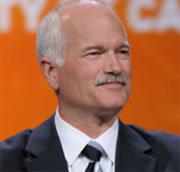
Jack LaytonIt will not do my readers much of a service to announce that Jack Layton has died. To non-Canadian readers, the name will probably mean little or nothing; Canadian readers in the past week will have heard of little else.

Jack Layton was the leader of the left-wing New Democratic Party, the only political party whose candidates I have ever voted for. He died of cancer on 22 August, at the relatively young age of 61 – at the peak of his career. Until Layton took over the NDP, the party had never received more than 44 of the roughly 300 seats in the Canadian Parliament. Earlier this year, under his leadership, the party earned over 100, most of those in Québec – where the party had never held more than a single seat before. It received more than twice as many seats as the third-place Liberals, a party which had governed Canada so often that it viewed itself as the “natural governing party.” And a great deal of this rapid rise derived from Layton’s personal popularity. His funeral has now been receiving coverage in Canada comparable to that of Princess Diana’s – at a time when it is held as a commonplace that people hate politicians and are fed up with them. His life and death moved a great many. My American wife, who a year ago didn’t know who Jack Layton was, was moved to tears watching the coverage of his memorials.

Now why am I going on about Jack Layton on a philosophy blog? Continue reading →

Politics as ethical analogy: Plato and Candrakīrti

27 Wednesday Oct 2010

Posted by Amod Lele in Confucianism, Greek and Roman Tradition, Humility, Mahāyāna, Metaphilosophy, Politics

≈ 3 Comments

Tags

Candrakīrti, Confucius, Disengaged Buddhism, justice, Mencius, Plato, Śāntideva

Even if one accepts Śāntideva’s idea that political participation is harmful to a good life, that doesn’t mean that one must be finished with political thought. For there’s another key way that politics enters into reflection: as analogy. The politician has often appeared in ethical texts as a figure for the individual; we learn what is good or bad in a single human life by examining what is good or bad for a king or a state.

The most famous use of this analogy between individual and state is likely in Plato’s Republic. In Book II, Socrates reminds Glaucon that one can typically see bigger things more clearly than smaller things. Similarly it is easier to observe justice in a state than in an individual, so we should first ask what justice is in a state, and then we will be more able to see what it is in an individual. The city or state is larger than the individual; “perhaps, then, there is more justice in the larger thing, and it will be easier to learn what it is.” (368)

Plato’s approach, of using the state to illuminate the individual, is not obvious or natural; it was not taken by the Confucians, as far as I can tell. Confucius in Analects I.2 says that those who behave well toward their parents don’t start revolutions; Mencius argues for benevolence over profit by arguing that a state of benevolent people will flourish. Here – not so surprising given the early Confucians’ social context – the point seems to be to figure out how to run a state, and individual conduct is addressed for its relevance to that goal, rather than the other way ’round.

But one can find a similar approach to Plato’s in a more surprising place, where it plays a different role: the work of the Buddhist thinker Candrakīrti (whom I also discussed last time). Continue reading →

Supernatural and political death

03 Sunday Oct 2010

Posted by Amod Lele in Death, Epicureanism, Flourishing, Foundations of Ethics, French Tradition, Mahāyāna, Metaphysics, Politics, Psychology, Self, Supernatural, Vedānta

≈ 18 Comments

Tags

Advaita Vedānta, ascent/descent, consequentialism, Disengaged Buddhism, Epicurus, Eric Voegelin, French Revolution, Lucretius, rebirth, Śaṅkara, Śāntideva, Sigmund Freud, Simone Weil, Vladimir Lenin

A couple of my recent posts have explored the idea of anti-politics – the idea that concern with affairs of the state is typically detrimental to a good human life. The anti-political view is one for which I have great sympathy. Now, as the previous post might have suggested, I also reject the supernatural; I believe that natural science is our best guide to the causality of the physical world, and that we would do well to look with skepticism on belief in celestial bodhisattvas, the multiplication of tooth relics, or an afterlife.

But if one takes up the resulting position – neither supernatural nor political – then one has relatively little company in the history of philosophy. From Yavanayāna Buddhists to Unitarian Universalists, those who have sought to move beyond the supernatural have typically also believed in political engagement. The vast majority of political quietists like Śāntideva believed in a vast panoply of unseen worlds far beyond those supported by empirically tested evidence.

I continue to wonder: is there something I’m missing? Is there some reason why so many in the end tend to supernaturalism, politics, or both? Continue reading →

On Śāntideva’s anti-politics

25 Wednesday Aug 2010

Posted by Amod Lele in Economics, External Goods, Faith, Foundations of Ethics, Generosity, Mahāyāna, Method and Theory in the Study of Religion, Monasticism, Politics

≈ 21 Comments

Tags

autobiography, Dalai Lama XIV, Disengaged Buddhism, Engaged Buddhism, Grad Student (blogger), Martha C. Nussbaum, Śāntideva, Stephen Jenkins, utilitarianism

In a recent post linking back to an earlier one, I spoke of being “saved from politics.” Judging by the comments and incoming links, that phrase seems to have struck a chord with several readers. But several of those readers, notably Grad Student, also rightly asked: does that mean you are urging us to be apolitical, or even anti-political?

It’s a great question, and one I’ve asked myself a number of times. Being anti-political is a position I’ve flirted with a lot, especially over the course of writing my dissertation, and my personal views are closely entangled with the ideas I address there. In many respects I see the dissertation’s main contribution to Śāntideva scholarship as pointing out the strongly anti-political nature of Śāntideva’s thought, and the underlying reasons for his anti-politics. Śāntideva is, I think, often thought of as a great friend to the Engaged Buddhist program of Buddhist political activism, since he is probably best known as the favourite thinker of that noted activist Tenzin Gyatso, the present (fourteenth) Dalai Lama; I claimed in the dissertation that such a placing of Śāntideva is mistaken. Continue reading →

Living through the ’00s

30 Wednesday Dec 2009

Posted by Amod Lele in Anger, Buddhism, External Goods, Gratitude, Happiness, Hope, Karmic Redirection, Meditation, Patient Endurance, Politics, Serenity

≈ Comments Off on Living through the ’00s

Tags

21st century, academia, Atrios (blogger), autobiography, Barack Obama, Canada, Disengaged Buddhism, Engaged Buddhism, George W. Bush, natural environment, S.N. Goenka, Śāntideva, United States, war

My philosophical awakening occurred in Thailand in 1997; but it has been over the past decade, “the ohs,” that I’ve really had the chance to develop my thoughts. As that decade closes, I would like to note how my thoughts were shaped by their time.

I spent almost the entire decade living in the United States, except for two three-month stints in Toronto in 2001 and India in 2005. It was not the ideal decade in which to do this, for the US of this decade was the US of George W. Bush: a man who opposed almost everything I had ever stood for, whether substantively (torture, wars of choice, gutting environmental regulations), procedurally (incompetent patronage appointments for natural disasters, governing unilaterally without respect for other branches of government) or symbolically (insisting on suits and ties in the White House). I had grown up despising Ronald Reagan, but Reagan now looked like a saint compared to W – Reagan at least was competent. And in the face of all this, Americans returned him to office in 2004.

For my many American friends – the vast majority of them left-wingers like me – this decade was a time of powerlessness and rage. But they at least could vote, could contribute to political campaigns, could do something about it. Continue reading →

Political quietism today

01 Monday Jun 2009

Posted by Amod Lele in Mahāyāna, Politics

≈ 2 Comments

Tags

Disengaged Buddhism, Engaged Buddhism, Jeffrey Kripal, Śāntideva

One of the recurring, and more controversial, themes in my dissertation was Śāntideva’s strong suspicion toward political involvement, as when he proclaims that texts on law and politics (da??an?ti) are fruitless and lead to delusion. When I first presented a chapter of the dissertation at a workshop, a colleague was critical of my attempt to use Śāntideva as a resource for contemporary ethical reflection. I don’t remember his exact words, but they ran along the lines of: “We cannot today accept an ethical system that does not involve working for political change.” For him, Buddhism could only now be acceptable if it was Engaged Buddhism. You can find similar points made in many other places; my friend and occasional mentor Jeff Kripal frequently insists (in the joint article Quietism and Karma, for example) that “quietistic” ascetic traditions cannot be “an adequate resource for contemporary ethics.”

But why should this be? The most typical argument has to do with a variety of “after”s: rhetorically, it is assumed that “after colonialism, after Auschwitz and Hiroshima, after Gandhi’s satyagraha…” political inaction is morally suspect or even unethical. (The quote is from Jeff’s book Crossing Boundaries, pp. 56-7.) I’m skeptical of such claims. History is full of genocides, massacres and struggles, dating back as far as it is recorded. What, if anything, makes our age different? Political quietism has been defended as perfectly ethical, for about as long as it has existed. Why shouldn’t it be similarly defended now?

Newer posts →

Welcome to Love of All Wisdom.

I invite you to leave comments on my blog, even - or especially - if I have no idea who you are. Philosophy is a conversation, and I invite you to join it with me; I welcome all comers (provided they follow a few basic rules). I typically make a new post every Sunday. If you'd like to be notified when a new post is posted, you can get email notifications whenever I add something new via the link further down in this sidebar. You can also follow this blog on Facebook. Or if you use RSS, you can get updates through the RSS feed.

Recent Comments

  • Pail D. Van Pelt on Hiding your ideas in plain sight
  • Amod Lele on Hiding your ideas in plain sight
  • Pail D. Van Pelt on Hiding your ideas in plain sight
  • Pail D. Van Pelt on Hiding your ideas in plain sight
  • Paul D. Van Pelt on Should we be polite to AIs?

Subscribe to receive Love of All Wisdom by email:

Post Tags

20th century academia Alasdair MacIntyre Aristotle ascent/descent Augustine autobiography Buddhaghosa Canada Confucius conservatism Disengaged Buddhism Engaged Buddhism Evan Thompson expressive individualism Four Noble Truths Friedrich Nietzsche G.W.F. Hegel gender Hebrew Bible identity Immanuel Kant intimacy/integrity justice Karl Marx Ken Wilber law Martha C. Nussbaum modernity music mystical experience nondualism Pali suttas pedagogy Plato race rebirth religion Siddhattha Gotama (Buddha) technology theodicy United States utilitarianism Śaṅkara Śāntideva

Categories

  • African Thought (15)
  • Applied Philosophy (380)
    • Death (44)
    • Family (53)
    • Food (22)
    • Friends (21)
    • Health (33)
    • Place (37)
    • Play (18)
    • Politics (239)
    • Sex (25)
    • Work (48)
  • Asian Thought (459)
    • Buddhism (331)
      • Early and Theravāda (140)
      • Mahāyāna (140)
      • Modernized Buddhism (101)
    • East Asia (101)
      • Confucianism (62)
      • Daoism (22)
      • Shinto (1)
    • South Asia (148)
      • Bhakti Poets (3)
      • Cārvāka-Lokāyata (5)
      • Epics (16)
      • Jainism (24)
      • Modern Hinduism (45)
      • Nyāya-Vaiśeṣika (6)
      • Sāṃkhya-Yoga (16)
      • Sikhism (1)
      • Vedānta (42)
      • Vedas and Mīmāṃsā (7)
  • Blog Admin (28)
  • Indigenous American Thought (8)
  • Method (278)
    • Metaphilosophy (180)
    • Method and Theory in the Study of Religion (155)
  • Practical Philosophy (431)
    • Action (17)
    • Aesthetics (52)
    • Emotion (195)
      • Anger (42)
      • Attachment and Craving (32)
      • Compassion (9)
      • Despair (7)
      • Disgust (5)
      • Faith (20)
      • Fear (15)
      • Grief (9)
      • Happiness (52)
      • Hope (19)
      • Pleasure (37)
      • Shame and Guilt (10)
    • External Goods (55)
    • Flourishing (103)
    • Foundations of Ethics (126)
    • Karma (44)
    • Morality (79)
    • Virtue (187)
      • Courage (7)
      • Generosity (14)
      • Gentleness (7)
      • Gratitude (13)
      • Honesty (15)
      • Humility (27)
      • Leadership (7)
      • Mindfulness (24)
      • Patient Endurance (31)
      • Self-Discipline (10)
      • Serenity (39)
      • Zest (8)
  • Practice (146)
    • Karmic Redirection (5)
    • Meditation (47)
    • Monasticism (47)
    • Physical Exercise (4)
    • Prayer (16)
    • Reading and Recitation (14)
    • Rites (23)
    • Therapy (11)
  • Theoretical Philosophy (403)
    • Consciousness (23)
    • Deity (76)
    • Epistemology (141)
      • Certainty and Doubt (19)
      • Dialectic (21)
      • Logic (15)
      • Prejudices and "Intuitions" (31)
    • Free Will (18)
    • Hermeneutics (66)
    • Human Nature (34)
    • Metaphysics (115)
    • Philosophy of Language (31)
    • Self (78)
    • Supernatural (54)
    • Truth (64)
    • Unconscious Mind (16)
  • Western Thought (525)
    • Analytic Tradition (107)
    • Christianity (162)
      • Early Factions (8)
      • Eastern Orthodoxy (3)
      • Protestantism (27)
      • Roman Catholicism (61)
    • French Tradition (50)
    • German Tradition (97)
    • Greek and Roman Tradition (126)
      • Epicureanism (25)
      • Neoplatonism (2)
      • Pre-Socratics (6)
      • Skepticism (2)
      • Sophists (8)
      • Stoicism (22)
    • Islam (44)
      • Mu'tazila (2)
      • Salafi (3)
      • Sufism (10)
    • Judaism (38)
    • Natural Science (101)
      • Biology (31)
      • Philosophy of Science (50)
      • Physics and Astronomy (11)
    • Social Science (196)
      • Economics (48)
      • Psychology (85)

Recent Posts

  • Should we be polite to AIs?
  • Why teach virtue to a robot
  • Being marginalized doesn’t make you smarter
  • “The future will belong to the mestiza”
  • Hiding your ideas in plain sight

Popular posts

  • One and a half noble truths?
  • Wishing George W. Bush well
  • Do Speculative Realists want us to be Chinese?
  • Why I am not a right-winger
  • On faith in tooth relics

Basic concepts

  • Ascent and Descent
  • Intimacy and integrity
  • Ascent-descent and intimacy-integrity together
  • Perennial questions?
  • Virtuous and vicious means
  • Dialectical and demonstrative argument
  • Chastened intellectualism and practice
  • Yavanayāna Buddhism: what it is
  • Why worry about contradictions?
  • The first philosophy blogger

Personal favourites

  • Can philosophy be a way of life? Pierre Hadot (1922-2010)
  • James Doull and the history of ethical motivation
  • Praying to something you don't believe in
  • What does postmodernism perform?
  • Why I'm getting married

Archives

Search this site

All posts, pages and metadata copyright 2009-2026 Amod Lele unless otherwise noted. Comments copyright 2009-2026 their comment authors. Creative Commons Attribution-NonCommercial-ShareAlike (BY-NC-SA) licence.

Proudly powered by WordPress Theme: Chateau by Ignacio Ricci.