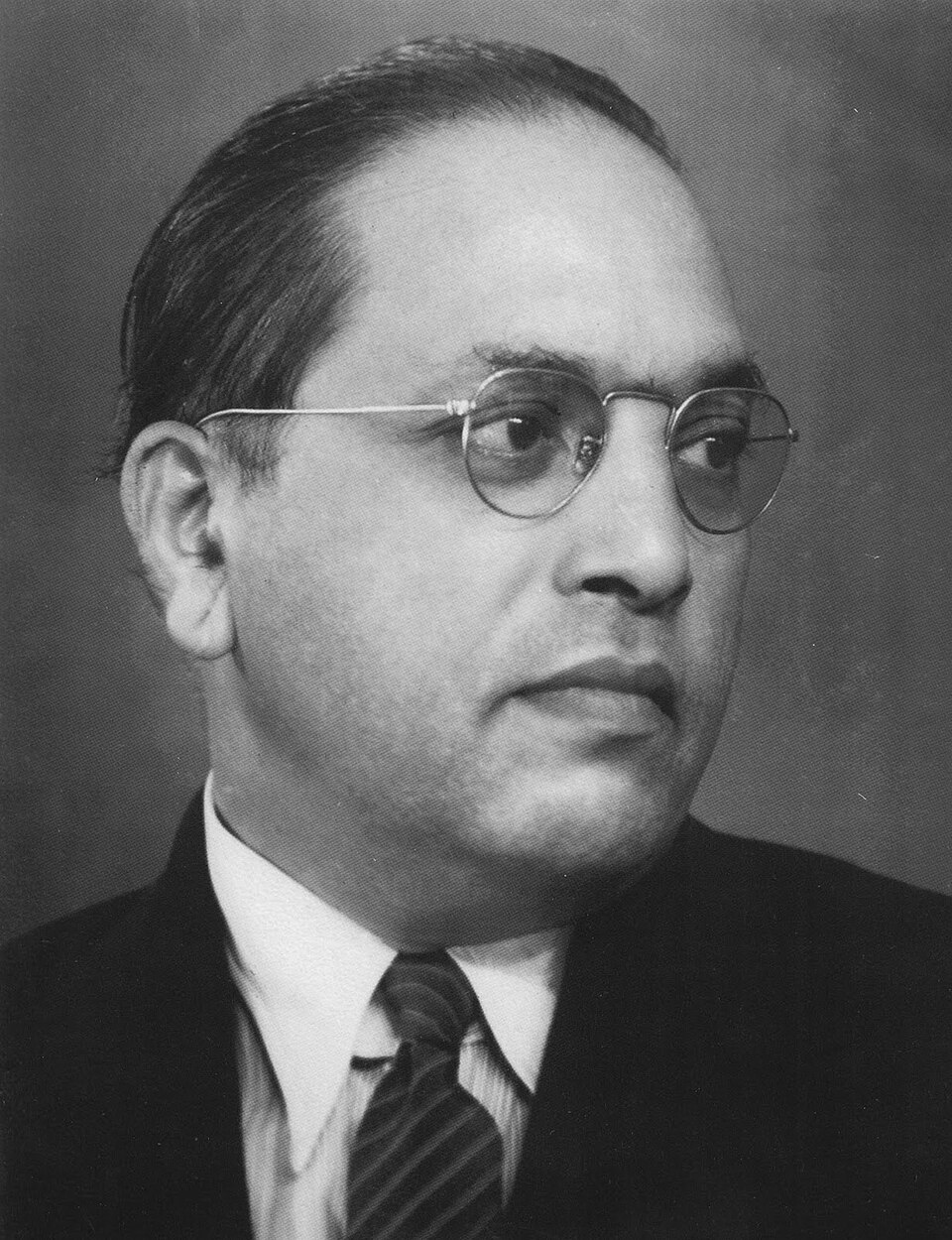
It’s hard for me to view B.R. Ambedkar as a real Buddhist, when he threw out the Four Noble Truths after getting to Buddhism by a mere process of elimination. But then, to a real Buddhist, it shouldn’t matter – at least it shouldn’t matter much – whether you are a “real Buddhist”! Buddhism has no more essence, no more svabhāva, than anything else does. What really matters is relieving suffering. What’s more important than his status as a Buddhist is that Ambedkar’s rejection of the Four Noble Truths deeply inhibits the relief of suffering – or rather, it has the potential to. Yet things might be a bit more complicated than that.
Dr. Ambedkar, the 20th-century leader of the lowest (“Dalit”, formerly “untouchable”) Indian caste groups, might be having a moment. In my Indian philosophy class in 2019, I wanted to have a segment on modern Indian philosophy, so I introduced the students to Gandhi and to Ambedkar as a critic of Gandhi – and was interested to see how the students absolutely loved Ambedkar. This year, I attended a fascinating workshop at Princeton on black Buddhist perspectives, where Ambedkar probably played a larger role than any other figure, even the Buddha himself. I’m glad to see black Americans discovering Ambedkar, since there are such close analogies between American race and Indian caste – already observed by Martin Luther King. A recent Economist article now mentions that even Narendra Modi is trying to proclaim Ambedkar as an ally for his militant Hindu agenda – a claim that should be laughable, given Ambedkar’s clearly expressed hostility to Hinduism, but an understandable attempt given Ambedkar’s huge popularity in India: there are now more statues of Ambedkar than any other Indian political figure, including Nehru, Gandhi and Aśoka.
I find Ambedkar overall a very admirable figure – both his personal story of rising through the ranks intellectually and becoming a leader, and his accomplishments. I also find his approach to caste more sensible than the American approach to race, one that Americans could learn a lot from. My late father admired him greatly. He is also a figure who makes me personally uncomfortable – perhaps in a good way.
One of the first things you’d learn in any Intro to Buddhism course is that most Buddhists alive today are part of the Mahāyāna tradition, in which one aspires to be a bodhisattva (and eventually become a buddha). Mahāyāna is the majority tradition because it’s the one practised in Japan, Korea, most of Vietnam, and China including Taiwan and Tibet. (Tibetans sometimes refer to their tradition as “Vajrayāna”, but they know that that’s still a form of Mahāyāna; there are no non-Mahāyāna Vajrayānists.) The name “Mahāyāna” (translated as “Great Vehicle”) is not in dispute; everybody agrees that that’s the preferred term. That part is easy.
Now here’s a question: what do you call all the other Buddhists?
Your typical intro Buddhism course gets around that question pretty easily, because there’s a simple answer if you’re exclusively talking about Buddhists today, in the modern era. As of about 1850, basically all the non-Mahāyāna Buddhists in the world identified as part of the Theravāda tradition, practised throughout Sri Lanka and mainland Southeast Asia. The only Buddhists who might identify as something else are more recent modernist Buddhists of one stripe or another – hippyish Western Buddhists who don’t want to be pinned down to specifics, or perhaps B.R. Ambedkar’s Navayāna – and they understand they’re doing something new and a little weird. (“Navayāna” means “new yāna”.) In general, it’s pretty reasonable to say that the Buddhism existing in the past thousand years or so has been divided into the two traditions of Mahāyāna and Theravāda.
But go back before that, and things look very different.
It was thirty years ago, in 1995, that a then-unknown junior academic named Jeffrey Kripal published Kālī’s Child: The Mystical and the Erotic in the Life and Teachings of Ramakrishna. The book took a new look at the stories written about the revered 19th-century Bengali mystic Ramakrishna, from the then-current Freudian lens: it explored passages that it described as homoerotic, and argued that there was a connection between the homoeroticism and the mysticism. Kripal, who was raised Catholic and once attempted to enter the priesthood, always saw an erotic dimension in mysticism, and found that goddess traditions like Ramakrishna’s felt a more natural fit than Christianity with his own heterosexuality – so was surprised to find homoerotic elements in Ramakrishna, and realized that was something worth writing about.
Few, least of all Kripal, expected what happened next. Ramakrishna devotees in India found out about the book and became furious that anyone would dare treat Ramakrishna’s mysticism as having a sexual element. Hindu nationalists burned copies of the book, there were multiple attempts to ban it, and Kripal was no longer able to travel to India out of fear for his safety. It was the first in a series of attacks that Hindu nationalists came to make against Western scholars in the decades to come, outraged that scholars would point to aspects of their traditions that they didn’t like.
I had read a little about this story before I arrived at Harvard as a new PhD student in 2000. There were three scholars of South Asian religions – John Carman, Edwin Bryant, and especially Charles Hallisey – who I’d expected to study under when I got there… and all three of them had just left, for various reasons, without (yet) being replaced. So I felt a little adrift. But as I had a first walk through the hallway of a Harvard Divinity School building, there outside an open office door was the name plate of a visiting professor in South Asian religions whose name I did recognize: Jeffrey Kripal.
When I described philosophy in my “Why Philosophy?” interview, I hadn’t intended my description to be controversial. Only when Céline Leboeuf gave the interview a title did I realize that it is.
Leboeuf entitled the interview “philosophy crosses boundaries”, which is a phrase that had just felt obvious to me when I wrote the interview answers. But when I saw that that was the title Leboeuf had picked, I suddenly realized that it isn’t. Many philosophers, I recalled, don’t think that way.
I’m delighted to be giving a talk at Psychedelic Science 2025, the annual conference of the Multidisciplinary Association of Psychedelic Studies. The conference (June 17-20 in Denver) promises to be really fun and stimulating. If you can make it, I’d love to say hi: registration isn’t cheap, but you can use code SPEAKER15 to get 15% off your registration.
I’m especially excited because my talk is really experimental, the kind of broad comparative work that would have got frowned on when I was in grad school. I’m still aiming to exercise scholarly caution to avoid saying anything false, trying to stay reasonably close to what’s in the texts, but I am writing about multiple thinkers whose source languages (classical Chinese and old German) I don’t know well: something which I think one has to do in order to investigate human cultural commonalities, but which would have raised every eyebrow in my PhD program. It’s the kind of project that an aspiring professor only undertakes after getting tenure; in my case, I can do it because I’m no longer trying for a faculty job.
Even more ubiquitous in the West than mindfulness meditation, and for a longer period of time, is yoga: specifically meaning the practice of postural stretching exercises, with names like “sun salutation” and “downward dog”. They can be supplemented by breathing exercises and perhaps occasionally meditation, and there is often some element of Sanskrit or philosophy involved, but to a normal English-speaking layperson, the core of what yoga means is the postures. This is the sort of yoga that is sometimes even a competitive sport. Its health benefits are rarely contested; as my own aging body gets less naturally flexible, it’s probably only a matter of time before I sign up with a local yoga studio myself.
Yoga as we know it today. Image copyright Somkiat, Adobe Stock.
Meanwhile, in the classical Sanskrit from which the term is derived, yoga refers to a variety of spiritual practices in which postures play a minor role, if any. Śāntideva uses the term “yogin” to describe people with a greater understanding of reality, with postures never being mentioned in the text. The most famous and influential yoga text, the Yoga Sūtras of Patañjali, says that posture (āsana) is one – just one – of the eight limbs of yoga, and the only thing it specifies about posture is that posture should be “firm and pleasant” (sthirasukham) (YS II.46). There’s no stretching involved here; indeed the text suggests the opposite, that one should be comfortable, likely for meditation. The Yoga Bhāṣya commentary – traditionally included with the original – names several kinds of posture without explaining them; when Vācaspati Miśra’s subcommentary does come to explain them, it shows that they are postures for meditation, ways of placing your feet while you sit. Meditation, in general, plays the largest role in this classical yoga; stretching plays none.
So it’s natural to ask: how exactly did we get from one to the other, from a meditative classical yoga in which stretching plays no role, to a modern yoga in which it plays the primary role? I’ve seen this question asked in surprisingly few places. I wanted to get a deeper understanding of that question, so I thought it would be worth reading Elizabeth De Michelis’s 2005 work with the very promising title A History of Modern Yoga.
American psychedelic advocates received a great disappointment a couple months ago when the Food and Drug Administration refused to approve MDMA (ecstasy) as a treatment for post-traumatic stress disorder. The disappointment was great enough to lead Jules Evans of the Ecstatic Integration Substack to ask: “Is the psychedelic renaissance over?“
It seems silly to me to read too much into this one decision. It is not final; a new application could be made in a few years. More importantly, it is one decision, about one substance, by one agency in one country – for one purpose. (It was also a great disappointment for us in Massachusetts that our state voted down the ballot question to legalize psychedelics, but it too is just one state, where the question was extremely poorly promoted; Oregon and Colorado have proceeded with decriminalizing psilocybin.) If the entire “psychedelic renaissance” hung on the outcome of one agency’s decision or one state referendum, it would have been a shallow “renaissance” indeed. Even within the US there are already many other avenues for improving the legal status of psychedelics.
Public-domain AP photo of Timothy Leary.
That said: Michael Pollan’s book How To Change Your Mind probably did more to kick off the supposed current renaissance than anything else, and one of Pollan’s most important takeaways in the book was, let’s not screw this up. Psychedelics were famously popular in the 1960s, but the messages around them were dominated by overenthusiastic salespeople like Timothy Leary, who had little sense of caution. The resulting backlash was so strong that it created the ignorant world I grew up in, in the 1980s and 1990s, where even video games felt the importance of including a heavy-handed “don’t do drugs” message – extending even to cannabis. What the FDA ruling should remind us of, is the importance of avoiding the mistakes of the ’60s – so that the renaissance can lead to an enlightenment, if you will.
Pema Chödrön’s When Things Fall Apart is a beautiful and valuable work on dealing with difficult circumstances. What strikes me in it is how Chödrön – despite being a monk herself – takes a position so deeply at odds with traditional Indian Buddhism.
Chödrön refers to the traditional Buddhist “three marks” (tilakkhaṇa or trilakṣaṇa) of existence: everything is impermanent, suffering, and non-self. This idea goes back to very early texts. But Chödrön does with it is something quite different from the earlier idea:
Even though they accurately describe the rock-bottom qualities of our existence, these words sound threatening. It’s easy to get the idea that there is something wrong with impermanence, suffering, and egolessness, which is like thinking that there is something wrong with our fundamental situation. But there’s nothing wrong with impermanence, suffering, and egolessness; they can be celebrated. Our fundamental situation is joyful. (59)
Here’s the problem with this passage: the classical Indian Buddhist texts are quite clear that in fact there is something wrong with our fundamental situation. She is disagreeing with them, whether or not she acknowledges it.